THE CLASSIC COLLECTION✦A Christmas Carol The original manuscriptCLASSIC FREE BOOKS
A Christmas Carol The original manuscript
Charles Dickens

THE CLASSIC COLLECTION · 1906
"Mr. Pickwick's Christmas" by Charles Dickens is a festive novella, likely written in the mid-19th century. This work serves as a delightful extension of the adventures of Mr. Pickwick and his companions, the Pickwickians, during their Christmas festivities at the Manor Farm. The narrative promises to explore themes of joy, camaraderie, and the heartwarming spirit of Christmas through the eyes of Mr. Pickwick and his friends as they engage in various holiday activities. The opening of the story sets the stage for a cheerful Christmas celebration, vividly describing the gathering of the Pickwickians on the morning of December 22nd. Mr. Pickwick is portrayed as a warm-hearted character in high spirits as he embarks on a journey to Dingley Dell with his friends. The scene is filled with merriment, anticipation, and quirky comic elements, including humorous mishaps with their luggage on the coach. As they arrive at the Manor Farm, the narrative hints at a wedding celebration that will occur soon, immediately introducing a lively and jovial atmosphere that welcomes readers into the whimsical world Dickens has crafted, marking the beginning of a heartwarming holiday adventure intertwined with friendship and festive cheer.
Introduction adapted from the source catalogue; source summaries may be automatically generated.
Free to read · English · 20,231 words · No account needed
MAKE TIME FOR A GOOD BOOK
On by default. Untick to stop anonymous reading totals. Each page counts after 10 seconds in view. How this works.
Anonymous counting is on unless you have switched it off.
“A what!” said Mr. Winkle, starting.
“A humbug, Sir. I will speak plainer, if you wish it. An impostor, Sir.”
With these words, Mr. Pickwick turned slowly on his heel, and rejoined
his friends.
While Mr. Pickwick was delivering himself of the sentiment just recorded, Mr. Weller and the fat boy, having by their joint endeavours cut out a slide, were exercising themselves thereupon, in a very masterly and brilliant manner. Sam Weller, in particular, was displaying that beautiful feat of fancy sliding which is currently denominated “knocking at the cobbler’s door,” and which is achieved by skimming over the ice on one foot, and occasionally giving a two-penny postman’s knock upon it with the other. It was a good long slide, and there was something in the motion which Mr. Pickwick, who was very cold with standing still, could not help envying.
“It looks a nice warm exercise that, doesn’t it?” he enquired of Wardle, when that gentleman was thoroughly out of breath, by reason of the indefatigable manner in which he had converted his legs into a pair of compasses, and drawn complicated problems on the ice.
“Ah, it does, indeed,” replied Wardle. “Do you slide?”
“I used to do so, on the gutters, when I was a boy,” replied Mr.
Pickwick.
“Try it now,” said Wardle.
“Oh, do, please Mr. Pickwick,” cried all the ladies.
“I should be very happy to afford you any amusement,” replied Mr. Pickwick, “but I haven’t done such a thing these thirty years.”
“Pooh! pooh! nonsense!” said Wardle, dragging off his skaits with the impetuosity which characterised all his proceedings. “Here; I’ll keep you company; come along.” And away went the good-tempered old fellow down the slide, with a rapidity which came very close upon Mr. Weller, and beat the fat boy all to nothing.
Mr. Pickwick paused, considered, pulled off his gloves and put them in his hat, took two or three short runs, baulked himself as often, and at last took another run and went slowly and gravely down the slide, with his feet about a yard and a quarter apart, amidst the gratified shouts of all the spectators.
“Keep the pot a bilin’, Sir,” said Sam; and down went Wardle again, and then Mr. Pickwick, and then Sam, and then Mr. Winkle, and then Mr. Bob Sawyer, and then the fat boy, and then Mr. Snodgrass, following closely upon each other’s heels, and running after each other with as much eagerness as if all their future prospects in life depended on their expedition.
Your reading position is saved on this browser. Take it to another device with a library code. Reading pages adapt to text, rather than matching a printed edition.
Charles Dickens
Samuel McChord Crothers & Charles Dickens

Rebecca Harding Davis & Thomas De Quincey & Charles Dickens & Nathaniel Hawthorne & Edward Bulwer Lytton, Baron Lytton & Edgar Allan Poe & Harriet Elizabeth Prescott Spofford
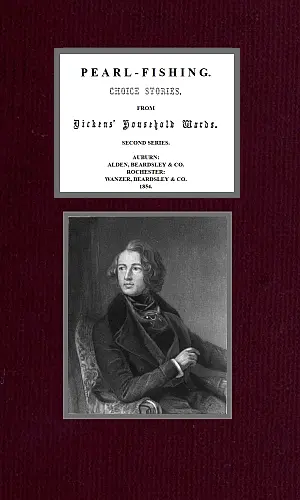
Charles Dickens
BEHIND THE BOOK
This eBook is for the use of anyone anywhere in the United States and most other parts of the world at no cost and with almost no restrictions whatsoever. You may copy it, give it away or re-use it under the terms of the Project Gutenberg License included with this eBook or online at www.gutenberg.org. If you are not located in the United States, you will have to check the laws of the country where you are located before using this eBook. Read the source licence.
The original source file, including credits and licence, is retained by this library. Request an original-format copy at no charge. Please include the book title and Project Gutenberg identifier #61193.
KEEP YOUR CURIOSITY GOING
Coulson Kernahan

Maurice Baring
Frances Wright
Cécile Tormay

Frederic Jesup Stimson

W. H. P. (William Henry Pope) Jarvis