THE CLASSIC COLLECTION✦A Christmas Carol The original manuscriptCLASSIC FREE BOOKS
A Christmas Carol The original manuscript
Charles Dickens

THE CLASSIC COLLECTION · 1906
"Mr. Pickwick's Christmas" by Charles Dickens is a festive novella, likely written in the mid-19th century. This work serves as a delightful extension of the adventures of Mr. Pickwick and his companions, the Pickwickians, during their Christmas festivities at the Manor Farm. The narrative promises to explore themes of joy, camaraderie, and the heartwarming spirit of Christmas through the eyes of Mr. Pickwick and his friends as they engage in various holiday activities. The opening of the story sets the stage for a cheerful Christmas celebration, vividly describing the gathering of the Pickwickians on the morning of December 22nd. Mr. Pickwick is portrayed as a warm-hearted character in high spirits as he embarks on a journey to Dingley Dell with his friends. The scene is filled with merriment, anticipation, and quirky comic elements, including humorous mishaps with their luggage on the coach. As they arrive at the Manor Farm, the narrative hints at a wedding celebration that will occur soon, immediately introducing a lively and jovial atmosphere that welcomes readers into the whimsical world Dickens has crafted, marking the beginning of a heartwarming holiday adventure intertwined with friendship and festive cheer.
Introduction adapted from the source catalogue; source summaries may be automatically generated.
Free to read · English · 20,231 words · No account needed
MAKE TIME FOR A GOOD BOOK
On by default. Untick to stop anonymous reading totals. Each page counts after 10 seconds in view. How this works.
Anonymous counting is on unless you have switched it off.
Old Wardle led the way to a pretty large sheet of ice; and the fat boy and Mr. Weller, having shovelled and swept away the snow which had fallen on it during the night, Mr. Bob Sawyer adjusted his skaits with a dexterity which to Mr. Winkle was perfectly marvellous, and described circles with his left leg, and cut figures of eight; and inscribed upon the ice, without once stopping for breath, a great many other pleasant and astonishing devices, to the excessive satisfaction of Mr. Pickwick, Mr. Tupman, and the ladies; which reached a pitch of positive enthusiasm, when old Wardle and Benjamin Allen, assisted by the aforesaid Bob Sawyer, performed some mystic evolutions, which they called a reel.
All this time, Mr. Winkle, with his face and hands blue with the cold, had been forcing a gimlet into the soles of his feet, and putting his skaits on, with the points behind, and getting the straps into a very complicated and entangled state, with the assistance of Mr. Snodgrass, who knew rather less about skaits than a Hindoo. At length, however, with the assistance of Mr. Weller, the unfortunate skaits were firmly screwed and buckled on, and Mr. Winkle was raised to his feet.
“Now, then, Sir,” said Sam, in an encouraging tone; “off vith you, and show ’em how to do it.”
“Stop, Sam, stop,” said Mr. Winkle, trembling violently, and clutching hold of Sam’s arms with the grasp of a drowning man. “How slippery it is, Sam!”
“Not an uncommon thing upon ice, Sir,” replied Mr. Weller. “Hold up,
Sir.”
This last observation of Mr. Weller’s bore reference to a demonstration Mr. Winkle made at the instant, of a frantic desire to throw his feet in the air, and dash the back of his head on the ice.
“These—these—are very awkward skaits; ain’t they, Sam?” inquired Mr. Winkle, staggering.
“I’m afeerd there’s orkard gen’lm’n in ’em, Sir,” replied Sam.
“Now, Winkle,” cried Mr. Pickwick, quite unconscious that there was anything the matter. “Come; the ladies are all anxiety.”
“Yes, yes,” replied Mr. Winkle, with a ghastly smile. “I’m coming.”
“Just a goin’ to begin,” said Sam, endeavouring to disengage himself. “Now, Sir, start off.”
“Stop an instant, Sam,” gasped Mr. Winkle, clinging most affectionately to Mr. Weller. “I find I’ve got a couple of coats at home, that I don’t want, Sam. You may have them, Sam.”
“Thankee, Sir,” replied Mr. Weller.
Your reading position is saved on this browser. Take it to another device with a library code. Reading pages adapt to text, rather than matching a printed edition.
Charles Dickens
Samuel McChord Crothers & Charles Dickens

Rebecca Harding Davis & Thomas De Quincey & Charles Dickens & Nathaniel Hawthorne & Edward Bulwer Lytton, Baron Lytton & Edgar Allan Poe & Harriet Elizabeth Prescott Spofford
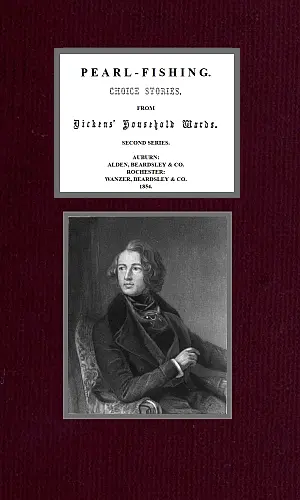
Charles Dickens
BEHIND THE BOOK
This eBook is for the use of anyone anywhere in the United States and most other parts of the world at no cost and with almost no restrictions whatsoever. You may copy it, give it away or re-use it under the terms of the Project Gutenberg License included with this eBook or online at www.gutenberg.org. If you are not located in the United States, you will have to check the laws of the country where you are located before using this eBook. Read the source licence.
The original source file, including credits and licence, is retained by this library. Request an original-format copy at no charge. Please include the book title and Project Gutenberg identifier #61193.
KEEP YOUR CURIOSITY GOING
Coulson Kernahan

Maurice Baring
Frances Wright
Cécile Tormay

Frederic Jesup Stimson

W. H. P. (William Henry Pope) Jarvis