THE CLASSIC COLLECTION✦A Christmas Carol The original manuscriptCLASSIC FREE BOOKS
A Christmas Carol The original manuscript
Charles Dickens

THE CLASSIC COLLECTION · 1906
"Mr. Pickwick's Christmas" by Charles Dickens is a festive novella, likely written in the mid-19th century. This work serves as a delightful extension of the adventures of Mr. Pickwick and his companions, the Pickwickians, during their Christmas festivities at the Manor Farm. The narrative promises to explore themes of joy, camaraderie, and the heartwarming spirit of Christmas through the eyes of Mr. Pickwick and his friends as they engage in various holiday activities. The opening of the story sets the stage for a cheerful Christmas celebration, vividly describing the gathering of the Pickwickians on the morning of December 22nd. Mr. Pickwick is portrayed as a warm-hearted character in high spirits as he embarks on a journey to Dingley Dell with his friends. The scene is filled with merriment, anticipation, and quirky comic elements, including humorous mishaps with their luggage on the coach. As they arrive at the Manor Farm, the narrative hints at a wedding celebration that will occur soon, immediately introducing a lively and jovial atmosphere that welcomes readers into the whimsical world Dickens has crafted, marking the beginning of a heartwarming holiday adventure intertwined with friendship and festive cheer.
Introduction adapted from the source catalogue; source summaries may be automatically generated.
Free to read · English · 20,231 words · No account needed
MAKE TIME FOR A GOOD BOOK
On by default. Untick to stop anonymous reading totals. Each page counts after 10 seconds in view. How this works.
Anonymous counting is on unless you have switched it off.
“Here he is at last,” said old Wardle. “Pickwick, this is Miss Allen’s brother, Mr. Benjamin Allen—Ben we call him, and so may you if you like. This gentleman is his very particular friend, Mr. ——”
“Mr. Bob Sawyer,” interposed Mr. Benjamin Allen, whereupon Mr. Bob Sawyer and Mr. Benjamin Allen laughed in concert.
Mr. Pickwick bowed to Bob Sawyer, and Bob Sawyer bowed to Mr. Pickwick; Bob and his very particular friend then applied themselves most assiduously to the eatables before them; and Mr. Pickwick had an opportunity of glancing at them both.
Mr. Benjamin Allen was a coarse, stout, thickset young man, with black hair cut rather short, and a white face cut rather long. He was embellished with spectacles, and wore a white neckerchief. Below his single-breasted black surtout, which was buttoned up to his chin, appeared the usual number of pepper-and-salt coloured legs, terminating in a pair of imperfectly polished boots. Although his coat was short in the sleeves, it disclosed no vestige of a linen wristband; and although there was quite enough of his face to admit of the encroachment of a shirt collar, it was not graced by the smallest approach to that appendage. He presented altogether rather a mildewy appearance, and emitted a fragrant odour of full-flavoured Cubas.
Mr. Bob Sawyer, who was habited in a coarse blue coat, which, without being either greatcoat or surtout, partook of the nature and qualities of both, had about him that sort of slovenly smartness, and swaggering gait, which is peculiar to young gentlemen who smoke in the streets by day, shout and scream in the same by night, call waiters by their christian names, and do various other acts and deeds of an equally facetious description. He wore a pair of plaid trousers, and a large rough double-breasted waistcoat; and out of doors, carried a thick stick with a big top. He eschewed gloves, and looked, upon the whole, something like a dissipated Robinson Crusoe.
Such were the two worthies to whom Mr. Pickwick was introduced, as he took his seat at the breakfast table on Christmas morning.
“Splendid morning, gentlemen,” said Mr. Pickwick.
Mr. Bob Sawyer slightly nodded his assent to the proposition, and asked Mr. Benjamin Allen for the mustard.
“Have you come far this morning, gentlemen?” inquired Mr. Pickwick.
“Blue Lion at Muggleton,” briefly responded Mr. Allen.
“You should have joined us last night,” said Mr. Pickwick.
“So we should,” replied Bob Sawyer, “but the brandy was too good to leave in a hurry: wasn’t it, Ben?”
“Certainly,” said Mr. Benjamin Allen; “and the cigars were not bad, or the pork chops either: were they, Bob?”
Your reading position is saved on this browser. Take it to another device with a library code. Reading pages adapt to text, rather than matching a printed edition.
Charles Dickens
Samuel McChord Crothers & Charles Dickens

Rebecca Harding Davis & Thomas De Quincey & Charles Dickens & Nathaniel Hawthorne & Edward Bulwer Lytton, Baron Lytton & Edgar Allan Poe & Harriet Elizabeth Prescott Spofford
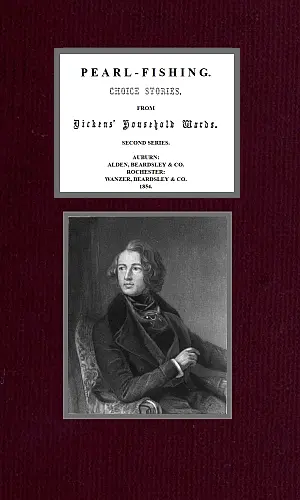
Charles Dickens
BEHIND THE BOOK
This eBook is for the use of anyone anywhere in the United States and most other parts of the world at no cost and with almost no restrictions whatsoever. You may copy it, give it away or re-use it under the terms of the Project Gutenberg License included with this eBook or online at www.gutenberg.org. If you are not located in the United States, you will have to check the laws of the country where you are located before using this eBook. Read the source licence.
The original source file, including credits and licence, is retained by this library. Request an original-format copy at no charge. Please include the book title and Project Gutenberg identifier #61193.
KEEP YOUR CURIOSITY GOING
Coulson Kernahan

Maurice Baring
Frances Wright
Cécile Tormay

Frederic Jesup Stimson

W. H. P. (William Henry Pope) Jarvis