THE CLASSIC COLLECTION✦A Christmas Carol The original manuscriptCLASSIC FREE BOOKS
A Christmas Carol The original manuscript
Charles Dickens

THE CLASSIC COLLECTION · 1906
"Mr. Pickwick's Christmas" by Charles Dickens is a festive novella, likely written in the mid-19th century. This work serves as a delightful extension of the adventures of Mr. Pickwick and his companions, the Pickwickians, during their Christmas festivities at the Manor Farm. The narrative promises to explore themes of joy, camaraderie, and the heartwarming spirit of Christmas through the eyes of Mr. Pickwick and his friends as they engage in various holiday activities. The opening of the story sets the stage for a cheerful Christmas celebration, vividly describing the gathering of the Pickwickians on the morning of December 22nd. Mr. Pickwick is portrayed as a warm-hearted character in high spirits as he embarks on a journey to Dingley Dell with his friends. The scene is filled with merriment, anticipation, and quirky comic elements, including humorous mishaps with their luggage on the coach. As they arrive at the Manor Farm, the narrative hints at a wedding celebration that will occur soon, immediately introducing a lively and jovial atmosphere that welcomes readers into the whimsical world Dickens has crafted, marking the beginning of a heartwarming holiday adventure intertwined with friendship and festive cheer.
Introduction adapted from the source catalogue; source summaries may be automatically generated.
Free to read · English · 20,231 words · No account needed
MAKE TIME FOR A GOOD BOOK
On by default. Untick to stop anonymous reading totals. Each page counts after 10 seconds in view. How this works.
Anonymous counting is on unless you have switched it off.
“‘It was not the echoes,’ said the goblin.
“Gabriel Grub was paralysed, and could make no reply.
“‘What do you do here on Christmas eve?’ said the goblin, sternly.
“‘I came to dig a grave Sir,’ stammered Gabriel Grub.
“‘What man wanders among graves and church-yards on such a night as this?’ said the goblin.
“‘Gabriel Grub! Gabriel Grub!’ screamed a wild chorus of voices that seemed to fill the church-yard. Gabriel looked fearfully round—nothing was to be seen.
“‘What have you got in that bottle?’ said the goblin.
“‘Hollands, Sir,’ replied the sexton, trembling more than ever; for he had bought it of the smugglers, and he thought that perhaps his questioner might be in the excise department of the goblins.
“‘Who drinks Hollands alone, and in a church-yard, on such a night as this?’ said the goblin.
“‘Gabriel Grub! Gabriel Grub!’ exclaimed the wild voices again.
“The goblin leered maliciously at the terrified sexton, and then raising his voice, exclaimed—
“‘And who, then, is our fair and lawful prize?’
“To this inquiry the invisible chorus replied, in a strain that sounded like the voices of many choristers singing to the mighty swell of the old church organ—a strain that seemed borne to the sexton’s ears upon a gentle wind, and to die away as its soft breath passed onward—but the burden of the reply was still the same, ‘Gabriel Grub! Gabriel Grub!’
“The goblin grinned a broader grin than before, as he said, ‘Well, Gabriel, what do you say to this?’
“The sexton gasped for breath.
“‘What do you think of this, Gabriel?’ said the goblin, kicking up his feet in the air on either side the tombstone, and looking at the turned-up points with as much complacency as if he had been contemplating the most fashionable pair of Wellingtons in all Bond Street.
“‘It’s—it’s—very curious, Sir,’ replied the sexton, half dead with fright, ‘very curious, and very pretty, but I think I’ll go back and finish my work, Sir, if you please.’
“‘Work!’ said the goblin, ‘what work?’
“‘The grave, Sir, making the grave,’ stammered the sexton.
“‘Oh, the grave, eh?’ said the goblin, ‘who makes graves at a time when all other men are merry, and takes a pleasure in it?’
“Again the mysterious voices replied, ‘Gabriel Grub! Gabriel Grub!’
“‘I’m afraid my friends want you, Gabriel,’ said the goblin, thrusting his tongue further into his cheek than ever—and a most astonishing tongue it was—‘I’m afraid my friends want you, Gabriel,’ said the goblin.
Your reading position is saved on this browser. Take it to another device with a library code. Reading pages adapt to text, rather than matching a printed edition.
Charles Dickens
Samuel McChord Crothers & Charles Dickens

Rebecca Harding Davis & Thomas De Quincey & Charles Dickens & Nathaniel Hawthorne & Edward Bulwer Lytton, Baron Lytton & Edgar Allan Poe & Harriet Elizabeth Prescott Spofford
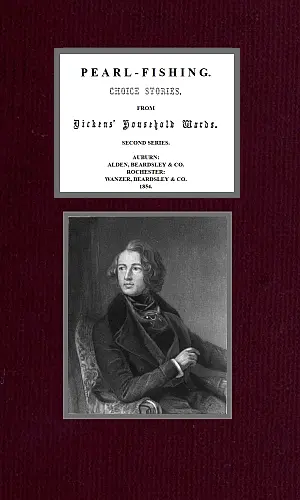
Charles Dickens
BEHIND THE BOOK
This eBook is for the use of anyone anywhere in the United States and most other parts of the world at no cost and with almost no restrictions whatsoever. You may copy it, give it away or re-use it under the terms of the Project Gutenberg License included with this eBook or online at www.gutenberg.org. If you are not located in the United States, you will have to check the laws of the country where you are located before using this eBook. Read the source licence.
The original source file, including credits and licence, is retained by this library. Request an original-format copy at no charge. Please include the book title and Project Gutenberg identifier #61193.
KEEP YOUR CURIOSITY GOING
Coulson Kernahan

Maurice Baring
Frances Wright
Cécile Tormay

Frederic Jesup Stimson

W. H. P. (William Henry Pope) Jarvis