THE CLASSIC COLLECTION✦A Christmas Carol The original manuscriptCLASSIC FREE BOOKS
A Christmas Carol The original manuscript
Charles Dickens

THE CLASSIC COLLECTION · 1906
"Mr. Pickwick's Christmas" by Charles Dickens is a festive novella, likely written in the mid-19th century. This work serves as a delightful extension of the adventures of Mr. Pickwick and his companions, the Pickwickians, during their Christmas festivities at the Manor Farm. The narrative promises to explore themes of joy, camaraderie, and the heartwarming spirit of Christmas through the eyes of Mr. Pickwick and his friends as they engage in various holiday activities. The opening of the story sets the stage for a cheerful Christmas celebration, vividly describing the gathering of the Pickwickians on the morning of December 22nd. Mr. Pickwick is portrayed as a warm-hearted character in high spirits as he embarks on a journey to Dingley Dell with his friends. The scene is filled with merriment, anticipation, and quirky comic elements, including humorous mishaps with their luggage on the coach. As they arrive at the Manor Farm, the narrative hints at a wedding celebration that will occur soon, immediately introducing a lively and jovial atmosphere that welcomes readers into the whimsical world Dickens has crafted, marking the beginning of a heartwarming holiday adventure intertwined with friendship and festive cheer.
Introduction adapted from the source catalogue; source summaries may be automatically generated.
Free to read · English · 20,231 words · No account needed
MAKE TIME FOR A GOOD BOOK
On by default. Untick to stop anonymous reading totals. Each page counts after 10 seconds in view. How this works.
Anonymous counting is on unless you have switched it off.
“Vell, young twenty stun,” said Sam, “you’re a nice specimen of a prize
boy, you are.”
“Thankee,” said the fat boy.
“You ain’t got nothin’ on your mind, as makes you fret yourself, have you?” inquired Sam.
“Not as I knows on,” replied the boy.
“I should rayther ha’ thought, to look at you, that you was a labourin’ under an unrequited attachment to some young ’ooman,” said Sam.
The fat boy shook his head.
“Vell,” said Sam, “I’m glad to hear it. Do you ever drink anythin’?”
“I likes eating, better,” replied the boy.
“Ah,” said Sam, “I should ha’ s’posed that; but what I mean is, should you like a drop of anythin’ as’d warm you? but I s’pose you never was cold, with all them elastic fixtures, was you?”
“Sometimes,” replied the boy; “and I likes a drop of something, when
it’s good.”
“Oh, you do, do you?” said Sam, “come this vay, then.”
The Blue Lion tap was soon gained, and the fat boy swallowed a glass of liquor without so much as winking,—a feat which considerably advanced him in Mr. Weller’s good opinion. Mr. Weller having transacted a similar piece of business on his own account, they got into the cart.
“Can you drive?” said the fat boy.
“I should rayther think so,” replied Sam.
“There, then,” said the fat boy, putting the reins in his hand, and pointing up a lane, “It’s as straight as you can go; you can’t miss it.”
With these words, the fat boy laid himself affectionately down by the side of the cod-fish, and placing an oyster-barrel under his head for a pillow, fell asleep instantaneously.
“Vell,” said Sam, “of all the cool boys ever I set my eyes on, this here young gen’lm’n is about the coolest. Come, vake up, young dropsy.”
But as young dropsy evinced no symptoms of returning animation, Sam Weller sat himself down in front of the cart, and starting the old horse with a jerk of the rein, jogged steadily on, towards Manor Farm.
Your reading position is saved on this browser. Take it to another device with a library code. Reading pages adapt to text, rather than matching a printed edition.
Charles Dickens
Samuel McChord Crothers & Charles Dickens

Rebecca Harding Davis & Thomas De Quincey & Charles Dickens & Nathaniel Hawthorne & Edward Bulwer Lytton, Baron Lytton & Edgar Allan Poe & Harriet Elizabeth Prescott Spofford
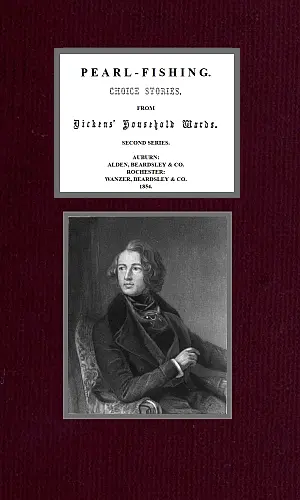
Charles Dickens
BEHIND THE BOOK
This eBook is for the use of anyone anywhere in the United States and most other parts of the world at no cost and with almost no restrictions whatsoever. You may copy it, give it away or re-use it under the terms of the Project Gutenberg License included with this eBook or online at www.gutenberg.org. If you are not located in the United States, you will have to check the laws of the country where you are located before using this eBook. Read the source licence.
The original source file, including credits and licence, is retained by this library. Request an original-format copy at no charge. Please include the book title and Project Gutenberg identifier #61193.
KEEP YOUR CURIOSITY GOING
Coulson Kernahan

Maurice Baring
Frances Wright
Cécile Tormay

Frederic Jesup Stimson

W. H. P. (William Henry Pope) Jarvis