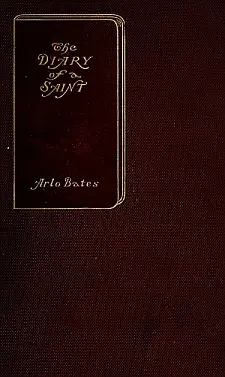
The Diary of a Saint
Arlo Bates
THE CLASSIC COLLECTION · 1883
"Mr. Jacobs: A Tale of the Drummer, the Reporter, and the Prestidigitateur" by Bates is a whimsical novel likely written in the late 19th century. Set in a colonial environment, the book intertwines humor and adventure within a narrative that reflects the absurdities of human relationships and social norms. It features a unique blend of characters, including a drummer, a reporter, and a magician, as they navigate their intertwined lives. The story follows Peter Briggs, a correspondent for the "Calcutta Jackal", who becomes entangled in the eccentric life of Mr. Jacobs, a man of many wives and an extensive history, seeking to charm his way through life’s challenges. As they engage in madcap adventures, including a tiger hunt and encounters with various quirky figures, themes of love and absurdity are explored. Throughout their escapades, Mr. Jacobs’ preoccupation with his wives and his friendship with Briggs serves as a humorous commentary on the complexities of companionship and the human condition, ultimately culminating in unexpected and comical resolutions. The narrative offers an entertaining blend of satire and slapstick, appealing to readers looking for light-hearted and inventive storytelling.
Introduction adapted from the source catalogue; source summaries may be automatically generated.
Free to read · English · 3,128 words · No account needed
MAKE TIME FOR A GOOD BOOK
On by default. Untick to stop anonymous reading totals. Each page counts after 10 seconds in view. How this works.
Anonymous counting is on unless you have switched it off.
In spite of Jean-Jacques and his school, men are not everywhere, especially in countries where excessive liberty or excessive tiffin favors the growth of that class of adventurers most usually designated as drummers, or by a still more potent servility, the ruthless predatory instinct of certain bold and unscrupulous persons may and almost certainly will; and in those more numerous and certainly more happy countries where the travelling show is discouraged, the unwearying flatterer, patient under abstemious high-feeding, will assuredly become a roving sleight-of-hand man.
Without doubt the Eastern portion of the world, when an hereditary, or, at least, a traditional, if not customary, or, perhaps, conservative, not to say legendary, or, more correctly speaking, historic, despotism has never ceased to ingrain the blood of Russia, Chinese, Ottoman, Persia, India, British, or Nantasket, in a perfect instance of a ruthless military tiffin, where neither blood nor stratagem have been spared.[1]
[Footnote 1: The editor was here obliged to omit a score of pages, in
which the only thing worth preserving was a carcanet of sulphur
springs.]
I was at tiffin. A man sat opposite whose servant brought him water in a large goblet cut from a single emerald. I observed him closely. A water-drinker is always a phenomenon to me; but a water-drinker who did the thing so artistically, and could swallow the fluid without wincing, was such a manifestation as I had never seen.
I contrasted him with our neighbors at the lunch-counter, who seemed to be vying, like the captives of Circe, to ascertain by trial who could swallow the most free lunch, and pay for the fewest "pegs,"--those vile concoctions of spirits, ice, and soda-water, which have destroyed so many splendid resolutions on the part of the Temperance Alliance,--and an impression came over me that he must be the most innocent man on the road.
Before I go farther let me try and describe him. His peculiarity was that, instead of eyes, he had jewels composed of six precious stones. There was a depth of life and vital light in them that told of the pent-up force of a hundred, or, at least, of ninety-nine generations of Persian magi. They blazed with the splendor of a god-like nature, needing neither tiffin nor brandy and soda to feed their power.
My mind was made up. I addressed him in Gaelic. To my surprise, and somewhat to my confusion, he answered in two words of modern Hebrew. We fell into a polyglot but refined conversation.
"Come and smoke," he said, at length.
Slipping into the office of the hotel, and ascertaining that there was no danger, I followed to his room.
Your reading position is saved on this browser. Take it to another device with a library code. Reading pages adapt to text, rather than matching a printed edition.
Arlo Bates
Arlo Bates
Arlo Bates
Arlo Bates
BEHIND THE BOOK
This eBook is for the use of anyone anywhere in the United States and most other parts of the world at no cost and with almost no restrictions whatsoever. You may copy it, give it away or re-use it under the terms of the Project Gutenberg License included with this eBook or online at www.gutenberg.org. If you are not located in the United States, you will have to check the laws of the country where you are located before using this eBook. Read the source licence.
The original source file, including credits and licence, is retained by this library. Request an original-format copy at no charge. Please include the book title and Project Gutenberg identifier #41125.
KEEP YOUR CURIOSITY GOING
Coulson Kernahan

Maurice Baring
Frances Wright
Cécile Tormay

Frederic Jesup Stimson

W. H. P. (William Henry Pope) Jarvis