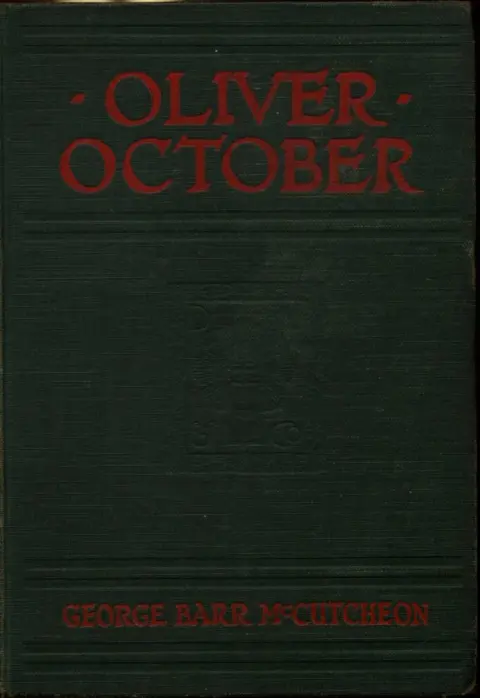
Oliver October
George Barr McCutcheon
THE CLASSIC COLLECTION · 1915
"Mr. Bingle" by George Barr McCutcheon is a novel written during the early 20th century, likely around the 1910s. The story centers around Mr. Thomas S. Bingle, a kind-hearted and gentle bookkeeper living in New York City, who shares a home with his wife, Mary. Despite their love for each other, they grapple with the heart-wrenching absence of children in their lives, which shapes their Christmas traditions and prompts them to invite the less fortunate into their home during the holidays, highlighting themes of kindness, loneliness, and the joy of giving. The opening of the novel introduces Mr. and Mrs. Bingle on Christmas Eve, filled with anticipation for their yearly gathering of children from the local community to celebrate the holiday. As they prepare their apartment and reflect on their longing for children, we meet the Sykes family, particularly the five excitable youngsters that bring vibrant energy to their otherwise quiet lives. Mr. Bingle is portrayed as a devoted man with a passion for reading "A Christmas Carol" to his guests, showcasing his sentimental nature and belief in the goodness of people. The narrative begins to build a backdrop that explores family, community, and the deep-seated yearning for parental connection, creating an emotional resonance that hints at the challenges and joys the Bingles will face as the story progresses.
Introduction adapted from the source catalogue; source summaries may be automatically generated.
Free to read · English · 86,385 words · No account needed
MAKE TIME FOR A GOOD BOOK
On by default. Untick to stop anonymous reading totals. Each page counts after 10 seconds in view. How this works.
Anonymous counting is on unless you have switched it off.
Diggs was telling Watson, the footman, just where to put the mistletoe. Watson's position was precarious. He was at the top of a step-ladder, struggling to reach the lowest crystal pendant on the enormous chandelier, and the ladder was wobbling.
"It's all tommy-rot," muttered Watson, apropos of nothing that had gone
before.
"Wot's all tommy-rot?" demanded Mr. Diggs severely.
"Christmas Eve," said Watson. "I have no objection to Christmas morning, but 'ang me if I can see any sense in Christmas Eve. What's it good for, anyway?"
"You'd better get a taller ladder," said Mr. Diggs. "It's getting on towards 'alf-past eight. We can't be all night 'anging that bunch of mistletoe, you know."
Melissa paused in her work long enough to devote an appraising look
upon Watson.
"You look very handsome up there, Watson. It gives you a very good height. Straighten your legs out a bit. If you stand up as straight as you can you'll be as tall as Mr. Diggs THINKS he is."
"See here, my fine lady," began Diggs, annoyed.
"Oh, I beg pardon, Mr. Diggs," cried Melissa. "I didn't see you."
"You'll get your walking papers if you don't keep your place," said
Diggs ominously.
"And I'll keep my place if I don't get my walking papers," retorted
Melissa, airily.
"And what's more," went on the butler, "you'll get the sack anyway if you don't stop filling the kids up with them yarns of yours. The nurses were telling Mrs. Bingle that the children didn't go to sleep for hours last night, they were that scared."
"Seeing ghosts, dragons and goblins all night long," said Hughes, the second footman, shoving a big chair into position. Chairs from all parts of the house had been brought to the drawing-room and arranged in a semi-circle in front of the huge fireplace, at one corner of which stood Mr. Bingle's reading lamp, accurately placed at the edge of a costly little Italian table. There were big chairs and little chairs, soft chairs and hard ones, chairs of velvet and chairs of silk, chairs of ancient needle-point and chairs that could not be sat upon.
"I didn't tell any ghost stories yesterday," said Melissa. "I told 'em about robbers and kidnappers."
"Get the ladder, Watson," said Diggs. "What are you standing there for? Do you think it's a pedestal you're on?"
"I just wanted to say that three of the kids saw sea-serpents and
crocodiles in their dreams--"
"Don't lay it to me, Watson," broke in Melissa. "I'm not to blame if they had delirium tremens. I didn't give them anything to drink."
"I--I shall have to speak to Mrs. Bingle about you, Melissa," exclaimed
Diggs severely.
Your reading position is saved on this browser. Take it to another device with a library code. Reading pages adapt to text, rather than matching a printed edition.
George Barr McCutcheon
George Barr McCutcheon
George Barr McCutcheon
George Barr McCutcheon
BEHIND THE BOOK
This eBook is for the use of anyone anywhere in the United States and most other parts of the world at no cost and with almost no restrictions whatsoever. You may copy it, give it away or re-use it under the terms of the Project Gutenberg License included with this eBook or online at www.gutenberg.org. If you are not located in the United States, you will have to check the laws of the country where you are located before using this eBook. Read the source licence.
The original source file, including credits and licence, is retained by this library. Request an original-format copy at no charge. Please include the book title and Project Gutenberg identifier #5963.
KEEP YOUR CURIOSITY GOING
Coulson Kernahan

Maurice Baring
Frances Wright
Cécile Tormay

Frederic Jesup Stimson

W. H. P. (William Henry Pope) Jarvis