
Human Work
Charlotte Perkins Gilman

THE CLASSIC COLLECTION · 1911
"Moving the Mountain" by Charlotte Perkins Gilman is a novel written in the early 20th century, specifically around 1911. The story explores a future society where a man, John Robertson, awakens after thirty years of unconsciousness, discovering a dramatically altered world shaped by the empowerment of women and societal changes. The narrative reflects on themes of gender roles, societal progress, and the potential for a changed human condition. At the start of the novel, we meet John Robertson, who has been found lost and disoriented in Tibet after a long absence. He is reunited with his sister, Nellie, who reveals the wild changes that have taken place while he was gone. As he grapples with the shock of waking up in a time that has progressed greatly beyond his last memories, he learns about the advancements in women's rights and societal transformations that have taken place. Through John's perspective, we are introduced to his bewilderment about the social dynamics, especially regarding the roles of women in this new world, leading to a complex exploration of identity, progress, and the nature of change in human society.
Introduction adapted from the source catalogue; source summaries may be automatically generated.
Free to read · English · 48,306 words · No account needed
MAKE TIME FOR A GOOD BOOK
On by default. Untick to stop anonymous reading totals. Each page counts after 10 seconds in view. How this works.
Anonymous counting is on unless you have switched it off.
That's where Nellie slips up. She cannot help having me in mind as the brave young brother she knew. She forgets that I am an old man now. Finally I told her that.
"No, John Robertson," she says, "that's where you are utterly wrong. Of course, you don't know what we're doing about age--how differently we feel. As a matter of physiology we find that about one hundred and fifty ought to be our natural limit; and that with proper conditions we can easily get to be a hundred now. Ever so many do."
"I don't want to be a hundred," I protested. "I saw a man of ninety-eight once, and never want to be one."
"It's not like that now," she said. "I mean we live to be a hundred and enjoy life still--'keep our faculties,' as they used to put it. Why, the ship's doctor here is eighty-seven."
This surprised me a good deal. I had talked a little with this man, and had thought him about sixty.
"Then a man of a hundred, according to your story, would look
like--like----"
"Like Grandpa Ely," she offered.
I remembered my mother's father--a tall, straight, hale old man of seventy-five. He had a clear eye, a firm step, a rosy color in his face. Well, that wasn't so bad a prospect.
"I consent to be a hundred--on those terms," I told her.
She talked to me a good bit, in small daily doses, of the more general changes in the world, showed me new maps, even let me read a little in the current magazines.
"I suppose you have a million of these now," I said. "There were
thousands when I left!"
"No," she answered. "There are fewer, I believe; but much better."
I turned over the one in my hand. It was pleasantly light and thin, it opened easily, the paper and presswork were of the best, the price was twenty-five cents.
"Is this a cheap one--at a higher price? or have the best ones come
down?"
"It's a cheap one," she told me, "if you mean by that a popular one, and it's cheap enough. They have all of a million subscribers."
"And what's the difference, beyond the paper and print?" I asked.
"The pictures are good."
I looked it through again.
"Yes, very good, much improved. But I don't see anything phenomenal--unless it is the absence of advertisements."
Nellie took it out of my hand and ran it over.
"Just read some of that," she said. "Read this story--and this
article--and that."
Your reading position is saved on this browser. Take it to another device with a library code. Reading pages adapt to text, rather than matching a printed edition.
Charlotte Perkins Gilman

Charlotte Perkins Gilman

Charlotte Perkins Gilman
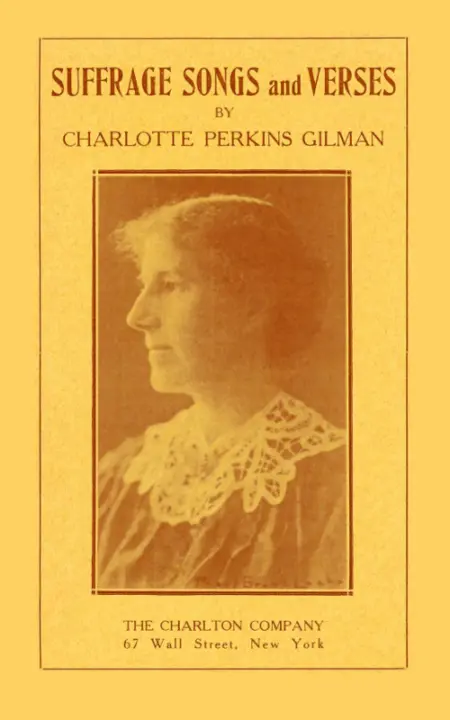
Charlotte Perkins Gilman
BEHIND THE BOOK
This eBook is for the use of anyone anywhere in the United States and most other parts of the world at no cost and with almost no restrictions whatsoever. You may copy it, give it away or re-use it under the terms of the Project Gutenberg License included with this eBook or online at www.gutenberg.org. If you are not located in the United States, you will have to check the laws of the country where you are located before using this eBook. Read the source licence.
The original source file, including credits and licence, is retained by this library. Request an original-format copy at no charge. Please include the book title and Project Gutenberg identifier #66864.
KEEP YOUR CURIOSITY GOING
Coulson Kernahan

Maurice Baring
Frances Wright
Cécile Tormay
Francis Greenleaf Allinson & Anne C. E. (Anne Crosby Emery) Allinson

Frederic Jesup Stimson