Human Work
Charlotte Perkins Gilman
THE CLASSIC COLLECTION · 1911
"Moving the Mountain" by Charlotte Perkins Gilman is a novel written in the early 20th century, specifically around 1911. The story explores a future society where a man, John Robertson, awakens after thirty years of unconsciousness, discovering a dramatically altered world shaped by the empowerment of women and societal changes. The narrative reflects on themes of gender roles, societal progress, and the potential for a changed human condition. At the start of the novel, we meet John Robertson, who has been found lost and disoriented in Tibet after a long absence. He is reunited with his sister, Nellie, who reveals the wild changes that have taken place while he was gone. As he grapples with the shock of waking up in a time that has progressed greatly beyond his last memories, he learns about the advancements in women's rights and societal transformations that have taken place. Through John's perspective, we are introduced to his bewilderment about the social dynamics, especially regarding the roles of women in this new world, leading to a complex exploration of identity, progress, and the nature of change in human society.
Introduction adapted from the source catalogue; source summaries may be automatically generated.
Free to read · English · 48,306 words · No account needed
MAKE TIME FOR A GOOD BOOK
On by default. Untick to stop anonymous reading totals. Each page counts after 10 seconds in view. How this works.
Anonymous counting is on unless you have switched it off.
"Suppose I refuse? Suppose I really am unable?"
"We won't suppose it for a moment," he said cheerfully. "Ideas are not nailed down. Just take out what you had and insert some new ones. Women are people--just as much as we are; that's a fact, my dear fellow. You'll have to accept it."
"And are men allowed to be people, too?" I asked gloomily.
"Why, of course! Nothing has interfered with our position as human beings; it is only our sex supremacy that we have lost."
"And do you like it?" I demanded.
"Some men made a good deal of fuss at first--the old-fashioned kind, and all the worst varieties. But modern men aren't worried in the least over their position. . . . See here, John, you don't grasp this--women are vastly more agreeable than they used to be."
I looked at him in amazement.
"Fact!" he said. "Of course, we loved our own mothers and daughters and sisters, more or less, no matter how they looked or what they did; and when we were 'in love' there was no limit to the glory of 'the beloved object.' But you and I know that women were pretty unsatisfactory in the old days."
I refused to admit it, but he went on calmly.
"The 'wife and mother' was generally a tired, nervous, overworked creature. She soon lost her beauty and vigor, her charm and inspiration. We were forever chasing fine, handsome, highly desirable young girls, and forever reducing them to weary, worn-out women--in the name of love! The gay outsiders were always a fresh attraction--as long as we couldn't have them. . . . See here, John, can't you understand? Our old way of using women wasn't good for them--nor for us, either, by the way--but it simply spoiled the women. They were hopelessly out of the running with us in all human lines; their business was housework, and ours was world work. There was very little real companionship.
"Now women are intelligent, experienced, well-trained citizens, fully our equals in any line of work they take up, and with us everywhere. It's made the world over!"
"Made it 'feminist' through and through, I suppose!" I groaned.
"Not a bit! It used to be 'masculist' through and through; now it's just human. And, see here--women are more attractive, as women, than they used to be."
I stared at this, unbelieving.
"That's true! You see, they are healthy; there's a new standard of physical beauty--very Greek--you must have noticed already the big, vigorous, fresh-colored, free-stepping girls."
I had, even in my brief hours of observation.
Your reading position is saved on this browser. Take it to another device with a library code. Reading pages adapt to text, rather than matching a printed edition.
Charlotte Perkins Gilman
Charlotte Perkins Gilman
Charlotte Perkins Gilman
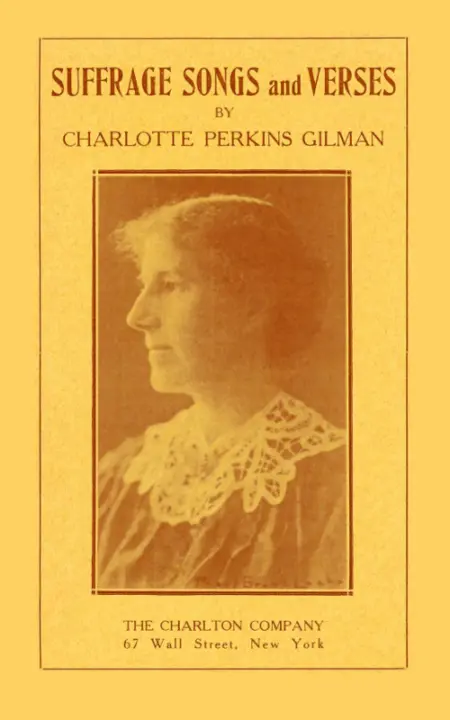
Charlotte Perkins Gilman
BEHIND THE BOOK
This eBook is for the use of anyone anywhere in the United States and most other parts of the world at no cost and with almost no restrictions whatsoever. You may copy it, give it away or re-use it under the terms of the Project Gutenberg License included with this eBook or online at www.gutenberg.org. If you are not located in the United States, you will have to check the laws of the country where you are located before using this eBook. Read the source licence.
The original source file, including credits and licence, is retained by this library. Request an original-format copy at no charge. Please include the book title and Project Gutenberg identifier #66864.
KEEP YOUR CURIOSITY GOING
Coulson Kernahan

Maurice Baring
Frances Wright
Cécile Tormay
Francis Greenleaf Allinson & Anne C. E. (Anne Crosby Emery) Allinson

Frederic Jesup Stimson