
Human Work
Charlotte Perkins Gilman

THE CLASSIC COLLECTION · 1911
"Moving the Mountain" by Charlotte Perkins Gilman is a novel written in the early 20th century, specifically around 1911. The story explores a future society where a man, John Robertson, awakens after thirty years of unconsciousness, discovering a dramatically altered world shaped by the empowerment of women and societal changes. The narrative reflects on themes of gender roles, societal progress, and the potential for a changed human condition. At the start of the novel, we meet John Robertson, who has been found lost and disoriented in Tibet after a long absence. He is reunited with his sister, Nellie, who reveals the wild changes that have taken place while he was gone. As he grapples with the shock of waking up in a time that has progressed greatly beyond his last memories, he learns about the advancements in women's rights and societal transformations that have taken place. Through John's perspective, we are introduced to his bewilderment about the social dynamics, especially regarding the roles of women in this new world, leading to a complex exploration of identity, progress, and the nature of change in human society.
Introduction adapted from the source catalogue; source summaries may be automatically generated.
Free to read · English · 48,306 words · No account needed
MAKE TIME FOR A GOOD BOOK
On by default. Untick to stop anonymous reading totals. Each page counts after 10 seconds in view. How this works.
Anonymous counting is on unless you have switched it off.
"You think so because you do not understand the food business, Uncle John; nobody did in those days. We were so used to the criminal waste of individual housekeeping, with its pitifully low standards, and to monotonous low-grade restaurant meals, with their waste and extortion, that it never occurred to us to estimate the amount of profit there really was in the business. These far-seeing women were pioneers--but not for long! Dozens are claiming first place now, just as the early 'Women's Clubs' used to.
"They established in that block a meal service that was a wonder for excellence, and for cheapness, too; and people began to learn."
I was impressed, but not convinced, and she saw it.
"Look here, Uncle John, I hate to use figures on a helpless listener,
but you drive me to it."
Then she reached for the bookcase and produced her evidence, sparingly, but with effect. She showed me that the difference between the expense of hiring separate service and the same number of people patronizing a service company was sufficient to reduce expenses to the patrons and leave a handsome payment for the company.
Owen looked on, interpreting to my ignorance.
"You never kept house, old, man," he said, "nor thought much about it, I expect; but you can figure this out for yourself easily enough. Here were a hundred families, equal to, say, five hundred persons. They hired a hundred cooks, of course; paid them something like six dollars a week--call it five on an average. There's $500 a week, just for cooks--$26,000 a year!"
"Now, as a matter of fact (our learned daughter tells us this), ten cooks are plenty for five hundred persons--at the same price would cost $1,300 a year!"
"Ten are plenty, and to spare," said Hallie; "but we pay them handsomely. One chef at $8,000; two next bests at $2,000 each, four thousand; two at $1,000 apiece, two thousand; five at $800, four thousand. That's $13,000--half what we paid before, and the difference in service between a kitchen maid and a scientific artist."
"Fifty per cent, saved on wages, and 500 per cent, added to skill," Owen continued. "And you can go right on and add 90 per cent, saving in fuel, 90 per cent, in plant, 50 per cent, in utensils, and--how much is it, Hallie, in materials?"
Hallie looked very important.
"Even when they first started, when food was shamefully expensive and required all manner of tests and examinations, the saving was all of 60 per cent. Now it is fully 80 per cent."
"That makes a good deal all told, Uncle John," Jerrold quietly remarked, handing me a bit of paper. "You see, it does leave a margin of profit."
Your reading position is saved on this browser. Take it to another device with a library code. Reading pages adapt to text, rather than matching a printed edition.
Charlotte Perkins Gilman

Charlotte Perkins Gilman

Charlotte Perkins Gilman
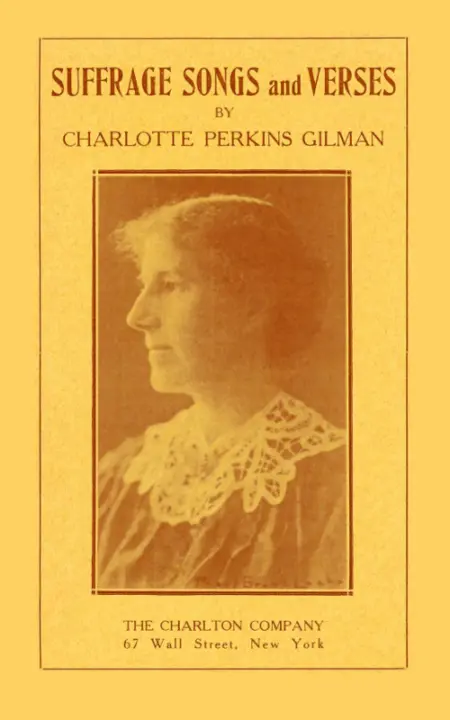
Charlotte Perkins Gilman
BEHIND THE BOOK
This eBook is for the use of anyone anywhere in the United States and most other parts of the world at no cost and with almost no restrictions whatsoever. You may copy it, give it away or re-use it under the terms of the Project Gutenberg License included with this eBook or online at www.gutenberg.org. If you are not located in the United States, you will have to check the laws of the country where you are located before using this eBook. Read the source licence.
The original source file, including credits and licence, is retained by this library. Request an original-format copy at no charge. Please include the book title and Project Gutenberg identifier #66864.
KEEP YOUR CURIOSITY GOING
Coulson Kernahan

Maurice Baring
Frances Wright
Cécile Tormay
Francis Greenleaf Allinson & Anne C. E. (Anne Crosby Emery) Allinson

Frederic Jesup Stimson