
Human Work
Charlotte Perkins Gilman

THE CLASSIC COLLECTION · 1911
"Moving the Mountain" by Charlotte Perkins Gilman is a novel written in the early 20th century, specifically around 1911. The story explores a future society where a man, John Robertson, awakens after thirty years of unconsciousness, discovering a dramatically altered world shaped by the empowerment of women and societal changes. The narrative reflects on themes of gender roles, societal progress, and the potential for a changed human condition. At the start of the novel, we meet John Robertson, who has been found lost and disoriented in Tibet after a long absence. He is reunited with his sister, Nellie, who reveals the wild changes that have taken place while he was gone. As he grapples with the shock of waking up in a time that has progressed greatly beyond his last memories, he learns about the advancements in women's rights and societal transformations that have taken place. Through John's perspective, we are introduced to his bewilderment about the social dynamics, especially regarding the roles of women in this new world, leading to a complex exploration of identity, progress, and the nature of change in human society.
Introduction adapted from the source catalogue; source summaries may be automatically generated.
Free to read · English · 48,306 words · No account needed
MAKE TIME FOR A GOOD BOOK
On by default. Untick to stop anonymous reading totals. Each page counts after 10 seconds in view. How this works.
Anonymous counting is on unless you have switched it off.
"I will talk!" cried Hallie. "Here I've inveigled Uncle John up here--and--and fed him to repletion; and have him completely at my mercy, and then you people butt in and do all the talking!"
"Go it, little sister--you're dead right!" agreed Jerrold.
"You see. Uncle, it's one thing to restrain and prevent and punish--and another thing to substitute improvements."
"Kindergarten methods?" I ventured.
"Yes, exactly. As women had learned this in handling children, they began to apply it to grown people--the same children, only a little older. Ever so many people had been talking and writing about this food business, and finally some of them got together and really started it."
"One of these co-operative schemes?" I was beginning, but the women looked at me with such pitying contempt that I promptly withdrew the suggestion.
"Not much!" said Nellie disdainfully. "Of course, those co-operative schemes were a natural result of the growing difficulties in our old methods, but they were on utterly wrong lines. No, sir; the new food business was a real business, and a very successful one. The first company began about 1912 or '13, I think. Just some women with a real business sense, and enough capital. They wisely concluded that a block of apartments was the natural field for their services; and that professional women were their natural patrons."
"The unprofessional women--or professional wives, as you might call them--had only their housewifery to preserve their self-respect, you see," put in Owen. "If they didn't do housekeeping for a living, what--in the name of decency--did they do?"
"This was called the Home Service Company," said Hallie. "(I will talk, mother!) They built some unusually attractive apartments, planned by women, to please women; this block was one of the finest designs of their architects--women, too, by the way."
"Who had waked up," murmured Jerrold, unnoticed.
"It was frankly advertised as specially designed for professional women. They looked at it, liked it, and moved it; teachers, largely doctors, lawyers, dressmakers; women who worked."
"Sort of a nunnery?" I asked.
"My dear brother, do you imagine that all working women were orphan spinsters, even in your day?" cried Nellie. "The self-supporting women of that time generally had other people to support, too. Lots of them were married; many were widows with children; even the single ones had brothers and sisters to take care of."
"They rushed in, anyhow," said Hallie. "The place was beautiful and built for enjoyment. There was a nice garden in the middle----"
"Like this one here?" I interrupted. "This is a charming patio. How did
they make space for it?"
Your reading position is saved on this browser. Take it to another device with a library code. Reading pages adapt to text, rather than matching a printed edition.
Charlotte Perkins Gilman

Charlotte Perkins Gilman

Charlotte Perkins Gilman
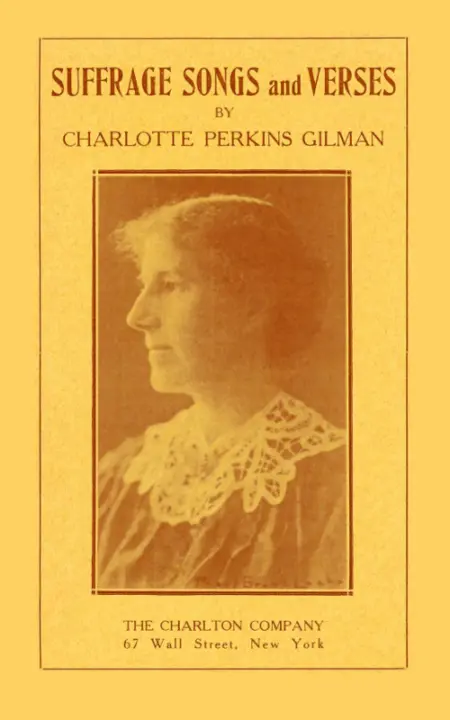
Charlotte Perkins Gilman
BEHIND THE BOOK
This eBook is for the use of anyone anywhere in the United States and most other parts of the world at no cost and with almost no restrictions whatsoever. You may copy it, give it away or re-use it under the terms of the Project Gutenberg License included with this eBook or online at www.gutenberg.org. If you are not located in the United States, you will have to check the laws of the country where you are located before using this eBook. Read the source licence.
The original source file, including credits and licence, is retained by this library. Request an original-format copy at no charge. Please include the book title and Project Gutenberg identifier #66864.
KEEP YOUR CURIOSITY GOING
Coulson Kernahan

Maurice Baring
Frances Wright
Cécile Tormay
Francis Greenleaf Allinson & Anne C. E. (Anne Crosby Emery) Allinson

Frederic Jesup Stimson