Human Work
Charlotte Perkins Gilman
THE CLASSIC COLLECTION · 1911
"Moving the Mountain" by Charlotte Perkins Gilman is a novel written in the early 20th century, specifically around 1911. The story explores a future society where a man, John Robertson, awakens after thirty years of unconsciousness, discovering a dramatically altered world shaped by the empowerment of women and societal changes. The narrative reflects on themes of gender roles, societal progress, and the potential for a changed human condition. At the start of the novel, we meet John Robertson, who has been found lost and disoriented in Tibet after a long absence. He is reunited with his sister, Nellie, who reveals the wild changes that have taken place while he was gone. As he grapples with the shock of waking up in a time that has progressed greatly beyond his last memories, he learns about the advancements in women's rights and societal transformations that have taken place. Through John's perspective, we are introduced to his bewilderment about the social dynamics, especially regarding the roles of women in this new world, leading to a complex exploration of identity, progress, and the nature of change in human society.
Introduction adapted from the source catalogue; source summaries may be automatically generated.
Free to read · English · 48,306 words · No account needed
MAKE TIME FOR A GOOD BOOK
On by default. Untick to stop anonymous reading totals. Each page counts after 10 seconds in view. How this works.
Anonymous counting is on unless you have switched it off.
Generally there appeared the trim short skirt I had noticed as so appropriate on shipboard; here and there a sort of Florentine gown, long, richly damasked; sometimes a Greekish flow of drapery; the men mostly knickerbockered. I couldn't deny that it was pleasant to the eye, but it worried me a little none the less.
"There's no hurry, John," said Nellie, always unobtrusively watching me. "Some things you'll just have to get used to."
"Before I wholly accept this sudden new brother," I presently suggested, "I'd like to know his name."
"Montrose--Owen Montrose, at your service," he said, bowing his fine head. "Also Jerrold Montrose--and Hallie Robertson!"
"Dear, dear!" I protested. "So it's come to that, has it?"
"It's come to that--and we still love each other!" Nellie cheerfully agreed. "But it isn't final. There's a strong movement on foot to drop hereditary names altogether."
I groaned. "In the name of common humanity, don't tell me anything worse
than you have now!"
Hallie's apartment was in a big building, far uptown, overlooking the
Hudson.
"I have to live in town nine months of the year, you see. Uncle, on account of my work," she explained rather apologetically.
"Hallie's an official--and awfully proud of it," her brother whispered
very loudly.
"Jerrold's only a musician--and pretends to be proud of it!" she retorted. Whereat he forcibly held and kissed her.
I could see no very strong difference between this brother and sister and others I had known--except that they were perhaps unusually affectionate.
It was a big, handsome place. The front windows faced the great river, the rear ones opened on a most unexpected scene of loveliness. A big sheltered garden, every wall-space surrounding it a joy to the eye--rich masses of climbing vines, a few trees, a quiet fountain, beautiful stone seats and winding walks, flowers in profusion, and birds singing.
"We used to have only the song of the tomcat in my time. Have you taught the cat to lie down with the canary--or killed him?"
"There are no animals kept in cities any more--except the birds--and
they come and go."
"Mostly sparrows, I suppose?"
"No; the sparrow went with the horse," Owen replied. "And the mouse, the fly and the croton bug went with the kitchen."
I turned with a gesture of despair.
"No homes left?----"
"I didn't say 'home'--I said 'kitchen.' Brace up, old man! We still eat--and better food than you ever dreamed of in your hungriest youth."
"That's a long story," Nellie here suggested. "We mustn't crowd him. Let's get washed and rested a bit, and have some of that food you're boasting of."
Your reading position is saved on this browser. Take it to another device with a library code. Reading pages adapt to text, rather than matching a printed edition.
Charlotte Perkins Gilman
Charlotte Perkins Gilman
Charlotte Perkins Gilman
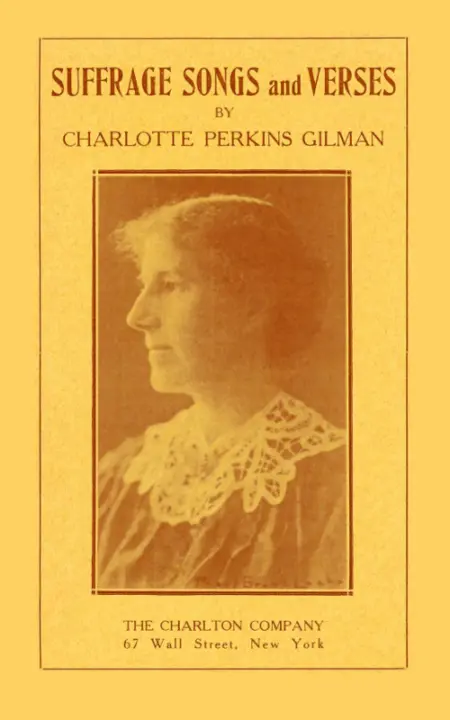
Charlotte Perkins Gilman
BEHIND THE BOOK
This eBook is for the use of anyone anywhere in the United States and most other parts of the world at no cost and with almost no restrictions whatsoever. You may copy it, give it away or re-use it under the terms of the Project Gutenberg License included with this eBook or online at www.gutenberg.org. If you are not located in the United States, you will have to check the laws of the country where you are located before using this eBook. Read the source licence.
The original source file, including credits and licence, is retained by this library. Request an original-format copy at no charge. Please include the book title and Project Gutenberg identifier #66864.
KEEP YOUR CURIOSITY GOING
Coulson Kernahan

Maurice Baring
Frances Wright
Cécile Tormay
Francis Greenleaf Allinson & Anne C. E. (Anne Crosby Emery) Allinson

Frederic Jesup Stimson