
Human Work
Charlotte Perkins Gilman

THE CLASSIC COLLECTION · 1911
"Moving the Mountain" by Charlotte Perkins Gilman is a novel written in the early 20th century, specifically around 1911. The story explores a future society where a man, John Robertson, awakens after thirty years of unconsciousness, discovering a dramatically altered world shaped by the empowerment of women and societal changes. The narrative reflects on themes of gender roles, societal progress, and the potential for a changed human condition. At the start of the novel, we meet John Robertson, who has been found lost and disoriented in Tibet after a long absence. He is reunited with his sister, Nellie, who reveals the wild changes that have taken place while he was gone. As he grapples with the shock of waking up in a time that has progressed greatly beyond his last memories, he learns about the advancements in women's rights and societal transformations that have taken place. Through John's perspective, we are introduced to his bewilderment about the social dynamics, especially regarding the roles of women in this new world, leading to a complex exploration of identity, progress, and the nature of change in human society.
Introduction adapted from the source catalogue; source summaries may be automatically generated.
Free to read · English · 48,306 words · No account needed
MAKE TIME FOR A GOOD BOOK
On by default. Untick to stop anonymous reading totals. Each page counts after 10 seconds in view. How this works.
Anonymous counting is on unless you have switched it off.
"My dear brother, the brutality of men lowered the birthrate--it didn't raise it! One of those undifferentiated peasant women would have a baby every year if she was married to a saint--and she couldn't have more in polyandry--unless it were twins! No, the birthrate was for women to settle--and they have."
"Out of fashion to have children at all?"
"No, John, you needn't sneer. We have better children than ever were born on earth before, and they grade higher every year. But we are approaching a balanced population."
I didn't like the subject, and turned to the clear skyline of the distant city. It towered as of old, but seemed not so close-packed. Not one black cloud--and very few white ones!
"You've ended the smoke nuisance, I'm glad to see. Has steam gone, too?"
"We use electricity altogether in all the cities now," she said. "It occurred to us that to pipe a leaking death into every bedroom; to thread the city with poison, fire and explosion, was foolish."
"Defective wiring used to cause both death and conflagration, didn't
it?"
"It did," she admitted; "but it is not 'defective' any more."
"Is the coal all gone?"
"No, but we burn it at the mines--by a process which does not waste ninety per cent of the energy--and transmit the power."
"For all New York?"
"Oh, no. New York has enough water power, you see. The tide mills are enough for this whole region."
"They solved the tide-mill problem, did they?"
"Yes. There are innumerable mechanical advances, of course. You'll enjoy
them."
We were near enough now to see the city clearly.
"What a splendid water front!" I cried. "Why, this is glorious."
It surely was. The wide shores swung away, glittering in the pure sunlight. Staten Island lay behind us, a vision of terraced loveliness; the Jersey shore shone clear, no foul pall of oil smoke overhanging; the Brooklyn banks were banks of palaces, and Manhattan itself towered royally before us, all bordered with broad granite piers.
"'Marginal mile after mile of smooth-running granite embankment,'" quoted Nellie. "'Broad steps of marble descending for the people to enter the water. White-pillared piers----"
"Look at the water!" I cried, suddenly. "It's clear!"
"Of course it's clear," she agreed laughingly. "This is a civilized
country, I tell you."
"I looked and looked. It was blue and bright in the distance; it was a clear, soft green beneath us. I saw a fish leap----"
"So far I'm with you, anyhow," said I. "That certainly is a big step--and looks like a miracle. New York harbor clean! . . . How about customs?" I asked as we drew in.
Your reading position is saved on this browser. Take it to another device with a library code. Reading pages adapt to text, rather than matching a printed edition.
Charlotte Perkins Gilman

Charlotte Perkins Gilman

Charlotte Perkins Gilman
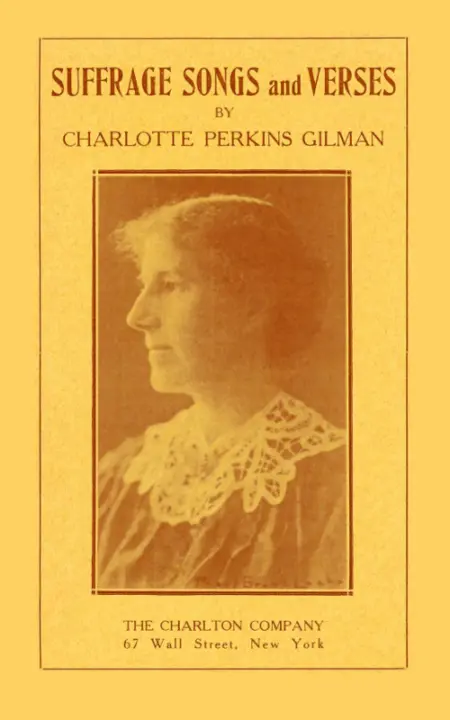
Charlotte Perkins Gilman
BEHIND THE BOOK
This eBook is for the use of anyone anywhere in the United States and most other parts of the world at no cost and with almost no restrictions whatsoever. You may copy it, give it away or re-use it under the terms of the Project Gutenberg License included with this eBook or online at www.gutenberg.org. If you are not located in the United States, you will have to check the laws of the country where you are located before using this eBook. Read the source licence.
The original source file, including credits and licence, is retained by this library. Request an original-format copy at no charge. Please include the book title and Project Gutenberg identifier #66864.
KEEP YOUR CURIOSITY GOING
Coulson Kernahan

Maurice Baring
Frances Wright
Cécile Tormay
Francis Greenleaf Allinson & Anne C. E. (Anne Crosby Emery) Allinson

Frederic Jesup Stimson