
Human Work
Charlotte Perkins Gilman

THE CLASSIC COLLECTION · 1911
"Moving the Mountain" by Charlotte Perkins Gilman is a novel written in the early 20th century, specifically around 1911. The story explores a future society where a man, John Robertson, awakens after thirty years of unconsciousness, discovering a dramatically altered world shaped by the empowerment of women and societal changes. The narrative reflects on themes of gender roles, societal progress, and the potential for a changed human condition. At the start of the novel, we meet John Robertson, who has been found lost and disoriented in Tibet after a long absence. He is reunited with his sister, Nellie, who reveals the wild changes that have taken place while he was gone. As he grapples with the shock of waking up in a time that has progressed greatly beyond his last memories, he learns about the advancements in women's rights and societal transformations that have taken place. Through John's perspective, we are introduced to his bewilderment about the social dynamics, especially regarding the roles of women in this new world, leading to a complex exploration of identity, progress, and the nature of change in human society.
Introduction adapted from the source catalogue; source summaries may be automatically generated.
Free to read · English · 48,306 words · No account needed
MAKE TIME FOR A GOOD BOOK
On by default. Untick to stop anonymous reading totals. Each page counts after 10 seconds in view. How this works.
Anonymous counting is on unless you have switched it off.
We were in our steamer chairs, most people dozing after their midday meal. She reached over and took my hand in hers, and held it tight. It was marvelously comforting, this one live visible link between what was forever past and this uncertain future. But for her, even those old, old days might have flickered and seemed doubtful--I should have felt like one swimming under water and not knowing, which way was up. She gave me solid ground underfoot at any rate. Whatever her place might be in this New World, she had talked to me only of the old one.
In these long, quiet, restful days, she had revived in my mind the pleasant memories of our childhood together; our little Southern home; our patient, restrained Northern mother and the fine education she gave her school-less little ones; our high-minded--and, alas, narrow-minded--father, handsome, courteous, inflexible. Under Nellie's gentle leading, my long unused memory-cells had revived like rain-washed leaves, and my past life had, at last, grown clear and steady.
My college life; my old chum, Granger, who had visited us once; our neighbors and relations; little gold-haired Cousin Drusilla, whom I, in ten years proud seniority, had teased as a baby, played with and tyrannized over as a confiding child, and kissed good-bye--a slim, startled little figure--when I left for Asia.
Nellie had always spoken of things as I remembered them, and avoided adroitly, or quietly refused to discuss, their new aspects.
I think she was right--at first.
"Out with it!" said I. "Come--Have we adopted Socialism?" I braced
myself for the answer.
"Socialism? Oh--why, yes. I think we did. But that was twenty years
ago."
"And it didn't last? You've proved the impracticable folly of it? You've
discarded it?"
I sat up straight, very eager.
"Why, no--" said Nellie. "It's very hard to put these new things into old words--We've got beyond it."
"Beyond Socialism! Not--not--Anarchy?"
"Oh, bless you, no; no indeed! We understand better what socialism meant, that's all. We have more, much more, than it ever asked; but we don't call it that."
I did not understand.
"It's like this," she said. "Suppose you had left a friend in the throes of a long, tempestuous' courtship, full of ardor, of keen joy, and keener anticipation. Then, returning, you say to your friend, 'Do you still have courtship?' And he says, 'Why no, I'm married.' It's not that he has discarded it, proved it's impracticable folly. He had to have it--he liked it--but he's got beyond it."
"Go on and elucidate," I said. "I don't quite follow your parable."
She considered a bit.
Your reading position is saved on this browser. Take it to another device with a library code. Reading pages adapt to text, rather than matching a printed edition.
Charlotte Perkins Gilman

Charlotte Perkins Gilman

Charlotte Perkins Gilman
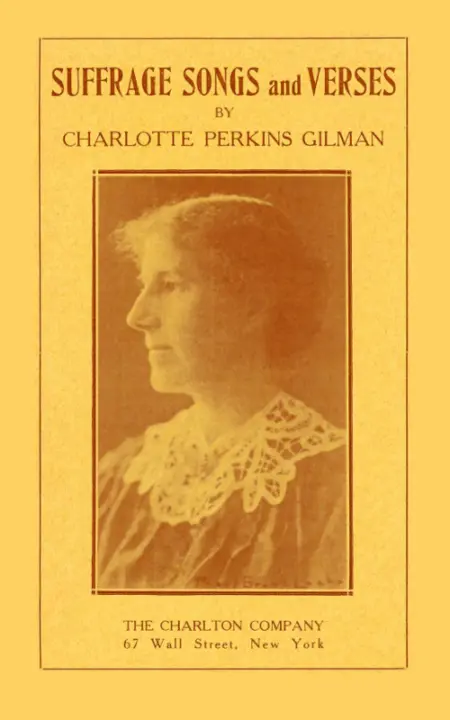
Charlotte Perkins Gilman
BEHIND THE BOOK
This eBook is for the use of anyone anywhere in the United States and most other parts of the world at no cost and with almost no restrictions whatsoever. You may copy it, give it away or re-use it under the terms of the Project Gutenberg License included with this eBook or online at www.gutenberg.org. If you are not located in the United States, you will have to check the laws of the country where you are located before using this eBook. Read the source licence.
The original source file, including credits and licence, is retained by this library. Request an original-format copy at no charge. Please include the book title and Project Gutenberg identifier #66864.
KEEP YOUR CURIOSITY GOING
Coulson Kernahan

Maurice Baring
Frances Wright
Cécile Tormay
Francis Greenleaf Allinson & Anne C. E. (Anne Crosby Emery) Allinson

Frederic Jesup Stimson