THE CLASSIC COLLECTION✦Borneo and the Indian Archipelago with drawings of costume and sceneryCLASSIC FREE BOOKS
Borneo and the Indian Archipelago with drawings of costume and scenery
Frank Marryat
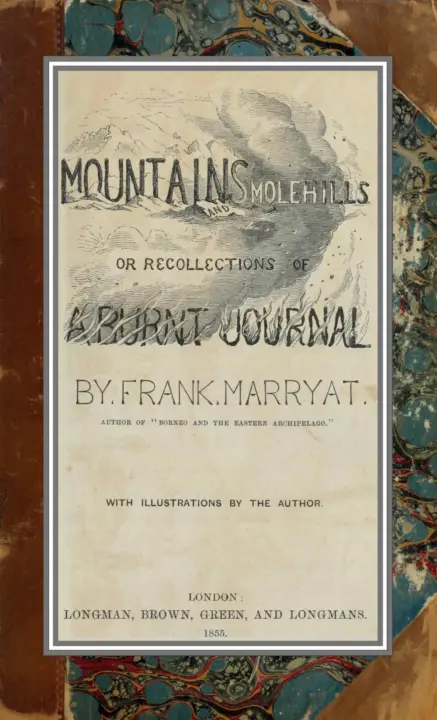
THE CLASSIC COLLECTION · 1855
"Mountains and Molehills; or, Recollections of a Burnt Journal" by Frank Marryat is a travel narrative written in the mid-19th century. The book chronicles the author's personal experiences and observations during his travels in California, capturing the essence of the Gold Rush era and the diverse characters he encounters along the way. Marryat's emphasis on storytelling suggests a lively recounting of his adventures, filled with humor and a rich perspective on life during this transformative period in American history. The opening of the work introduces readers to the author's reflective preface about the lost journal from which he draws his memories, establishing a tone of honest recollection. As he begins his journey, Marryat describes his arrival at Chagres and the subsequent encounters with fellow travelers, the local natives, and the chaotic environment of Panama. Vivid imagery portrays his observations of the landscape, living conditions, and the personalities of both immigrants and locals. Additionally, his first-hand account of the journey to Panama, filled with humorous anecdotes, challenges, and cultural insights, sets the stage for the unfolding narrative ahead, highlighting both the beauty and brutality of life during the Gold Rush era.
Introduction adapted from the source catalogue; source summaries may be automatically generated.
Free to read · English · 98,496 words · No account needed
MAKE TIME FOR A GOOD BOOK
On by default. Untick to stop anonymous reading totals. Each page counts after 10 seconds in view. How this works.
Anonymous counting is on unless you have switched it off.
SMITH.--“It’s a great country.”
JONES.--“It’s nothing shorter.”
And in a couple of days both Smith and Jones are on their legs again, and with a little help from their friends live to grow rich perhaps, and build brick buildings that withstand the flames.
This fire was attributed to incendiarism, but when the general carelessness that existed is considered, it is quite as probable that it resulted from accident. It is much to be regretted that these fires did not sweep off the gambling houses; but these buildings were now constructed of brick, and were tolerably well secured against all risk. When the burnt portion of the city was again covered with buildings, I had an opportunity of judging of the enormous strides the place had made since two years back, when it was, by all accounts, a settlement of tents. Three fires had checked its growth in this short space; but a daring confidence had laughed as it were at these obstacles, and any one who knew human nature might see, that so long as that spirit of energy animated every breast, the city would increase in size and wealth, in spite even of conflagrations so calamitous. For though many individually are ruined by the flames, and are forced to retire from the field, yet in a small community where all are armed with strong determination, the vacant ranks are soon filled up again, and shoulder to shoulder all march on in unity of purpose, and gain the victory at last, though at ever so great a sacrifice. Twelve months back there was little else but canvass tents here, and a small, shifting, restless, gambling, population: who was it then, when all looked uncertain in the future, that sent away so many thousand miles for steam excavators, and tramways, and railway trucks? who were those, again, who sent from this hamlet of shanties for all the material for large foundries of iron and brass, for blocks of granite, bricks and mortar, for pile-drivers and steam-boats? I don’t know,--but these things all arrived; and now, in eighteen hundred and fifty, the sand-hills tumble down as if by magic, and are carried to the water’s edge on a railroad where the pile-drivers are at work, and confine them to the new position assigned them on a water lot. The clang of foundries is heard on all sides, as machinery is manufactured for the mines,--brick buildings are springing up in the principal thoroughfares, steamers crowd the rivers, and thousands of men are blasting out huge masses of rock to make space for the rapid strides of this ambitious young city. The better portion of the population of San Francisco in eighteen hundred and fifty, may be said to have consisted of adventurers; these were of all nations, the Americans being in the proportion of about one-third. Many people object to the term adventurer, as one that has been generally associated with a class who travel with scanty purses and easy consciences. But Johnson defines an adventurer as “one who hazards a chance;” and when we consider that the population here have to a man almost made sacrifices elsewhere, in hopes of the speedier reward held out by the vicinity of these vast gold-fields, the term is not misapplied. Neither is it one that should ever carry opprobrium; while fresh countries remain to be explored, and facilities of communication are daily increasing, I have no objection to call myself an adventurer, and wish that I had been one of those fortunate ones who conferred a vast benefit upon mankind (and secured moderate advantages for themselves) by the discovery of the gold-fields of California and Australia. The most successful merchants of San Francisco were needy men, who by chance were on the spot when first the gold was discovered. The colossal fortunes that a few of these have reaped, sprung only from the chances that were open to all. Sam Brannan is probably the wealthiest of these speculators, and he commenced, they say, by levying a tax on the profits of a party of Mormons whom he piloted to the diggings. When the Mormons declined to pay the tax any longer, he called them a parcel of fools for having paid it so long, and then speculated in building-lots and real estate in San Francisco and other cities. The rapid rise in the value of this property elevated Sam to the top round of the ladder of fortune, where he will probably hold on as long as he can.
Your reading position is saved on this browser. Take it to another device with a library code. Reading pages adapt to text, rather than matching a printed edition.
BEHIND THE BOOK
This eBook is for the use of anyone anywhere in the United States and most other parts of the world at no cost and with almost no restrictions whatsoever. You may copy it, give it away or re-use it under the terms of the Project Gutenberg License included with this eBook or online at www.gutenberg.org. If you are not located in the United States, you will have to check the laws of the country where you are located before using this eBook. Read the source licence.
The original source file, including credits and licence, is retained by this library. Request an original-format copy at no charge. Please include the book title and Project Gutenberg identifier #69412.
KEEP YOUR CURIOSITY GOING
Wilfrid Scawen Blunt
Wilfrid Scawen Blunt

E. W. (Edgar Watson) Howe
Cécile Tormay

Moritz Busch
John L. Ransom