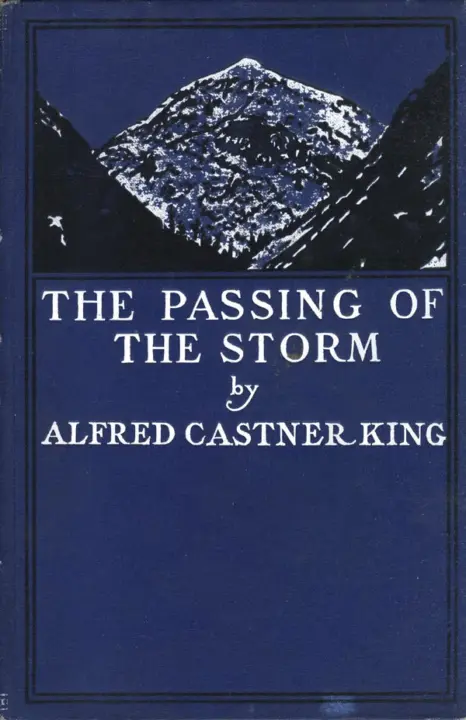
The Passing of the Storm, and Other Poems
Alfred Castner King
THE CLASSIC COLLECTION · 1901
"Mountain Idylls and Other Poems" by Alfred Castner King is a collection of lyrical poetry published in the early 20th century that reflects deep appreciation for nature and its profound impacts on the human spirit. The poems explore themes of beauty, solitude, and existential contemplation, often illustrated through vivid imagery of the Colorado mountains, highlighting an emotional connection to the natural world. The author, who faced the challenge of total blindness, infused his writings with rich descriptions and philosophical musings. The opening of this volume features a poignant preface where King shares his journey of becoming a poet, detailing the circumstances that led him to write despite his blindness. Born from personal tragedy, his work embodies a longing for beauty and understanding, revealing a sensitive exploration of both nature and human emotion. The poems introduce readers to the grandeur of mountain landscapes, the serenity of solitary moments, and reflections on life and death, captivating with their rhythmic flow and emotional depth. Overall, this introduction sets the stage for a reflective and inspiring reading experience that draws on elemental connections to the world around us.
Introduction adapted from the source catalogue; source summaries may be automatically generated.
Free to read · English · 16,603 words · No account needed
MAKE TIME FOR A GOOD BOOK
On by default. Untick to stop anonymous reading totals. Each page counts after 10 seconds in view. How this works.
Anonymous counting is on unless you have switched it off.
There is a proud, defiant mein,
Expressive, stern, and yet serene,
About the precipice;
Whose rugged form looks grimly down,
And answers, with an austere frown
The sunlight's kiss.
The mountain, with the snow bank crowned;
The gorge, abysmal and profound;
Impress with aspect grand:
With unfeigned reverence I see
In canon and declivity
The All-Wise Hand.
Think Not that the Heart is Devoid of Emotion.
Think not that the heart is devoid of emotion, Because of a countenance rugged and stern, The bosom may hide the most fervent devotion, As shadowy forests hide floweret and fern; As the pearls which are down in the depths of the ocean, The heart may have treasures which few can discern.
Think not the heart barren, because no reflection
Is flashed from the depths of its secret embrace;
External appearance may baffle detection,
And yet the heart beat with an ethical grace:
The breast may be charged with the truest affection
And never betray it by action or face.
Humanity's Stream.
I stood upon a crowded thoroughfare,
Within a city's confines, where were met
All classes and conditions, and surveyed,
From a secluded niche or aperture,
The various, ever-changing multitude
Which passed along in restless turbulence,
And, as a human river, ebbed and flowed
Within its banks of brick and masonry.
Within this vast and heterogeneous throng,
One might discern all stages and degrees,
From wealth and power to helpless indigence;
Extravagance to trenchant penury,
And all extremes of want and misery.
Some blest by wealth, some cursed by poverty;
Some in positions neutral to them both;
Some wore a gaunt and ill-conditioned look
Which told its tale of lack of nourishment;
While others showed that irritated air
Which speaks of gout and pampered appetite;
Some following vocations quite reverse
From those which nature had endowed them for;
Some passed with face self-satisfied and calm,
As if the world bore nothing else but joy;
And some there were who, from the cradle's mouth,
As they pursued their journey to the grave,
Had felt no throb save that of misery;
The man of large affairs passed by in haste,
With mind preoccupied, nor thought of else
Save undertakings which concerned himself;
The shallow son of misplaced opulence
Came strutting by with self-important air,
With head erect in a contemptuous poise,
As if the stars were subject to his will,
And e'en the golden sun was something base,
Which had offended with its wholesome light
In shining on so great a personage,
A being more than ordinary clay,
And much superior to the vulgar herd!
Some faces passed which knew no kindly look,
And felt no friendly pressure of the hand;
And if the face depict the character,
Some passed so steeped in crime and villainy
That Judas' vile, ill-favored countenance
Would seem in contrast quite respectable;
Some features glowed with unfeigned honesty,
Some grimaced in dissimulating craft,
Some smiled benignantly and passed along;
Some faces meek, some stern and resolute;
Some the embodiment of gentleness;
Some whose specific aspects plainly told
Their fondest dreams were not of earth, but heaven;
A newly wedded couple passed that way,
In the sweet zenith of their honeymoon,
But little dreaming what the future held.
The light and trivial fool, the brainless fop;
The staid and sober priest and minister;
And she who worshiped at proud fashion's shrine;
The mental giant, serious and sad;
The thoughtful student and philosopher;
And some of intellect diminutive;
The man of letters, with abstracted mien,
And he whose every thought was on the toil
Which made his bare existence possible;
The blushing maiden, pure and innocent;
The stately grandam, dignified and gray;
The matron, with the babe upon her breast;
The silly superannuated flirt,
Who nursed her waning beauty day by day,
And still essayed to act the role of youth;
The gay coquette and belle of other days,
Who in life's morning, with disdainful laugh,
Had quaffed the cup of pleasure to its dregs,
And now, grown old, must pay the penalty
In wrinkles and uncourted loneliness;
The widow, who, but newly desolate,
Would grasp a hand, then start to find it gone;
The spendthrift and the sordid usurer,
Who knew no sentiment save lust for gold;
The bloated drunkard, sinking 'neath the weight
Of wassail inclination dissolute;
The youth, who, following his baleful steps,
Reeled for the first time from intemperance;
And she who had forgot her covenant,
In brazen infamy and unwept shame;--
The good, the bad, the impious and unjust,
The energetic and the indolent,
The adolescent and the venerable,
Passed by, pursuant of their various ways.
Your reading position is saved on this browser. Take it to another device with a library code. Reading pages adapt to text, rather than matching a printed edition.
Alfred Castner King
BEHIND THE BOOK
This eBook is for the use of anyone anywhere in the United States and most other parts of the world at no cost and with almost no restrictions whatsoever. You may copy it, give it away or re-use it under the terms of the Project Gutenberg License included with this eBook or online at www.gutenberg.org. If you are not located in the United States, you will have to check the laws of the country where you are located before using this eBook. Read the source licence.
The original source file, including credits and licence, is retained by this library. Request an original-format copy at no charge. Please include the book title and Project Gutenberg identifier #13809.
KEEP YOUR CURIOSITY GOING

Eric Mackay
Edmund Gosse
Sophia Margaretta Hensley
Gilbert Parker
George MacDonald

Elizabeth Bibesco