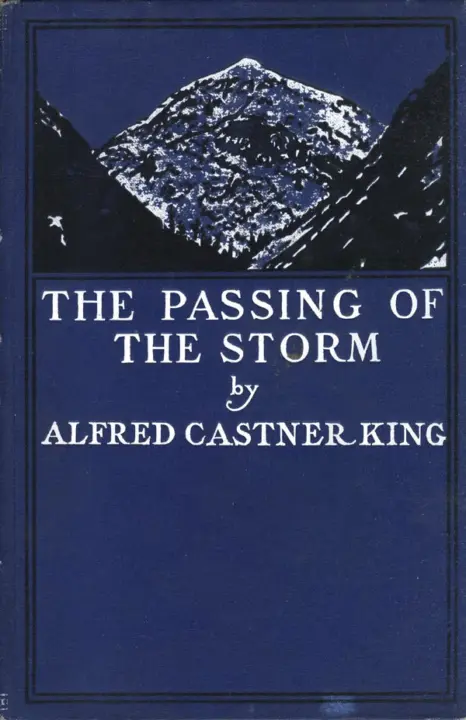
The Passing of the Storm, and Other Poems
Alfred Castner King
THE CLASSIC COLLECTION · 1901
"Mountain Idylls and Other Poems" by Alfred Castner King is a collection of lyrical poetry published in the early 20th century that reflects deep appreciation for nature and its profound impacts on the human spirit. The poems explore themes of beauty, solitude, and existential contemplation, often illustrated through vivid imagery of the Colorado mountains, highlighting an emotional connection to the natural world. The author, who faced the challenge of total blindness, infused his writings with rich descriptions and philosophical musings. The opening of this volume features a poignant preface where King shares his journey of becoming a poet, detailing the circumstances that led him to write despite his blindness. Born from personal tragedy, his work embodies a longing for beauty and understanding, revealing a sensitive exploration of both nature and human emotion. The poems introduce readers to the grandeur of mountain landscapes, the serenity of solitary moments, and reflections on life and death, captivating with their rhythmic flow and emotional depth. Overall, this introduction sets the stage for a reflective and inspiring reading experience that draws on elemental connections to the world around us.
Introduction adapted from the source catalogue; source summaries may be automatically generated.
Free to read · English · 16,603 words · No account needed
MAKE TIME FOR A GOOD BOOK
On by default. Untick to stop anonymous reading totals. Each page counts after 10 seconds in view. How this works.
Anonymous counting is on unless you have switched it off.
O, silvery moon, fair mistress of the night,
Thou mellow, ever vaccilating orb,
How many eons of unmeasured time
Hast thou, observant from thy astral poise,
Thy ever-changing station in the skies,
Beheld the wastes of earth, of air and space--
Ruling the waters, and the sombre night?
Pale queen of night, fair coquette of the skies,
Thou, who with fickle, sweet inconstancy
Receives the smile from the admiring sun,
And straight transmits it to the sordid earth,--
How many cycles of the silent past
Hast thou beheld the rise and fall of man,
His proud ascendency and swift decline;
His zenith and his pitiful decay;
E'er he emerged from out the dismal cave,
His habitation rude and primitive;
E'er yet the forest trembled at his stroke,
E'er his indenting chisel cleaved the stones
And framed the first crude human domicile?
As time rolled on and human skill advanced
By almost imperceptible degrees
Of slow, experimental tutorage,
Along a nobler, more artistic plane,
He hewed the stones in form of ornament,
Sculptured device of various design,
Embellishment of cunning symmetry,
Man's first attempt to scale the realms of art.
Thou hast beheld him on his suppliant kneel,
Engaged in worship, audible or mute,
Invoking thy protection and thy aid,
Thy gracious favor and beatitude;
With arms outstretched in reverential awe,
Propitiating thee, with fervent prayer
For the remission of thy baleful stroke.
Thou hast beheld his superstitious fear
And heard his curses, and his solemn prayers
As thy dark form eclipsed the smiling sun.
Thou hast beheld him fashion and adorn
The gorgeous altar and the totem pole;
With fervent zeal, and blind simplicity,
From base materials of wood or stone,
Carve out a God, then kneel and worship it.
Thou, too, hast heard the slave-whip's poignant crack,
The sound of avarice and turpitude,
As hands unwilling plied their arduous task,
Creating monuments to iron will,
Human injustice, greed and servitude.
Thou hast beheld him shape the pyramids,
Heap up the mound and build the massive wall,
Create the castle and the towering spire,
The ponderous dome and stately edifice.
From thy observant orbit in the skies,
Did'st thou behold that sacrilegious tower,
Which reared its massive form on Babel's plain,
Built by misguided and presumptuous men,
In vain and ineffectual attempt
To scale the heavens surreptitiously?
E'er the completion of the impious pile,
Thou mayest have heard, with silent nonchalance,
That strange catastrophe of human speech,
That dire confusion of the languages,
Confounding all the tongues and dialects
To unknown chaos of peculiar sounds.
Your reading position is saved on this browser. Take it to another device with a library code. Reading pages adapt to text, rather than matching a printed edition.
Alfred Castner King
BEHIND THE BOOK
This eBook is for the use of anyone anywhere in the United States and most other parts of the world at no cost and with almost no restrictions whatsoever. You may copy it, give it away or re-use it under the terms of the Project Gutenberg License included with this eBook or online at www.gutenberg.org. If you are not located in the United States, you will have to check the laws of the country where you are located before using this eBook. Read the source licence.
The original source file, including credits and licence, is retained by this library. Request an original-format copy at no charge. Please include the book title and Project Gutenberg identifier #13809.
KEEP YOUR CURIOSITY GOING

Eric Mackay
Edmund Gosse
Sophia Margaretta Hensley
Gilbert Parker
George MacDonald

Elizabeth Bibesco