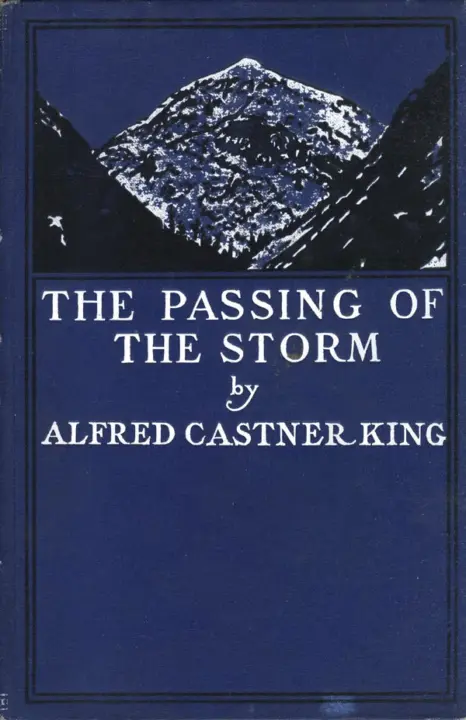
The Passing of the Storm, and Other Poems
Alfred Castner King
THE CLASSIC COLLECTION · 1901
"Mountain Idylls and Other Poems" by Alfred Castner King is a collection of lyrical poetry published in the early 20th century that reflects deep appreciation for nature and its profound impacts on the human spirit. The poems explore themes of beauty, solitude, and existential contemplation, often illustrated through vivid imagery of the Colorado mountains, highlighting an emotional connection to the natural world. The author, who faced the challenge of total blindness, infused his writings with rich descriptions and philosophical musings. The opening of this volume features a poignant preface where King shares his journey of becoming a poet, detailing the circumstances that led him to write despite his blindness. Born from personal tragedy, his work embodies a longing for beauty and understanding, revealing a sensitive exploration of both nature and human emotion. The poems introduce readers to the grandeur of mountain landscapes, the serenity of solitary moments, and reflections on life and death, captivating with their rhythmic flow and emotional depth. Overall, this introduction sets the stage for a reflective and inspiring reading experience that draws on elemental connections to the world around us.
Introduction adapted from the source catalogue; source summaries may be automatically generated.
Free to read · English · 16,603 words · No account needed
MAKE TIME FOR A GOOD BOOK
On by default. Untick to stop anonymous reading totals. Each page counts after 10 seconds in view. How this works.
Anonymous counting is on unless you have switched it off.
A wilderness of weird, fantastic shapes,
Of precipice and stern declivity;
Of dizzy heights, and towering minarets;
Colossal columns and basaltic spires
Which pointing heavenward, appeared to wave
In benediction o'er the depths beneath.
Uneven crags and cliffs of various form;
Abysmal depths, and dire profundities;
Chasms so deep and awful that the eye
Of soaring eagle dare not gaze below,
Lest, dizzied, he should lose his aerial poise,
And headlong falling, reach the gulf beneath.
Majestic turrets, and the stately dome
Which, ovaled by the slow but tireless hand
Of eons of disintegrating time,
Still with impressive aspect rears its brow
Defiant of mutation and decay.
The crevice deep and inaccessible;
Fissure and rent, where the intrusive dike's
Creative and destructive agency
Leaves many an enduring monument
Of metamorphic and eruptive power;
Of molten deluge, and volcanic flood;
Fracture and break, the silent stories tell
Of dire convulsion in the ages past;
Of subterranean catastrophe,
And cataclysm of internal force.
The trachyte wall, beseamed and battle scarred;
The porphyritic tower and citadel;
The granite ramparts and embattlements
Of nature's fort, impregnable and wild,
Stand as a symbol of eternal strength,
And hurl a challenge to the elements!
Cañons of startling and appalling depths,
With caverns, vast and gloomy, which would seem
Meet for the haunt of centaur or of gnome;
The gorgon and the labyrinthodon;
The clumsy mammoth and the dinosaur;
Or all gigantic and unwieldy shapes
Which earth has seen in the mysterious past,
Would seem in more accord and harmony
With such surroundings than the puny form
Of insignificant, conceited man.
And interspersed amid these solemn peaks
Lie many a pleasant vale and grassy slope,
Besprinkled with the drooping columbine,
And fragrant growths of all harmonious tints,
Whose variegated colors punctuate
Grandeur with beauty, and fearless, bloom
In the forbidding shadow of the cliffs,
And to the margin of the snowy combs
Which still resist the sun's persuasive ray.
A lakelet, cool, pellucid and serene,
Fed by the drippings from eternal snows,
Lies like a mirror 'neath a frowning cliff,
Or as a gem, majestically ensconced
In diadem of crag and pinnacle.
Down towards the distant valley's sultry clime,
Both solitary, and in straggling groups;
In solid phalanx, rigid and compact;
In labyrinth of branches interspread,
Impervious to the rain and midday sun;
In form spontaneous, without regard
To law of uniformity, there stand
In silent awe, or whispering to the breeze,
The sombre fir and melancholy pine.
And many a denuded avenue
Of varying and considerable width,
Cut through the growth of balsam, spruce and pine,
Which stands erect and proud on either hand,
Attests the swift and desolating force
Of fearful, devastating avalanche.
Your reading position is saved on this browser. Take it to another device with a library code. Reading pages adapt to text, rather than matching a printed edition.
Alfred Castner King
BEHIND THE BOOK
This eBook is for the use of anyone anywhere in the United States and most other parts of the world at no cost and with almost no restrictions whatsoever. You may copy it, give it away or re-use it under the terms of the Project Gutenberg License included with this eBook or online at www.gutenberg.org. If you are not located in the United States, you will have to check the laws of the country where you are located before using this eBook. Read the source licence.
The original source file, including credits and licence, is retained by this library. Request an original-format copy at no charge. Please include the book title and Project Gutenberg identifier #13809.
KEEP YOUR CURIOSITY GOING

Eric Mackay
Edmund Gosse
Sophia Margaretta Hensley
Gilbert Parker
George MacDonald

Elizabeth Bibesco