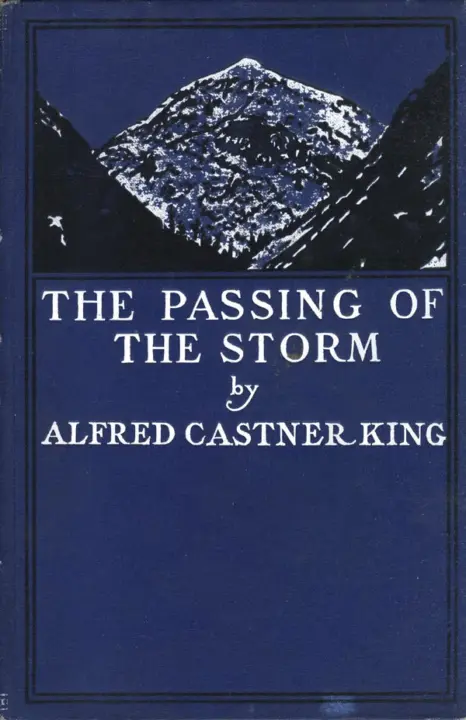
The Passing of the Storm, and Other Poems
Alfred Castner King
THE CLASSIC COLLECTION · 1901
"Mountain Idylls and Other Poems" by Alfred Castner King is a collection of lyrical poetry published in the early 20th century that reflects deep appreciation for nature and its profound impacts on the human spirit. The poems explore themes of beauty, solitude, and existential contemplation, often illustrated through vivid imagery of the Colorado mountains, highlighting an emotional connection to the natural world. The author, who faced the challenge of total blindness, infused his writings with rich descriptions and philosophical musings. The opening of this volume features a poignant preface where King shares his journey of becoming a poet, detailing the circumstances that led him to write despite his blindness. Born from personal tragedy, his work embodies a longing for beauty and understanding, revealing a sensitive exploration of both nature and human emotion. The poems introduce readers to the grandeur of mountain landscapes, the serenity of solitary moments, and reflections on life and death, captivating with their rhythmic flow and emotional depth. Overall, this introduction sets the stage for a reflective and inspiring reading experience that draws on elemental connections to the world around us.
Introduction adapted from the source catalogue; source summaries may be automatically generated.
Free to read · English · 16,603 words · No account needed
MAKE TIME FOR A GOOD BOOK
On by default. Untick to stop anonymous reading totals. Each page counts after 10 seconds in view. How this works.
Anonymous counting is on unless you have switched it off.
Is this some grand affair of state,
A coronation, or display,
By some vainglorious potentate,--
Or can this concourse mark the day
Of some victorious hero's march
Homeward, through triumphal arch?
Or, have they come to celebrate
Some sacred sacerdotal rite;
By civic feast, to emulate
Some deed, on history's pages bright?
Or can this grand occasion be
Some battle's anniversary?
But wherefore come the halt and blind?
What comfort can the pain-distressed
In such a tumult hope to find?
What is there here, to offer rest
To those, whom adverse fate has hurled,
Dismantled, on a hostile world?
Let us approach! A form we see,
Fairest beyond comparison;
For such an heavenly purity,
From other eyes, hath never shown;
Nor such a calm, majestic brow
On earth hath ne'er appeared, till now.
Draw nearer. Lo! a voice we hear,
Resonant, soft, pathetic, sweet;
In ringing accents, calm and clear,
He sways the thousands at his feet,
With more than mortal eloquence,
Or man's compassion, in his glance.
Ah! Strange, that such a form should stand
In raiment soiled, and travel stained;
Yes, mark the contour of that hand,
A hand by menial toil profaned.
Can one from such a station reach
All classes by sheer force of speech?
Can eloquence from mortal tongue
Break through the barriers, which divide
The toiling and down-trodden throng
From affluence, and official pride?
Then how can yonder speaker hold
An audience so manifold?
He spake as never orator
Before, or since, with burning thought,
In parable, and metaphor;
Each simple illustration taught
Some sacred truth, some truth which could
By sage, or fool, be understood.
With similes of common things,
The lilies of the field, the salt
Which lost its savour; gently brings
A lesson, from the common fault
Of self-admiring Pharisee,
Of ostentatious piety.
And from the prostrate penitent,
The Publican, who beat his breast,
Remorsefully his garment rent,
And thus, with tears, his sin confessed;
"Lord, Lord, a sinner vile am I,
Be merciful, and hear my cry!"
And from that man, beset by thieves,
And left upon the road, to die;
No aid or comfort he receives
From Priest, or Levite, passing by;
How the despised Samaritan
Proved the true neighbor to that man.
Yes, finished with such fervency
Of gesture, and similitude;
Such depths of love, and purity
His hearers marvelled, as they stood;
Nor through his discourse, was there heard,
Abusive, vain, or idle word.
Who may this wondrous speaker be?
Is he some judge, or orator?
Some one in high authority?
Physician, prince, or conqueror?
Answer, thou ever restless sea,
Who may this wondrous person be?
Your reading position is saved on this browser. Take it to another device with a library code. Reading pages adapt to text, rather than matching a printed edition.
Alfred Castner King
BEHIND THE BOOK
This eBook is for the use of anyone anywhere in the United States and most other parts of the world at no cost and with almost no restrictions whatsoever. You may copy it, give it away or re-use it under the terms of the Project Gutenberg License included with this eBook or online at www.gutenberg.org. If you are not located in the United States, you will have to check the laws of the country where you are located before using this eBook. Read the source licence.
The original source file, including credits and licence, is retained by this library. Request an original-format copy at no charge. Please include the book title and Project Gutenberg identifier #13809.
KEEP YOUR CURIOSITY GOING

Eric Mackay
Edmund Gosse
Sophia Margaretta Hensley
Gilbert Parker
George MacDonald

Elizabeth Bibesco