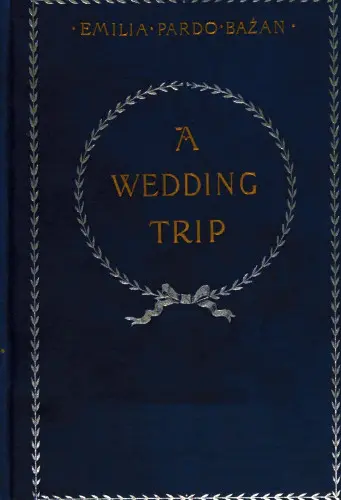
A Wedding Trip
Emilia, condesa de Pardo Bazán
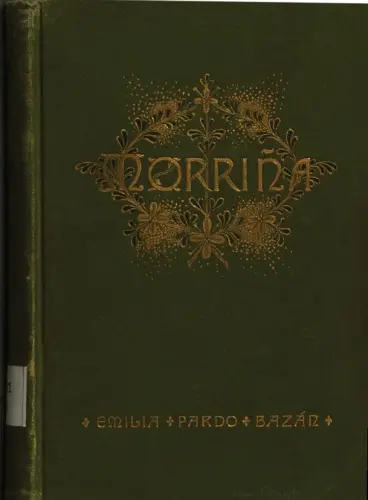
THE CLASSIC COLLECTION · 1891
"Morriña (Homesickness)" by Emilia Pardo Bazán is a novel written in the late 19th century. The story revolves around Doña Aurora de Pardiñas and her delicate son Rogelio, exploring themes of nostalgia, family, and the emotional struggles associated with homesickness. The narrative delves into their life in Madrid, characterized by the mother's unwavering affection and concern for her son, who is grappling with his identity and feelings of longing for Galicia, his homeland. At the start of the novel, we are introduced to the mundane yet intimate world of Doña Aurora and her son Rogelio as they navigate their daily routines in Madrid. Doña Aurora sits by the window, closely observing Rogelio as he attends university lectures, reflecting a mother's pride but also a deep-seated anxiety over his health. The opening describes their home filled with lighthearted banter and warmth, contrasting sharply with their underlying struggles—Doña Aurora's guilt about her son’s fragile health and Rogelio's yearning for his native Galicia. As they attempt to foster a sense of normalcy, the entry of a Galician girl, Esclavita, seeking work brings forth themes of belonging and identification, further illustrating the ties to their homeland that influence their collective experiences of homesickness.
Introduction adapted from the source catalogue; source summaries may be automatically generated.
Free to read · English · 48,045 words · No account needed
MAKE TIME FOR A GOOD BOOK
On by default. Untick to stop anonymous reading totals. Each page counts after 10 seconds in view. How this works.
Anonymous counting is on unless you have switched it off.
Esclavita took the silk necktie, and as she put it around the young man’s neck their glances met. During the previous operations this had not happened, for Rogelio’s head had been turned aside, as far as his fits of laughing would permit; but now it could not be avoided, for Esclavita’s face was raised, and Rogelio, taller than she, looked, of necessity, into her eyes, green, shot with golden lights; and the parting of the hair, straight and even, like a furrow cut through a field of ripe grain; and her rounded forehead, smooth and fine, and the little blue veins in her temples and eyelids. He inhaled her sweet breath, that intoxicated him for a moment, as if he had opened a jar of oxygen.
It was but for a moment, but it was a moment which seemed to Rogelio a year. Childhood, with its butterfly lightness, its blue and silvery skies, was left behind forever. Esclavita, having finished tying the cravat, drew back to a little distance, the better to observe the effect of the bow.
It was as if the communication between the wire and the battery had been interrupted. Rogelio came to his senses. “How disgraceful!” he thought. “What a vexation for my mother!”
The precepts of morality, which others learn as a rational necessity and a compulsory duty, or as a part of their religion, Rogelio, who as an only son, had been petted and spoiled, had learned through the medium of his feelings. All his ideas of decorum, of goodness, of rectitude, had come to him by this indirect but pleasant path. “Ah! what a grief it would be to me, child, if you were to do such or such a thing!” his mother used to say. “Heavens! what a mortification for me if you should commit this or that fault!” Thus it was that, without being conscious of it, what Rogelio first considered in all his actions was the effect they would be apt to produce on his mother’s feelings; and this was now his first thought when the vertigo passed away that had obscured his reason, while the girl was close beside him. When Esclavita had left the room his very want of confidence in himself made him take an honorable resolve, that of avoiding fresh temptations and still greater dangers. These resolutions are difficult to keep when the temptation is close at hand. Rogelio felt his first desire return to him continually, and the same fumes mount into his brain, like puffs of hot air. At table; when she came to his room, bringing the light, or some message, or his linen, he could not help devouring her with his eyes, following the perfect lines of her slender form, noting the grace and lightness of her movements. The stronger and more passionate his desire, the more embarrassed did he feel himself in the girl’s presence. When with her it seemed to him impossible that he should ever venture to pay her a serious compliment; while in the solitude of his own room at night, unable to sleep, and tossing about restlessly in his narrow bed, he felt himself equal to any undertaking, no absurdity seemed to him unreasonable, and he even thought--strange effect of passion--that it was his bounden duty to do what in the light of day he regarded as a crime and an act of madness. “And then,” he said to himself, “no one can call me a child any longer, and I shall be fully convinced myself that I am not one.” This absurd idea vanished in the morning, when his mother, according to her old affectionate habit, brought him his chocolate. When he saw Doña Aurora, dressed in her plaid morning gown, come into his room with the tray in her hands, when he tasted the fresh biscuit, the spoiled child felt all the power of the moral law imposing itself upon him with apodictic force; and precepts, unknown or denied a few moments before, now presented themselves to him clearly, significantly, plainly. “To give mamma cause for grief--it makes me shudder even to think of it; it would be unpardonable. Even though she should not discover it I should fancy she was reading it in my eyes, in my very breathing. And she would discover it,--she would discover it, there is not a doubt of it. Mamma is very shrewd, easy-going and good-natured as she appears. No one can throw dust in her eyes. She knows me so well that before the words were out of my mouth she can tell what I am going to say. As she cares for no one and thinks of nothing but me. God grant I may never give her cause for grief.”
Your reading position is saved on this browser. Take it to another device with a library code. Reading pages adapt to text, rather than matching a printed edition.
Emilia, condesa de Pardo Bazán
Emilia, condesa de Pardo Bazán
BEHIND THE BOOK
This eBook is for the use of anyone anywhere in the United States and most other parts of the world at no cost and with almost no restrictions whatsoever. You may copy it, give it away or re-use it under the terms of the Project Gutenberg License included with this eBook or online at www.gutenberg.org. If you are not located in the United States, you will have to check the laws of the country where you are located before using this eBook. Read the source licence.
The original source file, including credits and licence, is retained by this library. Request an original-format copy at no charge. Please include the book title and Project Gutenberg identifier #54742.
KEEP YOUR CURIOSITY GOING
Coulson Kernahan

Maurice Baring
Frances Wright
Cécile Tormay

Frederic Jesup Stimson

W. H. P. (William Henry Pope) Jarvis