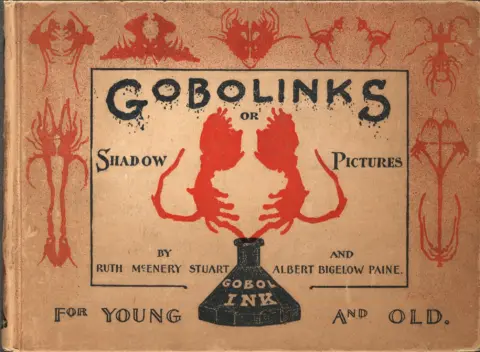
Gobolinks; or, Shadow Pictures for Young and Old
Ruth McEnery Stuart & Albert Bigelow Paine
THE CLASSIC COLLECTION · 1898
"Moriah's Mourning and Other Half-Hour Sketches" by Ruth McEnery Stuart is a collection of short stories written in the late 19th century. The sketches revolve around life in the plantation communities, focusing on the humorous and poignant experiences of African American characters, particularly reflecting on their customs, relationships, and societal norms. The opening story introduces Moriah, a widow who, despite her recent loss, becomes the topic of lively gossip when she announces her intention to remarry just a month after her husband's death. At the start of the collection, the stage is set through Moriah's character, who embodies a strong sense of individuality and resilience. The narrative follows her decision to marry Pete, a widower, emphasizing the community's reactions to her quick transition from mourning to new beginnings. Moriah’s pragmatic and humorous approach to grief reveals the nuanced dynamics of love, loss, and social expectations among the plantation folk. The blend of humor and social commentary in these opening pages suggests that the collection will explore deeper themes of mortality, relationship dynamics, and cultural practices in a light-hearted yet insightful manner.
Introduction adapted from the source catalogue; source summaries may be automatically generated.
Free to read · English · 37,467 words · No account needed
MAKE TIME FOR A GOOD BOOK
On by default. Untick to stop anonymous reading totals. Each page counts after 10 seconds in view. How this works.
Anonymous counting is on unless you have switched it off.
Years ago this man left his wife, for a price, to another who had betrayed her, and disappeared from the scene of his ignominy. When the woman was dead and her betrayer gone, the husband came back, an old man; and now, as I see him bending beneath its weight, the hump upon his shoulder seems to be labelled with this price which, in my imagination, though originally the bag of gold, has by a slow and chemically unexplained process of ossification, become a part of himself, and will grotesquely deform his skeleton a hundred years to come. When, morning and evening, I see this old man trudge laboriously, staggering always towards the left, down the street, until he disappears in the clump of willows that overshadow the cemetery gate, and I know that he is going for a lonely vigil to the grave of the dishonored woman, his lost wife, pain, keen as a Damascus blade, enters my heart.
I close my window and come in, for the night dews are falling and I am rheumatic and stiff in the legs.
So, every night, musing, I go early to my bed, but before I lie down, after my prayer is said, I rise to put fresh water in the vase of flowers, which are always fresh, beneath the picture upon my wall.
For one moment I stand and gaze into a pure, girlish face, with a pallid brow and far-away blue eyes.
She was only fifteen years old, and I twice as many, when we quarrelled
like foolish children.
The day she married my brother--my youngest, best-beloved brother
Benjamin--I laid this miniature, face downward, in a secret drawer of my
desk.
In the first year she died, and in another Benjamin had taken to himself a new wife, with merrier eyes and ruddier lips.
My heart leaped within me when I kissed my new sister, but she knew not that my joy was because she was giving me back my love.
Trembling with ecstasy, I took this image from its hiding-place, and for nearly fifty years the flowers beneath it have not withered.
As I stood alone here one night, ere I knew he had entered, my little brother's hand was upon my shoulder. For a moment only he was silent, awe-stricken.
"She was always yours, my brother," he said, presently, in a tremulous whisper. "I did not know until it was too late. She had misunderstood--but God was very merciful," and turning he left her to me.
And still each day I lay fresh flowers at her shrine, cherishing the dart that rends my heart the while, for its testimony to the immortality of my passion.
Your reading position is saved on this browser. Take it to another device with a library code. Reading pages adapt to text, rather than matching a printed edition.
Ruth McEnery Stuart & Albert Bigelow Paine
Ruth McEnery Stuart
Ruth McEnery Stuart
Ruth McEnery Stuart
BEHIND THE BOOK
This eBook is for the use of anyone anywhere in the United States and most other parts of the world at no cost and with almost no restrictions whatsoever. You may copy it, give it away or re-use it under the terms of the Project Gutenberg License included with this eBook or online at www.gutenberg.org. If you are not located in the United States, you will have to check the laws of the country where you are located before using this eBook. Read the source licence.
The original source file, including credits and licence, is retained by this library. Request an original-format copy at no charge. Please include the book title and Project Gutenberg identifier #20438.
KEEP YOUR CURIOSITY GOING
Coulson Kernahan

Maurice Baring
Frances Wright
Cécile Tormay

Frederic Jesup Stimson

W. H. P. (William Henry Pope) Jarvis