THE CLASSIC COLLECTION✦The Early Life of Mark Rutherford (W. Hale White)CLASSIC FREE BOOKS
The Early Life of Mark Rutherford (W. Hale White)
William Hale White
THE CLASSIC COLLECTION · 1910
"More Pages from a Journal" by William Hale White is a collection of fictional essays written in the late 19th century. The narrative captures the lives and thoughts of various characters navigating social interactions, personal struggles, and existential dilemmas within the confines of a boarding house in Brighton, England. The opening chapters present Miss Toller, a boarding house keeper, alongside her lodgers, including the widowed Mrs. Poulter, the clergyman Mr. Goacher, and the self-sufficient Miss Everard, exploring themes of class, social status, and human connection during a Christmas set against a backdrop of introspection and emotional complexity. The opening of the book introduces Miss Toller, her modest lodgings, and her interactions with the eclectic group of boarders living in Russell House. Each character is introduced with a backstory, revealing their unique motivations, relationships, and conflicts. The narrative delves into Christmas preparations and heated discussions among the lodgers, centering around social niceties and underlying tensions regarding class distinctions. Miss Toller, caught between her obligations to her lodgers and her own sense of self-worth, faces an internal struggle as she contemplates her past and the sacrifices she has made. The portrayal of these characters and their dynamics sets the stage for a rich exploration of themes such as resilience, connection, and the sometimes harsh realities of social life.
Introduction adapted from the source catalogue; source summaries may be automatically generated.
Free to read · English · 57,847 words · No account needed
MAKE TIME FOR A GOOD BOOK
On by default. Untick to stop anonymous reading totals. Each page counts after 10 seconds in view. How this works.
Anonymous counting is on unless you have switched it off.
Coleridge! Coleridge! How empty do the sweeping judgments passed on him appear if we recollect that by Wordsworth, Dorothy, Charles and Mary Lamb, he was honoured and fervently loved. If a man is loved by any human being condemnation is rash, and we ought at least to be silent.
Wandered about Holford. The apple-trees are in full blossom. One of them was a particularly exquisite survival of youth in old age. Its head was a white-and-pink mass, but it leaned almost horizontally, battered and weather-worn.
Thunder off and on all day till the afternoon. A low grey mist covered the whole sky at five o’clock, and the landscape was uninteresting, but in ten minutes the mist thinned a little, so that the sun came through it and lighted up the torn vapour.
Went over to East Quantock’s Head and came back across the hill. It was a dark day; the sky was overcast, and the moors were very lonely. The thought of London and other big cities over the horizon somewhat marred the solitude. Nevertheless there are the deserts of Arabia and Africa, the regions of the North and South Poles, the Ocean, and, encompassing the globe itself, silent, infinite space.
To Nether Stowey and Tom Poole’s house. In the hideous church is a monument to him fairly appreciative, but disfigured by snobbism. ‘His originality and grasp of mind,’ says the inscription, ‘counterbalanced the deficiencies of early education and secured him the friendship,’ etc. His ‘originality and grasp of mind’—his soul, that is to say, managed, when put in the scale, to turn it against those deficiencies which are made good to youths providentially directed to Eton and Oxford. According to the slab in the church, Poole died 8th September 1837, seventy-two years old. The house in which he lived in his later years is a pleasant place, but has been tortured into modern gentility. His revolving grate, which he turned round when he went out, has been replaced by an approved cast-iron ‘register.’ He was called ‘Justice Poole’ in the country round. Afterwards to Coleridge’s cottage—small, somewhat squalid rooms. Pity, pity, almost to tears. The second edition of his poems was published while he was here in 1797. In a note added to Religious Musings in that edition he declares his belief in the Millennium; that ‘all who in past ages have endeavoured to ameliorate the state of man, will rise and enjoy the fruits and flowers, the imperceptible seeds of which they had sown in their former life; and that the wicked will, during the same period, be suffering the remedies adapted to their several bad habits.’ This period is to be ‘followed by the passing away of this earth, and by our entering the state of pure intellect; when all creation shall rest from its labours.’ The ‘coadjutors of God’ in Religious Musings are Milton, Newton, Hartley, and Priestley. In the beginning of 1798 Coleridge was preaching at the Unitarian Chapel at Shrewsbury. But on the 13th November 1797, at half-past four in the afternoon (let us be particular in dating such an event), he and Dorothy and her brother began their walk over these Quantock hills, and The Ancient Mariner was born. These are the facts, and rash indeed would anybody be who should attempt to deduce anything from them. Of all foolish criticism there is none more foolish than that which treats the mental movement of men like Coleridge or Wordsworth as if it were in an imaginary straight line. Excepting lines 123–270, composed in the latter part of 1796, Coleridge wrote his contribution to Joan of Arc between 1794 and 1795. The Rose and Kisses were written in 1793, and On a Discovery Made Too Late in 1794. Could anybody, not knowing the dates, have believed that these three poems last-named, if not written before the Joan of Arc, were contemporaneous with it? In the Joan of Arc Coleridge is immature and led astray by politics, religion, and philosophy, but in the three little poems where he has subjects akin to him he is perfect, and could have done nothing better ten years later. Still more remarkable, Lewti, in its earliest form, cannot have been written later than 1794, for it was originally addressed to Mary Evans, from whom Coleridge parted in December 1794. As an example of the survival of his poetic power take Love’s First Hope, written probably in 1824:
Your reading position is saved on this browser. Take it to another device with a library code. Reading pages adapt to text, rather than matching a printed edition.
William Hale White
William Hale White
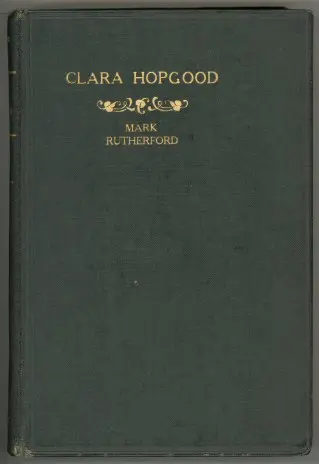
William Hale White
BEHIND THE BOOK
This eBook is for the use of anyone anywhere in the United States and most other parts of the world at no cost and with almost no restrictions whatsoever. You may copy it, give it away or re-use it under the terms of the Project Gutenberg License included with this eBook or online at www.gutenberg.org. If you are not located in the United States, you will have to check the laws of the country where you are located before using this eBook. Read the source licence.
The original source file, including credits and licence, is retained by this library. Request an original-format copy at no charge. Please include the book title and Project Gutenberg identifier #6404.
KEEP YOUR CURIOSITY GOING

David Patterson (Spirit) Hatch

David Patterson (Spirit) Hatch

David Patterson (Spirit) Hatch
Coulson Kernahan

Ralph Waldo Emerson

Maurice Baring