Misrepresentative Women
Harry Graham
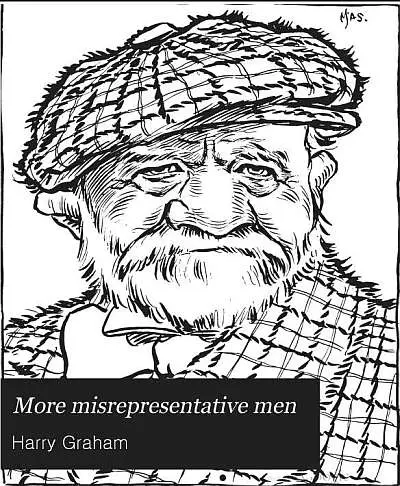
THE CLASSIC COLLECTION · 1905
"More Misrepresentative Men" by Harry Graham is a collection of satirical verse published in the early 20th century. This book continues the themes of humor and social commentary found in Graham's earlier works, featuring whimsical takes on various historical and contemporary figures. The collection is characterized by its witty, light-hearted tone and clever rhymes that poke fun at the foibles and idiosyncrasies of its subjects. The book presents a series of poems, each dedicated to a different character or figure, ranging from famous historical figures like Robert Burns and Henry VIII to modern personalities such as Andrew Carnegie and Sherlock Holmes. Each poem captures the essence of its subject while playfully critiquing their lives or legacies. Graham combines humor with insightful observations, drawing connections between the trivialities of human nature and the grand themes of societal norms. Overall, "More Misrepresentative Men" offers readers a delightful and engaging critique of both historical and contemporary personas through the lens of clever poetic satire.
Introduction adapted from the source catalogue; source summaries may be automatically generated.
Free to read · English · 6,569 words · No account needed
MAKE TIME FOR A GOOD BOOK
On by default. Untick to stop anonymous reading totals. Each page counts after 10 seconds in view. How this works.
Anonymous counting is on unless you have switched it off.
In pencil, on his shirt-cuff, he,
Without a moment's hesitation,
Elucidated easily
The most elab'rate calculation
(His washing got, I needn't mention,
The local laundry's best attention).
Behind a manner mild as mouse,
Blue-spectacled and inoffensive,
He hid a judgment and a nous
As overwhelming as extensive,
And cloaked a soul immune from wrong
Beneath an ample ong-bong-pong.
To rows of conscientious youths,
Whom 'twas his duty to take care of,
He loved to prove the truth of truths
Which they already were aware of;
They learnt to look politely bored,
Where modern students would have snored.
To show that Two and Two make Four,
That All is greater than a Portion,
Requires no dialectic lore,
Nor any cerebral contortion;
The public's faith in facts was steady,
Before the days of Mrs. Eddy.
But what was hard to overlook
(From which Society still suffers)
Was all the trouble Euclid took
To teach the game of Bridge to duffers.
Insisting, when he got a quorum,
On "Pons" (he called it) "Asinorum."
The guileless methods of his game
Provoked his partner's strongest strictures;
He hardly knew the cards by name,
But realised that some had pictures;
Exhausting ev'rybody's patience
By his perpetual revocations.
For weary hours, in deep concern,
O'er dummy's hand he loved to linger,
Denoting ev'ry card in turn,
With timid indecisive finger;
And stopped to say, at each delay,
"I really don't know what to play!"
He sought, at any cost, to win
His ev'ry suit in turn unguarding;
He trumped his partner's "best card in,"
His own egregiously discarding;
Remarking sadly, when in doubt,
"I quite forgot the King was out!"
Alert opponents always knew,
By what the look upon his face was,
When safety lay in leading through,
And where, of course, the fatal ace was;
Assuring the complete successes
Of bold but hazardous "finesses."
But nowadays we find no trace,
From distant Assouan to Cairo,
To mark the place where dwelt a race
Mistaught by so absurd a tyro;
And nothing but occult inscriptions
Recall the sports of past Egyptians.
Yes, "autre temps" and "autre moeurs,"
"Ou sont indeed les neiges d'antan?"
The modern native much prefers
Debauching in some cafe chantant,
Nor ever shows the least ambition
To solve a single Proposition.
O Euclid, luckiest of men!
You knew no English interloper;
For Allah's Garden was not then
The pleasure-ground of Alleh Sloper,
Nor (broth-like) had your country's looks
Been spoilt by an excess of "Cooks."
The Nile to your untutored ears
Discoursed in dull but tender tones;
Not yours the modern Dahabeahs,
Supplied with strident gramophones,
Imploring, in a loud refrain,
Bill Bailey to come home again.
Your reading position is saved on this browser. Take it to another device with a library code. Reading pages adapt to text, rather than matching a printed edition.
Harry Graham
Harry Graham
Harry Graham
Harry Graham
BEHIND THE BOOK
This eBook is for the use of anyone anywhere in the United States and most other parts of the world at no cost and with almost no restrictions whatsoever. You may copy it, give it away or re-use it under the terms of the Project Gutenberg License included with this eBook or online at www.gutenberg.org. If you are not located in the United States, you will have to check the laws of the country where you are located before using this eBook. Read the source licence.
The original source file, including credits and licence, is retained by this library. Request an original-format copy at no charge. Please include the book title and Project Gutenberg identifier #36782.
KEEP YOUR CURIOSITY GOING
Eric Mackay
Edmund Gosse
Sophia Margaretta Hensley
Gilbert Parker
George MacDonald
Elizabeth Bibesco