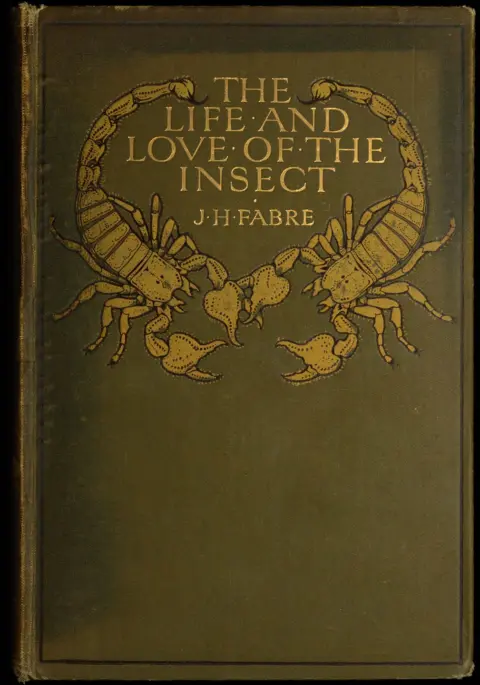
The Life and Love of the Insect
Jean-Henri Fabre
THE CLASSIC COLLECTION · 1921
"More Hunting Wasps" by Jean-Henri Fabre is a scientific publication written in the late 19th century. This work is part of a series of essays on wasps, offering a detailed examination of their behaviors, particularly focusing on the hunting wasps and the intricate relationships they form with their prey, particularly spiders and beetle larvae. The text explores the hunting techniques of various wasps, particularly the Pompilus and the Scoliae, providing insights into their life cycles and feeding habits. At the start of the book, Fabre delves into the behaviors of the Pompilus, a type of spider-hunting wasp, emphasizing the challenges these insects face when capturing powerful spiders like the Black-bellied Tarantula. He recounts his observations of a particular Pompilus as she hunts, successfully overcoming the spider's defenses through craft and speed rather than brute strength. Fabre details the delicate balance of power between the predator and prey, introducing various strategies the wasp employs to capture its quarry, laying the groundwork for understanding the complexities of wasp predation. As the chapter progresses, Fabre raises questions about the evolutionary adaptations of both the wasps and their prey, setting the stage for deeper explorations of insect behavior throughout the rest of the volume.
Introduction adapted from the source catalogue; source summaries may be automatically generated.
Free to read · English · 76,513 words · No account needed
MAKE TIME FOR A GOOD BOOK
On by default. Untick to stop anonymous reading totals. Each page counts after 10 seconds in view. How this works.
Anonymous counting is on unless you have switched it off.
Dog (see also Bull).
Drone-fly.
Dufour, Jean Marie Leon.
Duges, Louis Antoine.
Earth-worm.
Eight-spotted Pompilus.
Empusa.
Epeira (see also the varieties below).
Epeira fasciata (see Banded Epeira).
Epeira serica (see Silky Epeira).
Ephippiger.
Eristalis E. tenax (see Drone-fly).
Eucera.
Euchlora Julii.
Eumenes (see also Amedeus Eumenes).
Fabricius, Johan Christian.
Favier, the author's factotum.
Ferrero's Cerceris.
Field-mouse.
Fly (see also Gad-fly, House-fly).
Fox.
Frog.
Gad-fly.
Galileo.
Garden Scolia.
Garden Spider (see Epeira).
Geonomus.
Girdled Dioxys.
Gnat.
Goat.
Goatsucker (see Nightjar).
Golden Cetonia.
Golden-crested Wren.
Golden-mouthed Hornet.
Golden Osmia.
Gorilla.
Grasshopper.
Great Cellar Spider (see Cellar Spider).
Great Cerceris.
Grey Mantis.
Grey Worm.
Hairy Ammophila.
Halictus.
Harlequin Calicurgus.
Hedgehog.
Helophilus pendulus.
Hemorrhoidal Scolia.
Hen.
Herring.
Hive-bee.
Hog.
Hornet (see also Golden-mouthed Hornet).
House-fly.
Interrupted Scolia.
Jules, Ammophila.
Klug.
Lalande, Joseph Jerome Le Francais de.
Lamellicorn.
Languedocian Sphex.
Lark.
Latreille, Pierre Andre.
Leucopsis gigas, L. grandis.
Lily-beetle.
Linnet.
Locust.
Looper.
Lycosa (see Black-bellied Tarantula).
Macmillan Co.
Mantis (see also Grey Mantis, Praying Mantis).
Mantis-hunting Tachytes (see Mantis-killing Tachytes).
Mantis-killing Tachytes.
Mariotte, Edme.
Mason-bee (see also the Anthophora and the varieties below).
Mason-bee of the Pebbles (see Mason-bee of the Walls).
Mason-bee of the Sheds.
Mason-bee of the Shrubs.
Mason-bee of the Walls.
Measuring-worm (see Looper).
Megachile sericans.
Melanophora.
Meloe (see Oil-beetle).
Miall, Bernard.
Midge.
Mithradates VI.
Mole.
Mole-cricket.
Monkey.
Monoceros (see Oryctes nasicornis).
Morning Anoxia.
Mosquito.
Moth.
Mule.
Muscid (see House-fly).
Mylabris.
Narbonne Lycosa (see Black-bellied Tarantula).
Nest-building Odynerus.
Nightjar.
Nut-weevil.
Odynerus (see also Nest-building Odynerus).
Oil-beetle.
Ornate Cerceris.
Oryctes nasicornis.
Oryctes Silenus.
Osmia (see also the varieties below).
Osmia cyanea (see Blue Osmia).
Osmia cyanoxantha.
Osmia Latreillii (see Latreille's Osmia).
Osmia parvula (see Tiny Osmia).
Osmia tricornis (see Three-horned Osmia).
Ostrich.
Otiorhynchus.
Palarus (see also Palarus flavipes).
Palarus flavipes.
Pangonia.
Panzer's Tachytes.
Paragus.
Pascal, Blaise.
Passerini.
Pea-weevil.
Pelopaeus.
Pentodon punctatus.
Perez, J.
Phaneropteron falcata.
Philanthus (see also the varieties below).
Philanthus apivorus (see Bee-eating Philanthus).
Philanthus coronatus (see Crowned Philanthus).
Philanthus raptor (see Robber Philanthus).
Phynotomus.
Pieris (see Cabbage Pieris).
Pig.
Pine-chafer.
Pithecanthropus.
Plant-louse.
Pompilus (see also the varieties below).
Pompilus annulatus (see Ringed Calicurgus).
Pompilus apicalis.
Pompilus octopunctatus (see Eight-spotted Pompilus).
Poplar Leaf-Beetle.
Praying Mantis.
Pubescent Brachyderes.
Rat.
Resin-bee (see Anthidium bellicosum, Anthidium septemdentatum).
Rhinoceros Beetle (see Oryctes nasicornis).
Rhynchites betuleti.
Ringed Calicurgus.
Ringed Pompilus (see Ringed Calicurgus).
Robber Philanthus.
Robber-fly.
Robin.
Romanes, George John.
Rose-chafer (see Cetonia, Golden Cetonia).
Rostrate Bembex.
Sand Cerceris.
Sandy Ammophila.
Sapyga punctata (see Spotted Sapyga).
Sarcophaga.
Scarabaeid.
Scarabaeus pentodon.
Scolia (see also the varieties below).
Scolia bifasciata (see Two-banded Scolia).
Scolia haemorrhoidalis (see Hemorrhoidal Scolia).
Scolia hortorum (see Garden Scolia).
Scolia interrupta (see Interrupted Scolia).
Screech-owl.
Seal.
Segestria perfidia (see Cellar Spider).
Shaggy Anoxia.
Sheep.
Silkworm.
Silky Ammophila.
Silky Epeira.
Silky Leaf-cutter (see Megachile sericans).
Your reading position is saved on this browser. Take it to another device with a library code. Reading pages adapt to text, rather than matching a printed edition.
Jean-Henri Fabre
Jean-Henri Fabre
Jean-Henri Fabre
Jean-Henri Fabre
BEHIND THE BOOK
This eBook is for the use of anyone anywhere in the United States and most other parts of the world at no cost and with almost no restrictions whatsoever. You may copy it, give it away or re-use it under the terms of the Project Gutenberg License included with this eBook or online at www.gutenberg.org. If you are not located in the United States, you will have to check the laws of the country where you are located before using this eBook. Read the source licence.
The original source file, including credits and licence, is retained by this library. Request an original-format copy at no charge. Please include the book title and Project Gutenberg identifier #3462.
KEEP YOUR CURIOSITY GOING

John Muir

Asa Gray
Asa Gray

Florence Nightingale
Elizabeth Robins Pennell
Denison Olmsted