THE CLASSIC COLLECTION✦Nigeria and its tin fieldsCLASSIC FREE BOOKS
Nigeria and its tin fields
Albert Frederick Calvert
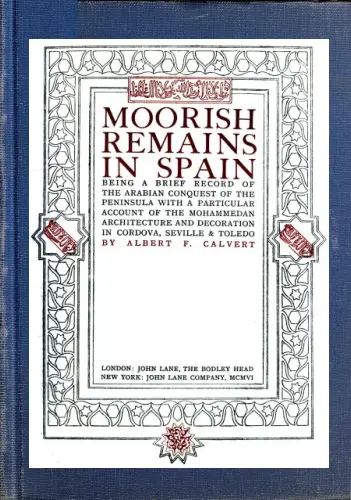
THE CLASSIC COLLECTION · 1906
"Moorish Remains in Spain" by Albert Frederick Calvert is a historical account likely written in the early 20th century. The book delves into the impact of the Arabian conquest of the Iberian Peninsula, with a keen focus on the architectural and decorative contributions of the Moors in significant cities like Cordova, Seville, and Toledo. It captures the essence of Moorish artistry and its historical significance in shaping Spain's cultural landscape. The opening of the volume introduces the author's dedication to King Alfonso XIII, reflecting the immense interest in Moorish monuments in Spain. It outlines the author's journey of discovery, revealing a broader array of Moorish architecture and art beyond the well-known Alhambra. Calvert emphasizes the historical narrative of the Moors in Spain, discussing their initial conquest, the establishment of their rule, and their lasting contributions that remain visible today. He expresses a desire to transport readers through visual representations, presenting a vivid tapestry of the Moorish influence that shaped not only the architectural heritage but also the cultural identity of Spain.
Introduction adapted from the source catalogue; source summaries may be automatically generated.
Free to read · English · 59,173 words · No account needed
MAKE TIME FOR A GOOD BOOK
On by default. Untick to stop anonymous reading totals. Each page counts after 10 seconds in view. How this works.
Anonymous counting is on unless you have switched it off.
“‘Praised be God, who has increased the glory of Islam, thanks to the sword of the champion of the Faith, and who, in his Holy Book, has promised aid and victory to the believer.
“‘Allah scatters his benefits over the world.
“‘If he did not impel men to dash armed against each other, the earth
would be lost.
“‘Allah has ordered that the people be fought against until they know
there is but one God.
“‘The flame of war will not be extinguished until the end of the world.
“‘The Divine benediction will fall upon the mane of the war-horse until
the Day of Judgment.
“‘Be you armed from head to foot, or only lightly armed, rise, and take
your departure.
“‘O, believers! what will become of you if, when you are called to battle, you remain with your face turned toward the ground?
“‘Do you prefer the life of this world to that of the future?
“‘Believe me: the gates of paradise stand in the shadow of the sword.
“‘He who dies in battle for the cause of God, washes with the blood he sheds all the stains of his sins.
“‘His body will not be washed like the other bodies, because in the Day of Judgment his wounds will send out a fragrance like musk.
“‘When the warriors shall present themselves at the Gates of Paradise, a voice from within will ask: “What have you done during your life?”
“‘And they will reply: “We have brandished the sword in the struggle for the cause of God.”
“‘Then the eternal Gates will open, and the warriors will enter forty years before the others.
“‘Up, then, O believers! Abandon women, children, brothers, and worldly possessions, and go forth to the holy war!
“‘And thou, O God, Lord of the present and future world, fight for the armies of those who recognise thy Unity! Destroy the incredulous, idolaters, and enemies of thy holy faith! Overthrow their standards, and give them, with all they possess, as booty to the Mussulmans!’”
The preacher, when he has finished his discourse, exclaims, turning towards the congregation: “Ask of God!” and prays in silence. All the faithful, touching the ground with their foreheads, follow his example. The “mubaliges” sing: “Amen! Amen, O Lord of all beings!” Like the intense heat which precedes the tempest, the enthusiasm of the multitude (restrained, up to this time, in a marvellous silence) breaks out in loud murmurs, which, rising like the waves of the sea, and inundating the temple, finally make the echo of a thousand united voices resound through the naves, chapels, and vaults in one single shout: “There is no God but Allah!”
Your reading position is saved on this browser. Take it to another device with a library code. Reading pages adapt to text, rather than matching a printed edition.
Albert Frederick Calvert
Albert Frederick Calvert
Albert Frederick Calvert
Albert Frederick Calvert
BEHIND THE BOOK
This eBook is for the use of anyone anywhere in the United States and most other parts of the world at no cost and with almost no restrictions whatsoever. You may copy it, give it away or re-use it under the terms of the Project Gutenberg License included with this eBook or online at www.gutenberg.org. If you are not located in the United States, you will have to check the laws of the country where you are located before using this eBook. Read the source licence.
The original source file, including credits and licence, is retained by this library. Request an original-format copy at no charge. Please include the book title and Project Gutenberg identifier #59776.
KEEP YOUR CURIOSITY GOING
Cécile Tormay

Moritz Busch
John L. Ransom
Frances Wright
Cécile Tormay

Mabel Potter Daggett