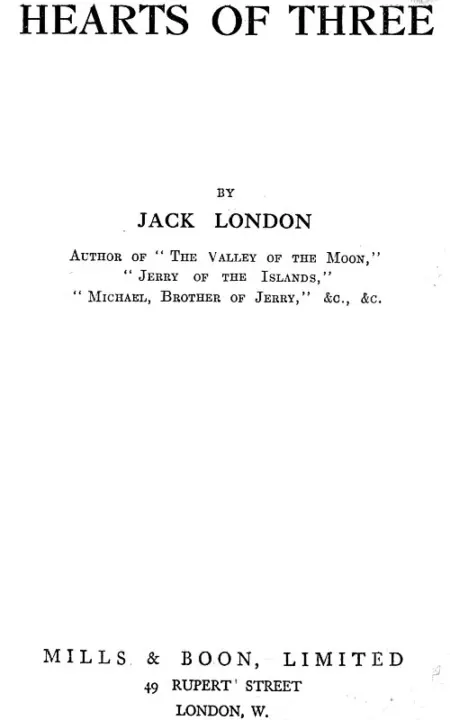
Hearts of three
Jack London
THE CLASSIC COLLECTION · 1906
"Moon-Face, and Other Stories" by Jack London is a collection of short stories likely written during the early 20th century. The first story, "Moon-Face," delves into themes of jealousy and the dark urges of the human psyche, centering on a character named John Claverhouse, who is described as a jovial man with an annoying, infectious laugh that drives the narrator into a rage and eventually leads him to contemplate murder. The opening of the book introduces us to the narrator’s intense dislike for John Claverhouse, whose very existence seems to irk him. The narrator reveals a series of petty, spiteful actions meant to disrupt Claverhouse's happiness, culminating in darkly constructed plans to eliminate him. The story captures the narrator's internal turmoil as he becomes increasingly obsessed with Claverhouse’s optimism and laughter, which he finds intolerable. This introduction hints at a suspenseful narrative filled with psychological conflict, setting the tone for a gripping exploration of human emotions and moral ambiguity.
Introduction adapted from the source catalogue; source summaries may be automatically generated.
Free to read · English · 48,691 words · No account needed
MAKE TIME FOR A GOOD BOOK
On by default. Untick to stop anonymous reading totals. Each page counts after 10 seconds in view. How this works.
Anonymous counting is on unless you have switched it off.
“What was that you said about Dolly’s never cutting up?” he asked, when the blood had been stanched and his nerves and pulse-beats were normal again.
“I am stunned,” Lute answered. “I cannot understand it. She never did anything like it in all her life. And all animals like you so—it’s not because of that. Why, she is a child’s horse. I was only a little girl when I first rode her, and to this day—”
“Well, this day she was everything but a child’s horse,” Chris broke in. “She was a devil. She tried to scrape me off against the trees, and to batter my brains out against the limbs. She tried all the lowest and narrowest places she could find. You should have seen her squeeze through. And did you see those bucks?”
Lute nodded.
“Regular bucking-bronco proposition.”
“But what should she know about bucking?” Lute demanded. “She was never known to buck—never.”
He shrugged his shoulders. “Some forgotten instinct, perhaps, long-lapsed and come to life again.”
The girl rose to her feet determinedly. “I’m going to find out,” she
said.
They went back to the horses, where they subjected Dolly to a rigid examination that disclosed nothing. Hoofs, legs, bit, mouth, body—everything was as it should be. The saddle and saddle-cloth were innocent of bur or sticker; the back was smooth and unbroken. They searched for sign of snake-bite and sting of fly or insect, but found nothing.
“Whatever it was, it was subjective, that much is certain,” Chris said.
“Obsession,” Lute suggested.
They laughed together at the idea, for both were twentieth-century products, healthy-minded and normal, with souls that delighted in the butterfly-chase of ideals but that halted before the brink where superstition begins.
“An evil spirit,” Chris laughed; “but what evil have I done that I should be so punished?”
“You think too much of yourself, sir,” she rejoined. “It is more likely some evil, I don’t know what, that Dolly has done. You were a mere accident. I might have been on her back at the time, or Aunt Mildred, or anybody.”
As she talked, she took hold of the stirrup-strap and started to shorten
it.
“What are you doing?” Chris demanded.
“I’m going to ride Dolly in.”
“No, you’re not,” he announced. “It would be bad discipline. After what has happened I am simply compelled to ride her in myself.”
But it was a very weak and very sick mare he rode, stumbling and halting, afflicted with nervous jerks and recurring muscular spasms—the aftermath of the tremendous orgasm through which she had passed.
Your reading position is saved on this browser. Take it to another device with a library code. Reading pages adapt to text, rather than matching a printed edition.
Jack London
Jack London
Jack London
Jack London
BEHIND THE BOOK
This eBook is for the use of anyone anywhere in the United States and most other parts of the world at no cost and with almost no restrictions whatsoever. You may copy it, give it away or re-use it under the terms of the Project Gutenberg License included with this eBook or online at www.gutenberg.org. If you are not located in the United States, you will have to check the laws of the country where you are located before using this eBook. Read the source licence.
The original source file, including credits and licence, is retained by this library. Request an original-format copy at no charge. Please include the book title and Project Gutenberg identifier #1089.
KEEP YOUR CURIOSITY GOING
Coulson Kernahan

Maurice Baring
Frances Wright
Cécile Tormay

Frederic Jesup Stimson

W. H. P. (William Henry Pope) Jarvis