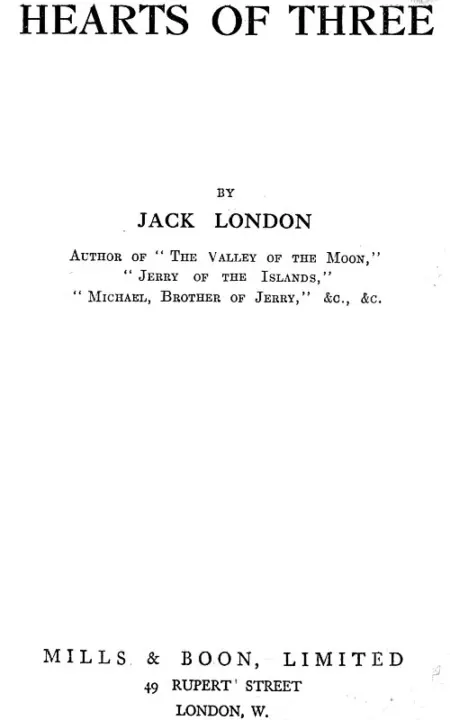
Hearts of three
Jack London
THE CLASSIC COLLECTION · 1906
"Moon-Face, and Other Stories" by Jack London is a collection of short stories likely written during the early 20th century. The first story, "Moon-Face," delves into themes of jealousy and the dark urges of the human psyche, centering on a character named John Claverhouse, who is described as a jovial man with an annoying, infectious laugh that drives the narrator into a rage and eventually leads him to contemplate murder. The opening of the book introduces us to the narrator’s intense dislike for John Claverhouse, whose very existence seems to irk him. The narrator reveals a series of petty, spiteful actions meant to disrupt Claverhouse's happiness, culminating in darkly constructed plans to eliminate him. The story captures the narrator's internal turmoil as he becomes increasingly obsessed with Claverhouse’s optimism and laughter, which he finds intolerable. This introduction hints at a suspenseful narrative filled with psychological conflict, setting the tone for a gripping exploration of human emotions and moral ambiguity.
Introduction adapted from the source catalogue; source summaries may be automatically generated.
Free to read · English · 48,691 words · No account needed
MAKE TIME FOR A GOOD BOOK
On by default. Untick to stop anonymous reading totals. Each page counts after 10 seconds in view. How this works.
Anonymous counting is on unless you have switched it off.
“Where I am going to take you this afternoon.”
“You plan well without knowing my wishes.”
“I knew well what your wishes are. It is to see a horse I have found.”
Her voice betrayed her delight, as she cried, “Oh, good!”
“He is a beauty,” Chris said.
But her face had suddenly gone grave, and apprehension brooded in her
eyes.
“He’s called Comanche,” Chris went on. “A beauty, a regular beauty, the perfect type of the Californian cow-pony. And his lines—why, what’s the matter?”
“Don’t let us ride any more,” Lute said, “at least for a while. Really, I think I am a tiny bit tired of it, too.”
He was looking at her in astonishment, and she was bravely meeting his
eyes.
“I see hearses and flowers for you,” he began, “and a funeral oration; I see the end of the world, and the stars falling out of the sky, and the heavens rolling up as a scroll; I see the living and the dead gathered together for the final judgement, the sheep and the goats, the lambs and the rams and all the rest of it, the white-robed saints, the sound of golden harps, and the lost souls howling as they fall into the Pit—all this I see on the day that you, Lute Story, no longer care to ride a horse. A horse, Lute! a horse!”
“For a while, at least,” she pleaded.
“Ridiculous!” he cried. “What’s the matter? Aren’t you well?—you who are always so abominably and adorably well!”
“No, it’s not that,” she answered. “I know it is ridiculous, Chris, I know it, but the doubt will arise. I cannot help it. You always say I am so sanely rooted to the earth and reality and all that, but—perhaps it’s superstition, I don’t know—but the whole occurrence, the messages of Planchette, the possibility of my father’s hand, I know not how, reaching, out to Ban’s rein and hurling him and you to death, the correspondence between my father’s statement that he has twice attempted your life and the fact that in the last two days your life has twice been endangered by horses—my father was a great horseman—all this, I say, causes the doubt to arise in my mind. What if there be something in it? I am not so sure. Science may be too dogmatic in its denial of the unseen. The forces of the unseen, of the spirit, may well be too subtle, too sublimated, for science to lay hold of, and recognize, and formulate. Don’t you see, Chris, that there is rationality in the very doubt? It may be a very small doubt—oh, so small; but I love you too much to run even that slight risk. Besides, I am a woman, and that should in itself fully account for my predisposition toward superstition.
Your reading position is saved on this browser. Take it to another device with a library code. Reading pages adapt to text, rather than matching a printed edition.
Jack London
Jack London
Jack London
Jack London
BEHIND THE BOOK
This eBook is for the use of anyone anywhere in the United States and most other parts of the world at no cost and with almost no restrictions whatsoever. You may copy it, give it away or re-use it under the terms of the Project Gutenberg License included with this eBook or online at www.gutenberg.org. If you are not located in the United States, you will have to check the laws of the country where you are located before using this eBook. Read the source licence.
The original source file, including credits and licence, is retained by this library. Request an original-format copy at no charge. Please include the book title and Project Gutenberg identifier #1089.
KEEP YOUR CURIOSITY GOING
Coulson Kernahan

Maurice Baring
Frances Wright
Cécile Tormay

Frederic Jesup Stimson

W. H. P. (William Henry Pope) Jarvis