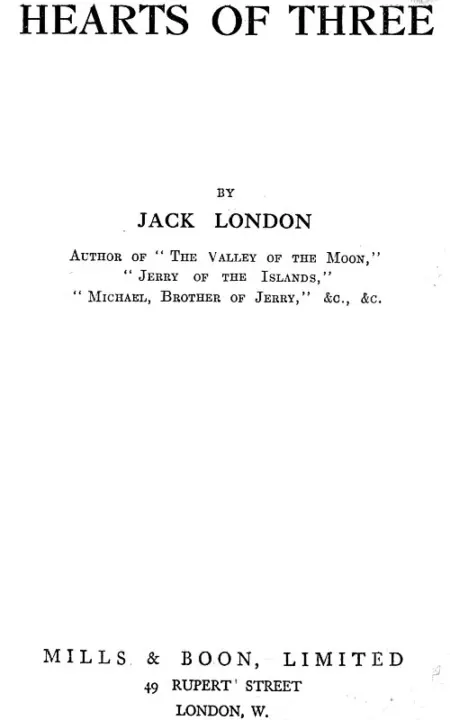
Hearts of three
Jack London
THE CLASSIC COLLECTION · 1906
"Moon-Face, and Other Stories" by Jack London is a collection of short stories likely written during the early 20th century. The first story, "Moon-Face," delves into themes of jealousy and the dark urges of the human psyche, centering on a character named John Claverhouse, who is described as a jovial man with an annoying, infectious laugh that drives the narrator into a rage and eventually leads him to contemplate murder. The opening of the book introduces us to the narrator’s intense dislike for John Claverhouse, whose very existence seems to irk him. The narrator reveals a series of petty, spiteful actions meant to disrupt Claverhouse's happiness, culminating in darkly constructed plans to eliminate him. The story captures the narrator's internal turmoil as he becomes increasingly obsessed with Claverhouse’s optimism and laughter, which he finds intolerable. This introduction hints at a suspenseful narrative filled with psychological conflict, setting the tone for a gripping exploration of human emotions and moral ambiguity.
Introduction adapted from the source catalogue; source summaries may be automatically generated.
Free to read · English · 48,691 words · No account needed
MAKE TIME FOR A GOOD BOOK
On by default. Untick to stop anonymous reading totals. Each page counts after 10 seconds in view. How this works.
Anonymous counting is on unless you have switched it off.
Chris’s drowsiness had disappeared. “I’m becoming interested myself,” he acknowledged. “We haven’t said anything about it. Ban broke his back this afternoon. He threw himself off the bank, and I ran the risk of being caught underneath.”
“I wonder, I wonder,” Mrs. Grantly communed aloud. “There is something in this.... It is a warning.... Ah! You were hurt yesterday riding Miss Story’s horse! That makes the two attempts!”
She looked triumphantly at them. Planchette had been vindicated.
“Nonsense,” laughed Uncle Robert, but with a slight hint of irritation in his manner. “Such things do not happen these days. This is the twentieth century, my dear madam. The thing, at the very latest, smacks of mediaevalism.”
“I have had such wonderful tests with Planchette,” Mrs. Grantly began, then broke off suddenly to go to the table and place her hand on the board.
“Who are you?” she asked. “What is your name?”
The board immediately began to write. By this time all heads, with the exception of Mr. Barton’s, were bent over the table and following the pencil.
“It’s Dick,” Aunt Mildred cried, a note of the mildly hysterical in her
voice.
Her husband straightened up, his face for the first time grave.
“It’s Dick’s signature,” he said. “I’d know his fist in a thousand.”
“‘Dick Curtis,’” Mrs. Grantly read aloud. “Who is Dick Curtis?”
“By Jove, that’s remarkable!” Mr. Barton broke in. “The handwriting in both instances is the same. Clever, I should say, really clever,” he added admiringly.
“Let me see,” Uncle Robert demanded, taking the paper and examining it. “Yes, it is Dick’s handwriting.”
“But who is Dick?” Mrs. Grantly insisted. “Who is this Dick Curtis?”
“Dick Curtis, why, he was Captain Richard Curtis,” Uncle Robert
answered.
“He was Lute’s father,” Aunt Mildred supplemented. “Lute took our name. She never saw him. He died when she was a few weeks old. He was my brother.”
“Remarkable, most remarkable.” Mrs. Grantly was revolving the message in her mind. “There were two attempts on Mr. Dunbar’s life. The subconscious mind cannot explain that, for none of us knew of the accident to-day.”
“I knew,” Chris answered, “and it was I that operated Planchette. The explanation is simple.”
“But the handwriting,” interposed Mr. Barton. “What you wrote and what Mrs. Grantly wrote are identical.”
Chris bent over and compared the handwriting.
“Besides,” Mrs. Grantly cried, “Mr. Story recognizes the handwriting.”
She looked at him for verification.
He nodded his head. “Yes, it is Dick’s fist. I’ll swear to that.”
Your reading position is saved on this browser. Take it to another device with a library code. Reading pages adapt to text, rather than matching a printed edition.
Jack London
Jack London
Jack London
Jack London
BEHIND THE BOOK
This eBook is for the use of anyone anywhere in the United States and most other parts of the world at no cost and with almost no restrictions whatsoever. You may copy it, give it away or re-use it under the terms of the Project Gutenberg License included with this eBook or online at www.gutenberg.org. If you are not located in the United States, you will have to check the laws of the country where you are located before using this eBook. Read the source licence.
The original source file, including credits and licence, is retained by this library. Request an original-format copy at no charge. Please include the book title and Project Gutenberg identifier #1089.
KEEP YOUR CURIOSITY GOING
Coulson Kernahan

Maurice Baring
Frances Wright
Cécile Tormay

Frederic Jesup Stimson

W. H. P. (William Henry Pope) Jarvis