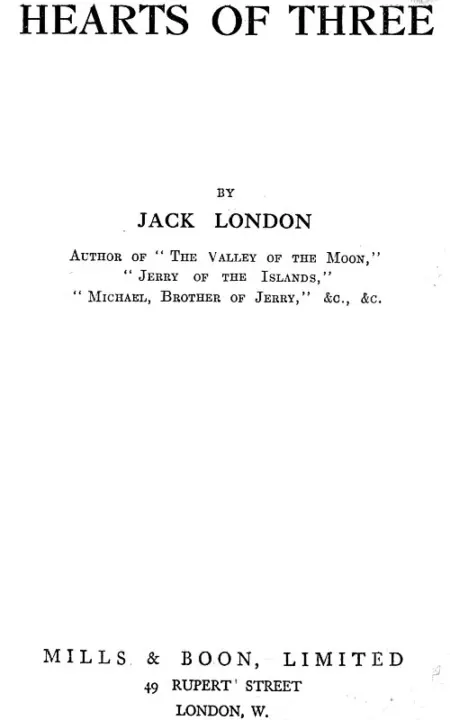
Hearts of three
Jack London
THE CLASSIC COLLECTION · 1906
"Moon-Face, and Other Stories" by Jack London is a collection of short stories likely written during the early 20th century. The first story, "Moon-Face," delves into themes of jealousy and the dark urges of the human psyche, centering on a character named John Claverhouse, who is described as a jovial man with an annoying, infectious laugh that drives the narrator into a rage and eventually leads him to contemplate murder. The opening of the book introduces us to the narrator’s intense dislike for John Claverhouse, whose very existence seems to irk him. The narrator reveals a series of petty, spiteful actions meant to disrupt Claverhouse's happiness, culminating in darkly constructed plans to eliminate him. The story captures the narrator's internal turmoil as he becomes increasingly obsessed with Claverhouse’s optimism and laughter, which he finds intolerable. This introduction hints at a suspenseful narrative filled with psychological conflict, setting the tone for a gripping exploration of human emotions and moral ambiguity.
Introduction adapted from the source catalogue; source summaries may be automatically generated.
Free to read · English · 48,691 words · No account needed
MAKE TIME FOR A GOOD BOOK
On by default. Untick to stop anonymous reading totals. Each page counts after 10 seconds in view. How this works.
Anonymous counting is on unless you have switched it off.
Suddenly Aunt Mildred’s hand began to twitch into movement. A mild concern showed in her face as she observed the movement of her hand and heard the scratching of the pencil-point at the apex of Planchette.
For another five minutes this continued, when Aunt Mildred withdrew her hand with an effort, and said, with a nervous laugh:
“I don’t know whether I did it myself or not. I do know that I was growing nervous, standing there like a psychic fool with all your solemn faces turned upon me.”
“Hen-scratches,” was Uncle Robert’s judgement, when he looked over the paper upon which she had scrawled.
“Quite illegible,” was Mrs. Grantly’s dictum. “It does not resemble writing at all. The influences have not got to working yet. Do you try it, Mr. Barton.”
That gentleman stepped forward, ponderously willing to please, and placed his hand on the board. And for ten solid, stolid minutes he stood there, motionless, like a statue, the frozen personification of the commercial age. Uncle Robert’s face began to work. He blinked, stiffened his mouth, uttered suppressed, throaty sounds, deep down; finally he snorted, lost his self-control, and broke out in a roar of laughter. All joined in this merriment, including Mrs. Grantly. Mr. Barton laughed with them, but he was vaguely nettled.
“You try it, Story,” he said.
Uncle Robert, still laughing, and urged on by Lute and his wife, took the board. Suddenly his face sobered. His hand had begun to move, and the pencil could be heard scratching across the paper.
“By George!” he muttered. “That’s curious. Look at it. I’m not doing it. I know I’m not doing it. Look at that hand go! Just look at it!”
“Now, Robert, none of your ridiculousness,” his wife warned him.
“I tell you I’m not doing it,” he replied indignantly. “The force has got hold of me. Ask Mrs. Grantly. Tell her to make it stop, if you want it to stop. I can’t stop it. By George! look at that flourish. I didn’t do that. I never wrote a flourish in my life.”
“Do try to be serious,” Mrs. Grantly warned them. “An atmosphere of levity does not conduce to the best operation of Planchette.”
“There, that will do, I guess,” Uncle Robert said as he took his hand away. “Now let’s see.”
He bent over and adjusted his glasses. “It’s handwriting at any rate, and that’s better than the rest of you did. Here, Lute, your eyes are young.”
“Oh, what flourishes!” Lute exclaimed, as she looked at the paper. “And look there, there are two different handwritings.”
Your reading position is saved on this browser. Take it to another device with a library code. Reading pages adapt to text, rather than matching a printed edition.
Jack London
Jack London
Jack London
Jack London
BEHIND THE BOOK
This eBook is for the use of anyone anywhere in the United States and most other parts of the world at no cost and with almost no restrictions whatsoever. You may copy it, give it away or re-use it under the terms of the Project Gutenberg License included with this eBook or online at www.gutenberg.org. If you are not located in the United States, you will have to check the laws of the country where you are located before using this eBook. Read the source licence.
The original source file, including credits and licence, is retained by this library. Request an original-format copy at no charge. Please include the book title and Project Gutenberg identifier #1089.
KEEP YOUR CURIOSITY GOING
Coulson Kernahan

Maurice Baring
Frances Wright
Cécile Tormay

Frederic Jesup Stimson

W. H. P. (William Henry Pope) Jarvis