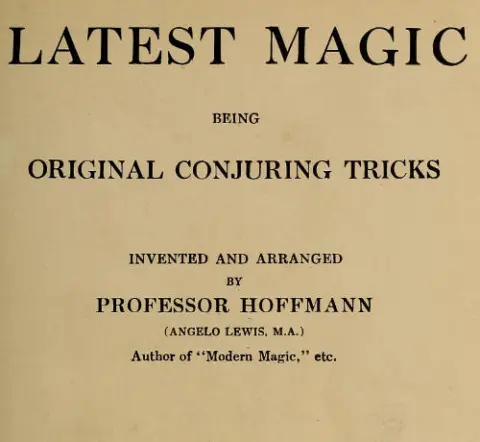
Latest Magic, Being original conjuring tricks
Professor Hoffmann
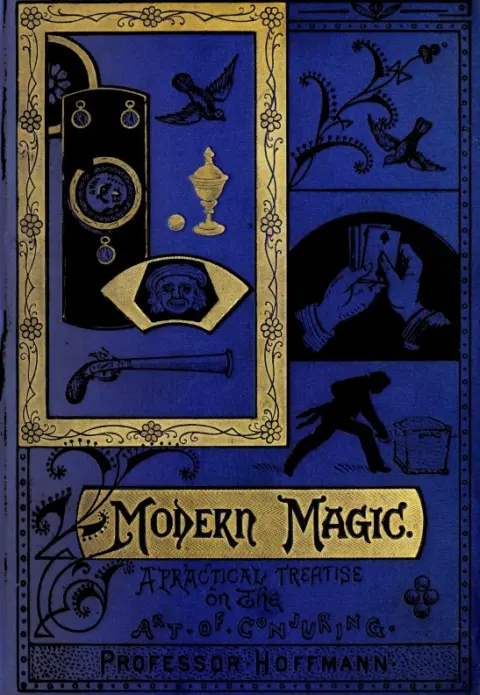
THE CLASSIC COLLECTION · 1876
"Modern Magic: A Practical Treatise on the Art of Conjuring" by Professor Hoffmann is a treatise first published in 1876. This groundbreaking work reveals the apparatus, methods, and tricks used by conjurors of the Victorian era, covering everything from card manipulation to grand stage illusions. The first English-language book to truly explain magical performance, it sparked controversy among magicians while influencing legends like Houdini and Thurston. Its publication may have catalyzed magic's entire golden age.
Introduction adapted from the source catalogue; source summaries may be automatically generated.
Free to read · English · 208,686 words · No account needed
MAKE TIME FOR A GOOD BOOK
On by default. Untick to stop anonymous reading totals. Each page counts after 10 seconds in view. How this works.
Anonymous counting is on unless you have switched it off.
Now, can you tell this? A pocket-book.
Would you like this? Yes; a watch.
Do you admire this? A brooch.
Who gave me this? A lady--a bracelet.
What is in my hand? A pin.
Now, who gave me this? A gentleman--a chain.
What have I now? Money.
Now, what have I got? A sovereign.
Can you tell me again? A shilling.
Is this the same? Sixpence.
You say I have money; but you don’t say the kind? A florin.
You say I have money; but you don’t say its value? A half crown.
You say I have money; but tell me its value? Ten shillings.
What is the value of the money? A penny.
I cannot hear you? A halfpenny.
I think I have given sufficient queries and answers to indicate the simplicity and the secret of second sight. When all the particulars of the articles are required, although the questions may seem perplexing to the spectator, yet they are extremely simple to the person who knows each question and its reply by heart.
Here is an illustration of a complicated series of questions, and the reader will see at once that the answering is very simple:
What is in my hand? A pin.
What is the metal? Gold.
Any stone? Amethyst.
What have I now? Money.
You say I have money; but you don’t say the kind? A florin.
Can you tell me again? A shilling.
From the illustrations I have given above, the reader will perceive that, provided a large and well-selected assortment of questions, corresponding with replies, be agreed upon, and well known by the two confederates, almost any question may be answered and any article known, together with its properties, color, contents, etc.
Another exhibition of clairvoyance--the reading of writing sealed up and unopened--adds greatly to the mystery of the performance; but how this is done can be easily explained. Previous to going on the stage, a sentence is selected, and written in blacklead on a piece of paper. During the performance similar pieces of paper are handed round to several of the audience, who are requested to write a sentence thereon. These papers are sealed similarly to the prepared one, and placed in a hat. The professor then pretends to select one at random, after having shaken up the papers; but he really takes up the one he had already in his hand. The lady clairvoyant is then requested to read a sentence, which, of course, she can easily do. The paper is then handed to one of the audience and to their astonishment it is found to have been the actual sentence written. It will be understood that each writer of a sentence is ignorant of what another has written, and the given sentence is therefore thought to have been written by one of the audience. This suspicion may be heightened by the queer method of spelling, or the character of the caligraphy; it may be made still more astounding by writing the sentence in a foreign language with a slight mistake in spelling, or grammar, upon which the clairvoyant can comment in her reply, and thus acquire a reputation for scholarly and linguistic attainments. The same means are resorted to in the adding up of a sum. The figures are all prepared behind the stage, and the bona fide sums given by the audience are never the ones answered by the clairvoyant. I think I have given, or I hope I have, a clear and full explanation of clairvoyance or second sight, and the reader may, by a little practice, become as perfect in this special branch of magic as the mysterious lady--Heller--Miss Anderson, Dr. Lynn, and a host of others, who have mystified and bewildered thousands of wondering spectators.
Your reading position is saved on this browser. Take it to another device with a library code. Reading pages adapt to text, rather than matching a printed edition.
Professor Hoffmann
Professor Hoffmann & Edmond Hoyle
BEHIND THE BOOK
This eBook is for the use of anyone anywhere in the United States and most other parts of the world at no cost and with almost no restrictions whatsoever. You may copy it, give it away or re-use it under the terms of the Project Gutenberg License included with this eBook or online at www.gutenberg.org. If you are not located in the United States, you will have to check the laws of the country where you are located before using this eBook. Read the source licence.
The original source file, including credits and licence, is retained by this library. Request an original-format copy at no charge. Please include the book title and Project Gutenberg identifier #58057.
KEEP YOUR CURIOSITY GOING

Charles G. (Charles Griffith) Ross
Hannah Webster Foster

Emily Lawless
Edwin Hamlin Carr

Charles De Lano Hine
Andrew Ure