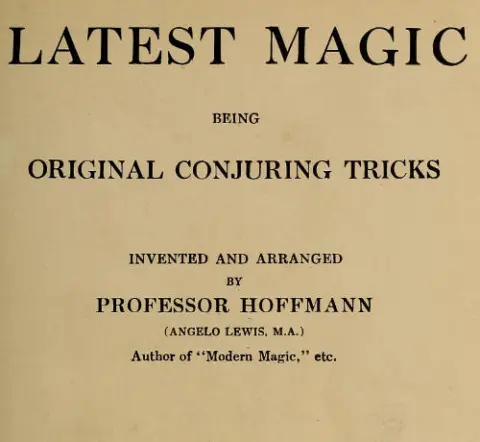
Latest Magic, Being original conjuring tricks
Professor Hoffmann
THE CLASSIC COLLECTION · 1876
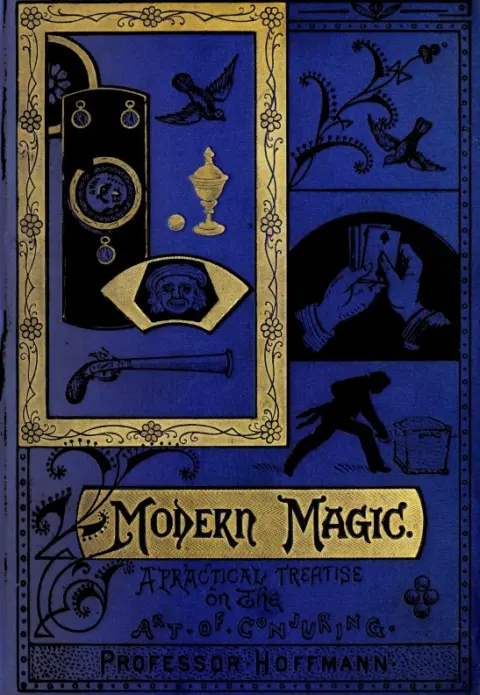
"Modern Magic: A Practical Treatise on the Art of Conjuring" by Professor Hoffmann is a treatise first published in 1876. This groundbreaking work reveals the apparatus, methods, and tricks used by conjurors of the Victorian era, covering everything from card manipulation to grand stage illusions. The first English-language book to truly explain magical performance, it sparked controversy among magicians while influencing legends like Houdini and Thurston. Its publication may have catalyzed magic's entire golden age.
Introduction adapted from the source catalogue; source summaries may be automatically generated.
Free to read · English · 208,686 words · No account needed
MAKE TIME FOR A GOOD BOOK
On by default. Untick to stop anonymous reading totals. Each page counts after 10 seconds in view. How this works.
Anonymous counting is on unless you have switched it off.
First Method.--The apparatus in this case consists of four glass balls (two of plain glass an inch and a half in diameter, one of ruby-coloured glass of the same size, and one of plain glass, three-quarters of an inch in diameter) and a decanter of clear glass, with a hollow or “kick” underneath it just large enough to admit one of the larger balls. The decanter is two-thirds filled with port or claret, and is brought forward with the red ball beneath it, in the hollow we have mentioned, and is placed on the performer’s table. The remaining balls are disposed as follows: the two large balls in the performer’s left pochette, and the small one in the pochette on the other side. Thus provided, the performer comes forward, wand in hand. Taking the wand carelessly in his right hand, he says, “Ladies and gentlemen, I have already given you some proofs of the singular powers of this wand, but I do not know whether I have drawn your attention to one remarkable faculty which it possesses, viz., that if I strike anything with it, at the same time mentally calling for any object, that object is instantly produced from the article touched. Let us put it to the test.” (He pulls back his coat-sleeves, showing indirectly, by a careless gesture, that his hands are empty.) “For the purpose of the trick I am about to show you, I require a crystal ball. Now, observe, I give but one gentle touch, not here upon the table” (he raps the table with his wand), “where you might suspect some mechanism or preparation, but here in my empty hand, and instantly, you see, a ball appears at my bidding.” As he touches the table with the wand, thereby drawing the eyes of the spectators in that direction, he carelessly drops his left hand to his side, and takes from the pochette and palms one of the plain glass balls, which as soon as the wand reaches his hand he produces at the finger-tips. “The ball, as you see, ladies and gentlemen, is of solid crystal, without crack or flaw” (he takes it in the right hand, tosses it up, and catches it again). “The hardest steel would fail to chip it, and yet, by my magic power, I am able instantly to divide it into two equal portions, each round and true as the original.” At the moment of tossing the ball in the air, all eyes are naturally attracted to it, and the performer has ample opportunity to again drop the left hand to his side, and palm the second ball. Keeping this in the palm of the left hand, he transfers the first ball to the finger-tips of the same hand. Drawing the wand across it, he allows it to drop into the palm, and to strike against the ball already there. Rubbing his palms together, as if to mould the divided ball into shape, he shows the two balls, professedly the divided portions of the first. Taking one in each hand, he continues, “I undertook to make the divided portions exactly equal, but I have not succeeded so well as usual. It seems to me that this one is rather the larger, what say you, ladies and gentlemen?” He places the two balls on the table, side by side, as if for comparison, and carelessly dropping the right hand to his side, palms between the second and third fingers (see page 273), the small ball. “Yes, this one is certainly the larger, but I can easily rectify the mistake by pinching a little piece off.” Taking the ball in the left hand, he pretends to pinch off a portion from it with the right, at the same time letting the little ball fall to the finger-tips of the latter. He replaces the large ball on the table, rolling the little ball between the fingers, as though to give it roundness. “No, that one is still the biggest, I haven’t taken quite enough yet. I must take a little more; or, better still, I will add this little piece to the smaller one.” Taking the supposed smaller ball in the left hand, he pretends to squeeze the little one into it, presently letting the latter fall behind it into the palm of the left hand, and replacing the two larger balls side by side on the table, dropping the little ball at the first opportunity into the pochette. He continues, “I think they are now about right. The reason why I have been so particular about it is that I am about to pass one of these balls into the other, which I could not have done unless they had been of exactly the same size. Now which of them shall I pass into the other? It is for you to decide.” He has meanwhile moved so as to be behind his table, standing sideways, with his right side to the table. Whichever ball the company decides is to be passed into the other, he takes in his right hand, immediately afterwards taking the other in the left hand, which he holds aloft, following it with his eyes. Stretching back the right arm, as though to give an impetus to the ball, he drops it into a padded box, or basket, placed upon the servante to receive it, immediately afterwards bringing the right hand with a semicircular sweep upon the left, and rolling the ball the latter contains between the palms, as though to press the one ball into the other; and presently showing that the hands now contain one ball only.
Your reading position is saved on this browser. Take it to another device with a library code. Reading pages adapt to text, rather than matching a printed edition.
Professor Hoffmann
Professor Hoffmann & Edmond Hoyle
BEHIND THE BOOK
This eBook is for the use of anyone anywhere in the United States and most other parts of the world at no cost and with almost no restrictions whatsoever. You may copy it, give it away or re-use it under the terms of the Project Gutenberg License included with this eBook or online at www.gutenberg.org. If you are not located in the United States, you will have to check the laws of the country where you are located before using this eBook. Read the source licence.
The original source file, including credits and licence, is retained by this library. Request an original-format copy at no charge. Please include the book title and Project Gutenberg identifier #58057.
KEEP YOUR CURIOSITY GOING

Charles G. (Charles Griffith) Ross
Hannah Webster Foster

Emily Lawless
Edwin Hamlin Carr

Charles De Lano Hine
Andrew Ure