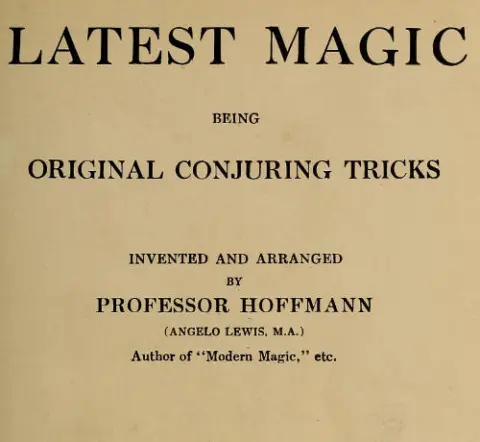
Latest Magic, Being original conjuring tricks
Professor Hoffmann
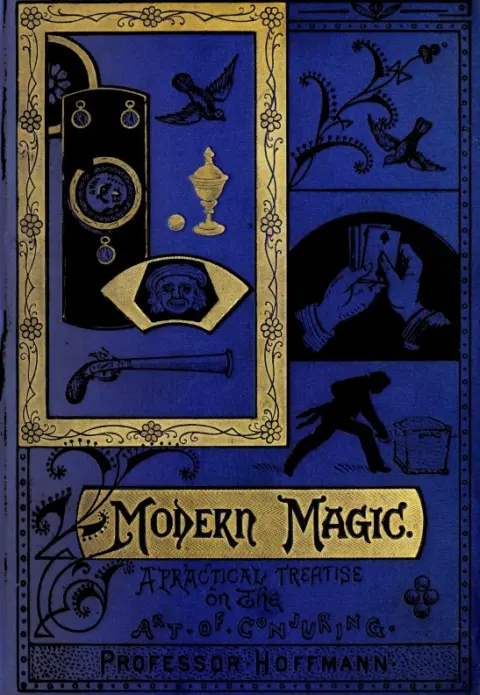
THE CLASSIC COLLECTION · 1876
"Modern Magic: A Practical Treatise on the Art of Conjuring" by Professor Hoffmann is a treatise first published in 1876. This groundbreaking work reveals the apparatus, methods, and tricks used by conjurors of the Victorian era, covering everything from card manipulation to grand stage illusions. The first English-language book to truly explain magical performance, it sparked controversy among magicians while influencing legends like Houdini and Thurston. Its publication may have catalyzed magic's entire golden age.
Introduction adapted from the source catalogue; source summaries may be automatically generated.
Free to read · English · 208,686 words · No account needed
MAKE TIME FOR A GOOD BOOK
On by default. Untick to stop anonymous reading totals. Each page counts after 10 seconds in view. How this works.
Anonymous counting is on unless you have switched it off.
The weak point of the trick, as above performed, is the sound of the hammer on the glass, which is but a poor imitation of that of coins, or the like, falling into it. In some trays the hammer is altogether dispensed with, the performer himself holding the tray, and the necessary sound being produced by the assistant actually dropping a coin into a glass behind the scenes, as near the standing place of the performer as possible. This latter plan is much to be preferred.
A further improvement consists in the use, in place of the salver, of a small round table, or guéridon, made on the same principle (without the hammer), and worked by pulling a string from behind the scenes. With a little dexterity, the articles may be introduced into the “ladle,” while in the act of placing the glass upon the table, or of moving the latter to the front of the stage, though it is more usual to do this behind the scenes, and then to bring the table forward, as described in the case of the salver.
The trick may be varied by borrowing four half-crowns or florins, duly marked, which, being exchanged, and their substitutes placed in the half-crown casket (see page 202), are thence made to pass one by one into the glass.
THE VANISHING DIE.--The effect of this trick, in its simplest shape, is merely to make a die, some three inches square, pass through the crown of a hat, and be found inside. The trick in this form is but a poor and transparent affair, but it is sometimes useful as affording a pretext for borrowing a hat which you design to make use of for some other purpose; and it furnishes the germ of two or three really effective illusions. The apparatus consists of three portions--a solid wooden die, generally painted black with white spots, a tin counterpart thereof,--fitting loosely over it, and exactly similar in appearance, but with one side open,--and an ornamental cover of thin pasteboard (sometimes this also is of tin), fitting in like manner over the hollow die. The trick is worked very much after the manner of the “cone,” recently described. The performer comes forward, having the solid die in the one hand, and the cover, with the tin counterpart within it, in the other. Placing these on the table, he borrows two hats, which he likewise places on the table, mouth upwards. “Ladies and gentlemen,” he commences, “I have here a block of wood” (he lets it fall on the floor, the sound sufficiently indicating its solidity, and again picks it up), “and a cover of simple pasteboard.” He places the cover over it, as if merely suiting the action to the word, and in again removing it, leaves the tin die over the solid one. “If any one would like to examine it, he is perfectly welcome to do so. I have here also two hats, borrowed haphazard from the audience, and, as you can all see, perfectly empty, and not prepared in any way. Now I propose to make this solid die” (he tosses it carelessly into one of the hats, and again apparently takes it out, but really takes out the hollow shell only) “pass right through the crown of one of these hats, and fall into the other.” He places the hats one upon the other, mouth to mouth, and the tin shell, with the opening downwards, upon the uppermost. “Here is the die, which I cover, thus. Now, at my command it shall pass downwards through the hat. One, two, three! Pass! See, the cover is empty” (taking it up with gentle pressure, so as to lift the shell with it, and placing both on the end of his wand, proving, apparently, that the cover is empty), “and here, in the lower hat, is the die. Let us try the experiment again. I will replace the die in the lower hat. One, two, three! Pass!” He lifts the cover, without pressure, leaving the hollow die on the upper hat. “It has obeyed, you see. Once more. One, two, three! Pass!” Again the cover is empty, and again the die has passed into the lower hat.
Your reading position is saved on this browser. Take it to another device with a library code. Reading pages adapt to text, rather than matching a printed edition.
Professor Hoffmann
Professor Hoffmann & Edmond Hoyle
BEHIND THE BOOK
This eBook is for the use of anyone anywhere in the United States and most other parts of the world at no cost and with almost no restrictions whatsoever. You may copy it, give it away or re-use it under the terms of the Project Gutenberg License included with this eBook or online at www.gutenberg.org. If you are not located in the United States, you will have to check the laws of the country where you are located before using this eBook. Read the source licence.
The original source file, including credits and licence, is retained by this library. Request an original-format copy at no charge. Please include the book title and Project Gutenberg identifier #58057.
KEEP YOUR CURIOSITY GOING

Charles G. (Charles Griffith) Ross
Hannah Webster Foster

Emily Lawless
Edwin Hamlin Carr

Charles De Lano Hine
Andrew Ure