Latest Magic, Being original conjuring tricks
Professor Hoffmann
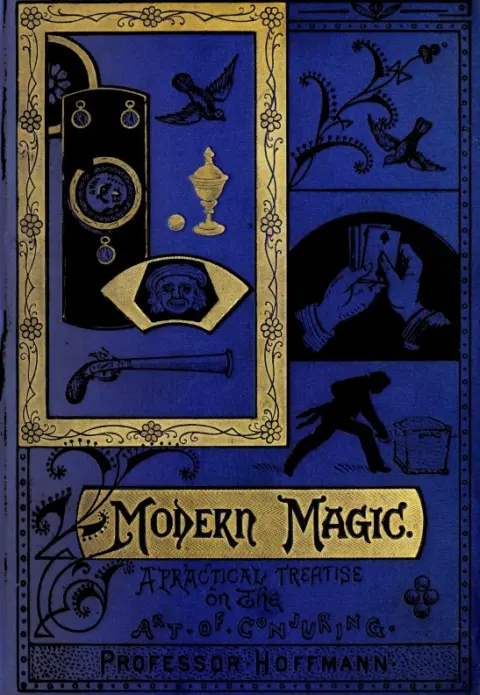
THE CLASSIC COLLECTION · 1876
"Modern Magic: A Practical Treatise on the Art of Conjuring" by Professor Hoffmann is a treatise first published in 1876. This groundbreaking work reveals the apparatus, methods, and tricks used by conjurors of the Victorian era, covering everything from card manipulation to grand stage illusions. The first English-language book to truly explain magical performance, it sparked controversy among magicians while influencing legends like Houdini and Thurston. Its publication may have catalyzed magic's entire golden age.
Introduction adapted from the source catalogue; source summaries may be automatically generated.
Free to read · English · 208,686 words · No account needed
MAKE TIME FOR A GOOD BOOK
On by default. Untick to stop anonymous reading totals. Each page counts after 10 seconds in view. How this works.
Anonymous counting is on unless you have switched it off.
PASS XII. TO AGAIN TRANSFORM THE BALLS TO STILL LARGER ONES.--The last Pass having reached the stage we have just described, i.e., a large ball being under each cup, but not yet exhibited to the audience, you secretly take in your left hand from the servante one of the still larger balls. These balls should be soft and elastic, and of such a size that, if pressed lightly into the cup, they shall require a slight tap of the cup on the table to dislodge them.
Having taken the ball in the left hand, you hold it at the ends of the fingers behind the table, as near the top as possible consistently with its being out of sight of the spectators. Then saying, “Now, ladies and gentlemen, I must ask for your very closest attention,” you raise C with the right hand, and with the same movement lower it for a moment behind the table, and over the ball in the left hand, which remains in the cup of its own accord. All eyes go instinctively to the ball on the table, whose increased size is a new phenomenon, and not one in a hundred will, in this first moment of surprise, think of watching the cup, which is naturally supposed to have, for the moment, concluded its share of the trick. You replace the cup on the table lightly, so as not to loosen the ball, meanwhile getting ready another ball in the left hand, and repeat the operation with B. With A you make a slight variation in your mode of procedure. Taking a third ball in your left hand, you hold it as before, but, as if through carelessness or clumsiness, allow it to be seen for a moment above the edge of the table. When you raise the third cup, you move it behind the table as before, and make a feint of introducing the ball which the spectators have just seen, but really let it drop on the servante, and replace the cup empty. A murmur from the audience will quickly apprise you that they have, as they imagine, found you out. Looking as innocent as you can, you inquire what is the matter, and are informed that you were seen to introduce a ball into the cup. “I beg your pardon,” you reply, lifting up, however, not A, which you have just replaced, but C, which is the farthest remote from it. There is really a ball in this cup, but having been pressed in, and fitting tightly, it does not fall. The audience, seeing you raise the wrong cup, are more and more confirmed in their suspicion. “Not that one, the other,” they exclaim. You next raise B, the ball in which also does not fall, for the reason already stated. “No, no,” the audience shout, “the other cup, the end one.” “You are really very obstinate, gentlemen,” you reply, “but pray satisfy yourselves,” turning over A as you speak, and showing the inside, which is manifestly empty, and your critics rapidly subside. Meanwhile, you drop your left hand to the servante, and secretly take from it two similar balls. Then, addressing the audience, you say, “Surely, gentlemen, you don’t imagine that, if I wanted to place a ball under a cup, I should set about it after such a clumsy fashion as this!” As you say this, you place your left hand in your left pocket, as if taking a ball from thence (as it obviously would not do to give the audience cause to suspect the existence of a secret receptacle behind the table), and bring out again the two balls, but allow one only to be seen, keeping the other concealed in the palm. Bringing the cup over the hand, you squeeze in both balls as far as you can, when the innermost will remain, but the outermost, not having sufficient space, will drop out again on the table. The audience, not knowing that there are two balls, believe the cup, which you now replace on the table, to be empty. You continue, “No, gentlemen; when I pass a ball under a cup, you may be sure that I don’t let anybody see me do so.” As you speak, you take the ball on the table in your right hand, and make the movement of transferring it to your left, really palming it by the second method, and holding the left hand closed and high, as if containing it, and keeping your eyes fixed thereon, you carelessly drop your right hand till the finger-tips rest on the table, when you are able to let fall the ball upon the servante. You continue, “I will now pass this ball under either of the cups which you like to name. Indeed, I will do more; I will cause this ball invisibly to multiply itself into three, one of which shall pass under each of the cups. First, however, let me show you that there is nothing under the cups at present.” You raise each in turn--“Nothing here, nothing here, and nothing here!” The balls still adhere to the sides of the cups, which, therefore, appear to be empty, but you replace each with a slight rap on the table, and thereby loosen the ball within it. “Now, then!” You bring the two hands together, and gently rub them over each cup in turn; finally parting them and showing that both are empty, and then lifting the cups, show the three large balls underneath.
Your reading position is saved on this browser. Take it to another device with a library code. Reading pages adapt to text, rather than matching a printed edition.
Professor Hoffmann
Professor Hoffmann & Edmond Hoyle
BEHIND THE BOOK
This eBook is for the use of anyone anywhere in the United States and most other parts of the world at no cost and with almost no restrictions whatsoever. You may copy it, give it away or re-use it under the terms of the Project Gutenberg License included with this eBook or online at www.gutenberg.org. If you are not located in the United States, you will have to check the laws of the country where you are located before using this eBook. Read the source licence.
The original source file, including credits and licence, is retained by this library. Request an original-format copy at no charge. Please include the book title and Project Gutenberg identifier #58057.
KEEP YOUR CURIOSITY GOING

Charles G. (Charles Griffith) Ross
Hannah Webster Foster

Emily Lawless
Edwin Hamlin Carr

Charles De Lano Hine
Andrew Ure