Latest Magic, Being original conjuring tricks
Professor Hoffmann
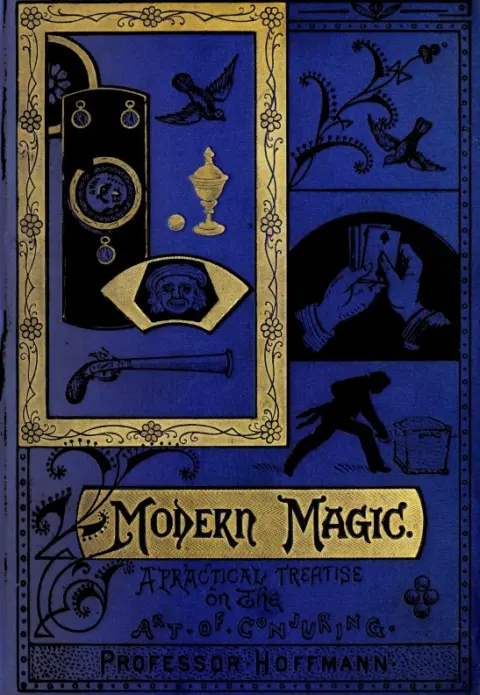
THE CLASSIC COLLECTION · 1876
"Modern Magic: A Practical Treatise on the Art of Conjuring" by Professor Hoffmann is a treatise first published in 1876. This groundbreaking work reveals the apparatus, methods, and tricks used by conjurors of the Victorian era, covering everything from card manipulation to grand stage illusions. The first English-language book to truly explain magical performance, it sparked controversy among magicians while influencing legends like Houdini and Thurston. Its publication may have catalyzed magic's entire golden age.
Introduction adapted from the source catalogue; source summaries may be automatically generated.
Free to read · English · 208,686 words · No account needed
MAKE TIME FOR A GOOD BOOK
On by default. Untick to stop anonymous reading totals. Each page counts after 10 seconds in view. How this works.
Anonymous counting is on unless you have switched it off.
The effect last mentioned is produced by the use of a double paper, pasted together round three of its sides, and thus forming a kind of bag in the centre. In this bag the performer, during his momentary absence from the stage, places the genuine handkerchief, folded so as to occupy as little space as possible. The handkerchief, therefore, lies between the two thicknesses of the paper, and when the rolled up packet is torn open from outside, may be removed without disturbing the burnt fragments, which still remain inside the paper.
Where it is necessary, as for the purpose of this trick, to introduce some article into a lemon, the necessary preparation should be made as follows:--A lemon with a thick hard rind should be selected, and a plug-shaped piece, about an inch and a half in diameter, should be scooped with a sharp knife out of one end. The pulp may now be removed, leaving the rind a mere shell, while the piece originally cut out will form a kind of stopper, which may be secured in its place by thrusting a hair-pin or piece of wire through the fruit and plug from side to side, and nipping off the ends flush with the outer surface. When the performer exhibits the lemon, he takes care to have the cut end inwards towards his palm; so that the circular mark is concealed by the fingers, and when he desires to produce the handkerchief he cuts the opposite end.
THE HANDKERCHIEF CUT UP, BURNT, AND FINALLY FOUND IN A CANDLE.--We have already described one or two modes in which a handkerchief, after being apparently cut up, or burnt, may be reproduced in its original condition. This is another and very effective form of the same trick.
Having borrowed a white handkerchief, you exchange it, by one or other of the means already described, for a substitute of similar appearance, and place the latter on the table. You then remember that, as you are about to burn the handkerchief, you will want a candle. You call to your attendant, but he, previously instructed, does not answer, and after a momentary pause you determine to fetch it yourself. You have, however, no sooner left the stage, than you meet the defaulter, and angrily remarking, in a stage whisper, so that the audience may hear, that he is never at hand when you want him, or making some similar observation, you order him to bring a lighted candle. Your absence is only momentary, but it has enabled you to throw him the real handkerchief, which he forthwith rolls up, and places inside a candle made hollow for the purpose; which he then places in a candlestick, lights, and brings on the stage. You have meanwhile taken up the substitute handkerchief, and advanced to the audience, getting ready the while in your palm a small piece of cambric, about six inches in diameter. Taking the handkerchief by the centre, in the same hand, you pull out between the first finger and thumb a portion of the piece of cambric, which is naturally taken to be a part of the handkerchief. Handing to one of the spectators a pair of scissors, you request him to cut off a small portion of the handkerchief. He cuts off a piece of the cambric. Holding this piece in the one hand, and taking the remainder, with the substitute handkerchief hanging down below it, in the other, you offer to teach the company your patent method of mending handkerchiefs, requiring neither thimble, needle, nor thread. Applying the cut edges to the candle, you set them on fire, rubbing them together. Finally, blowing out the flame, and throwing the handkerchief over the hand that holds the pieces, you palm them, and immediately afterwards show the handkerchief (i.e., the substitute) completely restored.
Your reading position is saved on this browser. Take it to another device with a library code. Reading pages adapt to text, rather than matching a printed edition.
Professor Hoffmann
Professor Hoffmann & Edmond Hoyle
BEHIND THE BOOK
This eBook is for the use of anyone anywhere in the United States and most other parts of the world at no cost and with almost no restrictions whatsoever. You may copy it, give it away or re-use it under the terms of the Project Gutenberg License included with this eBook or online at www.gutenberg.org. If you are not located in the United States, you will have to check the laws of the country where you are located before using this eBook. Read the source licence.
The original source file, including credits and licence, is retained by this library. Request an original-format copy at no charge. Please include the book title and Project Gutenberg identifier #58057.
KEEP YOUR CURIOSITY GOING

Charles G. (Charles Griffith) Ross
Hannah Webster Foster

Emily Lawless
Edwin Hamlin Carr

Charles De Lano Hine
Andrew Ure