Latest Magic, Being original conjuring tricks
Professor Hoffmann
THE CLASSIC COLLECTION · 1876
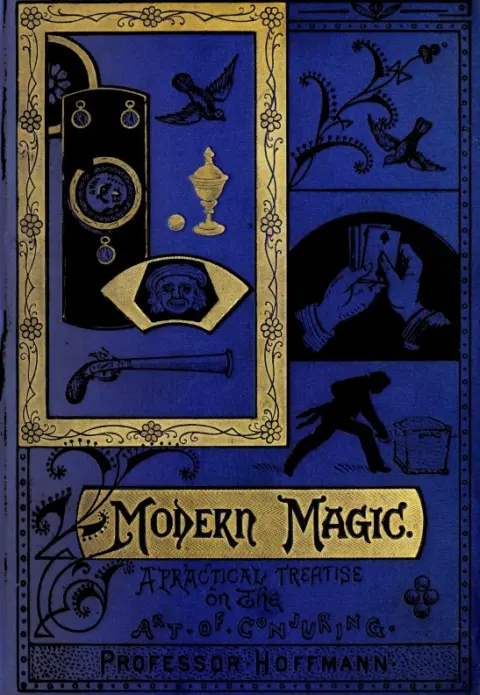
"Modern Magic: A Practical Treatise on the Art of Conjuring" by Professor Hoffmann is a treatise first published in 1876. This groundbreaking work reveals the apparatus, methods, and tricks used by conjurors of the Victorian era, covering everything from card manipulation to grand stage illusions. The first English-language book to truly explain magical performance, it sparked controversy among magicians while influencing legends like Houdini and Thurston. Its publication may have catalyzed magic's entire golden age.
Introduction adapted from the source catalogue; source summaries may be automatically generated.
Free to read · English · 208,686 words · No account needed
MAKE TIME FOR A GOOD BOOK
On by default. Untick to stop anonymous reading totals. Each page counts after 10 seconds in view. How this works.
Anonymous counting is on unless you have switched it off.
ODD OR EVEN, OR THE MYSTERIOUS ADDITION.--This is a trick of almost childish simplicity, depending upon an elementary arithmetical principle. We have, however, known it to occasion great perplexity, even to more than ordinarily acute persons.
You take a handful of coins or counters, and invite another person to do the same, and to ascertain privately whether the number he has taken is odd or even. You request the company to observe that you have not asked him a single question, but that you are able, notwithstanding, to divine and counteract his most secret intentions, and that you will in proof of this, yourself take a number of coins, and add them to those he has taken, when, if his number was odd, the total shall be even; if his number was even, the total shall be odd. Requesting him to drop the coins he holds into a hat, held on high by one of the company, you drop in a certain number on your own account. He is now asked whether his number was odd or even; and, the coins being counted, the total number proves to be, as you stated, exactly the reverse. The experiment is tried again and again, with different numbers, but the result is the same.
The secret lies in the simple arithmetical fact, that if you add an odd number to an even number the result will be odd; if you add an odd number to an odd number the result will be even. You have only to take care, therefore, that the number you yourself add, whether large or small, shall always be odd.
TO CHANGE A FLORIN INTO A PENNY, BACK AGAIN, AND THEN TO PASS THE SAME INVISIBLY INTO THE POCKET OF THE OWNER.--This is a trick of genuine sleight-of-hand, and will test your expertness in two or three different passes. Having beforehand palmed a penny in your right hand, you borrow from one of the company a florin (or half-crown), requesting the owner to mark it in such manner that he may be able to identify it. Make him stand up facing you, your own right side and his left being towards the audience. Taking the marked florin between the fingers and thumb of the right hand (the back of which, from your position, will be toward the spectators), you ask him whether he is nervous, whether he can hold fast, and so on. On receiving satisfactory replies, you state that you are about to put him to the test, and request him to hold out his right hand, telling him that you are about to count three, and that at the word “three” you will drop the florin into his hand, which he is to close tightly upon it. You accordingly count, “One! two! three!” each time making a motion as of dropping the florin into his hand, and at the word “three” actually do drop it, when he closes his hand upon it, as directed; but you are not satisfied. “That won’t do, my dear sir,” you exclaim; “you are not half quick enough--you allow all the electric fluid to escape. We’ll try once more, and pray be a little quicker in your movements. Oblige me with the coin again. Now, then, are you ready?--One! two!! THREE!!!” giving the words with great energy. As you say “three” you stamp your foot, and apparently again drop the florin, but really drop the penny instead, by Change 3. He is sure this time to close his hand very quickly, and, having no reason to the contrary, naturally believes that it is the florin which he holds, your previous feint, when you did actually drop the florin, being specially designed to lead him to that conclusion. You next request him to hold the closed hand high, that all may see it. This draws the general attention to him, and away from yourself, and enables you to place in your palm the florin, which was left, after the change, in the bend of your right thumb. You continue, “You did better that time, sir. Now, what will you bet me that I cannot take that two-shilling-piece out of your hand without your knowing it?” Whether he admits or defies your power, the course of the trick is the same. “Well,” you say at last, “you seem so determined that I am almost afraid to take the whole of the two-shilling piece away from you, I think I must be content with one-and-elevenpence. Allow me to touch your hand with my wand.” You do so, and on opening his hand he discovers that the two-shilling piece has changed into a penny.
Your reading position is saved on this browser. Take it to another device with a library code. Reading pages adapt to text, rather than matching a printed edition.
Professor Hoffmann
Professor Hoffmann & Edmond Hoyle
BEHIND THE BOOK
This eBook is for the use of anyone anywhere in the United States and most other parts of the world at no cost and with almost no restrictions whatsoever. You may copy it, give it away or re-use it under the terms of the Project Gutenberg License included with this eBook or online at www.gutenberg.org. If you are not located in the United States, you will have to check the laws of the country where you are located before using this eBook. Read the source licence.
The original source file, including credits and licence, is retained by this library. Request an original-format copy at no charge. Please include the book title and Project Gutenberg identifier #58057.
KEEP YOUR CURIOSITY GOING

Charles G. (Charles Griffith) Ross
Hannah Webster Foster

Emily Lawless
Edwin Hamlin Carr

Charles De Lano Hine
Andrew Ure