Latest Magic, Being original conjuring tricks
Professor Hoffmann
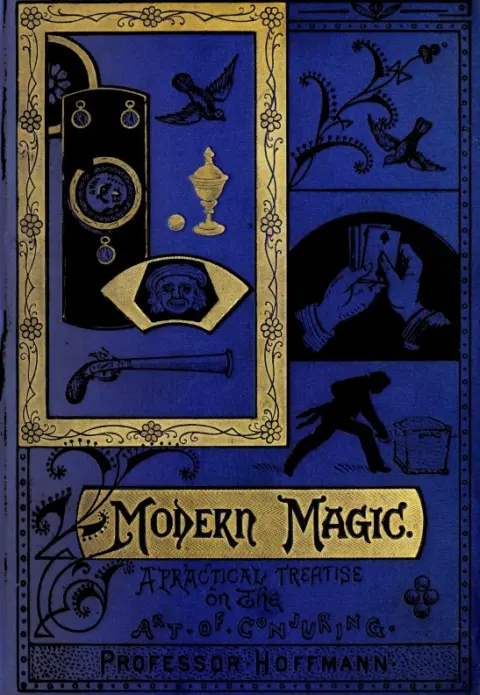
THE CLASSIC COLLECTION · 1876
"Modern Magic: A Practical Treatise on the Art of Conjuring" by Professor Hoffmann is a treatise first published in 1876. This groundbreaking work reveals the apparatus, methods, and tricks used by conjurors of the Victorian era, covering everything from card manipulation to grand stage illusions. The first English-language book to truly explain magical performance, it sparked controversy among magicians while influencing legends like Houdini and Thurston. Its publication may have catalyzed magic's entire golden age.
Introduction adapted from the source catalogue; source summaries may be automatically generated.
Free to read · English · 208,686 words · No account needed
MAKE TIME FOR A GOOD BOOK
On by default. Untick to stop anonymous reading totals. Each page counts after 10 seconds in view. How this works.
Anonymous counting is on unless you have switched it off.
The secret of this surprising feat lies mainly in the sword. This is an ordinary small-sword (see Fig. 41), with a three-sided rapier blade, but altered in a particular way for the purpose of the trick. The tip of the blade (see Fig. 42) is cut off at about a third of an inch distance from the extreme point, and across the concave side of this tip, and also across the corresponding part of the shortened blade, are soldered minute cross-pieces of brass, each bent outwards in the middle, so as to form, with the concavity of the blade, a kind of eye just large enough to admit freely a piece of thin black elastic cord, the other end of which is passed through a similar small hole in the guard of the hilt. The elastic thus lies along the hollow side of the blade, passing through the two “eyes” already mentioned, and is kept in position by a knot at each end. The tension of the elastic holds the moveable tip in its natural position at the end of the blade. It may, however, be drawn away from it in any direction as far as the elastic will permit, but, when released, immediately flies back to its old position. On the same side of the hilt--viz., the side farthest away from the palm of the hand when grasping the sword (see Fig. 43)--is fixed a flat, oblong piece of tin, painted black, with its longer edges folded over about half an inch on each side, in such manner as to form a receptacle for a card.
Unless you are tolerably expert in forcing, you will also require some forcing cards of the same pattern as the ordinary pack you have in use. These, however, need not be a full pack, a dozen cards alike being amply sufficient for your purpose. You commence your preparations by taking one of the cards of the forcing pack, cut a small slit in its centre with a penknife, and thrust completely through it the moveable tip of the sword (taking care not to enlarge the hole more than absolutely necessary), and place the sword thus prepared out of sight of the audience, but so as to be easily got at when you want it. Have your forcing cards in your pocket, or somewhere where you can lay your hand on them without attracting observation, and your ordinary pack on the table. You may begin by remarking, “Let me ask you to take particular notice that I perform this trick with whatever card you choose, not influencing your choice in any way. To show you that I don’t compel you to take any particular card, I will just take a handful of cards from the top of the pack” (as you say this you place your forcing cards, which you have previously palmed, for an instant on the top of the ordinary pack, immediately taking them off again, as if they had formed part of it, and were the handful of cards you referred to, and offer them to some one to draw). “Take whichever you please--first card, last card, middle card, it is precisely the same to me. Observe that I don’t attempt to press upon you any particular card, but hold the cards perfectly motionless while you make your choice.” As soon as a card is drawn, without waiting for it to be replaced, return to your table, holding the remaining forcing cards in your left hand. Pick up the pack with your right hand. Place it on the cards in your left hand, at the same moment making the pass to bring these cards to the top. Palm these (with the right hand), and, dropping them into your profonde, or elsewhere out of sight, advance with the pack to the person who drew, and request him to replace his card, and shuffle thoroughly. While he does so, you retire to fetch your sword, as before mentioned. Before returning to the audience, you prepare it as follows:--Taking it in your right hand in the ordinary manner, you draw down with the other hand the pierced card, and slide the card endways into the receptacle on the hilt. The elastic, which is now stretched to double its ordinary length, will pull at the card pretty tightly; but you retain it in position by pressing on the face of the card with the second and third fingers of the hand that grasps the hilt. Having done this, you return to the audience, taking care so to stand that the back of the hand that holds the sword shall be towards them. When the cards are flung in the air, as already described, you make a lunge among them, and at the same moment relax the pressure of the fingers on the pierced card. The elastic, being thus released, flies rapidly back to its original position, and carries the moveable tip, and with it the card, to the end of the blade, by which the card appears to be transfixed, as in Fig. 41. The movement of the sword in the lunge, coupled with that of the falling cards, completely covers the rapid flight of the pierced card from hilt to point. To get the card off the sword, pull it down the blade, and tear it roughly off. When you have taken off the card, drop the point of the sword, and hand the card at once to the drawer for examination. This serves to divert attention, not only from the sword itself, but also from the cards scattered on the ground, among which the one actually drawn still remains.
Your reading position is saved on this browser. Take it to another device with a library code. Reading pages adapt to text, rather than matching a printed edition.
Professor Hoffmann
Professor Hoffmann & Edmond Hoyle
BEHIND THE BOOK
This eBook is for the use of anyone anywhere in the United States and most other parts of the world at no cost and with almost no restrictions whatsoever. You may copy it, give it away or re-use it under the terms of the Project Gutenberg License included with this eBook or online at www.gutenberg.org. If you are not located in the United States, you will have to check the laws of the country where you are located before using this eBook. Read the source licence.
The original source file, including credits and licence, is retained by this library. Request an original-format copy at no charge. Please include the book title and Project Gutenberg identifier #58057.
KEEP YOUR CURIOSITY GOING

Charles G. (Charles Griffith) Ross
Hannah Webster Foster

Emily Lawless
Edwin Hamlin Carr

Charles De Lano Hine
Andrew Ure