Latest Magic, Being original conjuring tricks
Professor Hoffmann
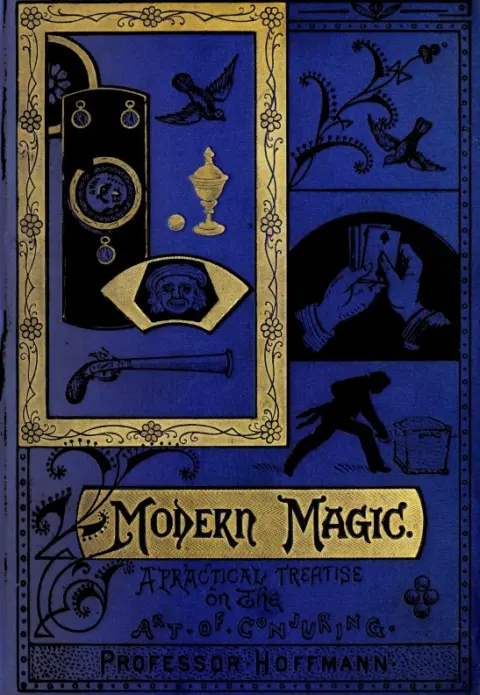
THE CLASSIC COLLECTION · 1876
"Modern Magic: A Practical Treatise on the Art of Conjuring" by Professor Hoffmann is a treatise first published in 1876. This groundbreaking work reveals the apparatus, methods, and tricks used by conjurors of the Victorian era, covering everything from card manipulation to grand stage illusions. The first English-language book to truly explain magical performance, it sparked controversy among magicians while influencing legends like Houdini and Thurston. Its publication may have catalyzed magic's entire golden age.
Introduction adapted from the source catalogue; source summaries may be automatically generated.
Free to read · English · 208,686 words · No account needed
MAKE TIME FOR A GOOD BOOK
On by default. Untick to stop anonymous reading totals. Each page counts after 10 seconds in view. How this works.
Anonymous counting is on unless you have switched it off.
If you are using an ordinary table, the most effective mode of finishing the trick is as follows:--Walk boldly to the table, and pick up with the right hand (in which the card actually thought of is palmed) the card lying on the table, and, without looking at it yourself, hold it towards your audience, remarking, “Here it is, you see, the ace of spades.” The card being, in truth, a totally different one (say the seven of diamonds), the audience naturally imagine that the trick has broken down, and a derisive murmur apprises you of the fact. You thereupon glance at the card, and affect some little surprise and embarrassment on finding that it is a wrong one. However, after a moment’s pause, you say, taking the card face downwards between the thumb and second finger of the left hand, “Well, I really don’t know how the mistake could have occurred. However, I can easily correct it.” Change the card by the fifth method (see page 32), and, after a little byplay to heighten the effect of the transformation, again show the card, which this time proves to be the right one. The audience will readily conclude that the supposed mistake was really a feint, designed to heighten the effect of the trick.
A CARD HAVING BEEN SECRETLY THOUGHT OF BY ONE OF THE AUDIENCE, TO PLACE TWO INDIFFERENT CARDS UPON THE TABLE, AND TO CHANGE SUCH ONE OF THEM AS THE AUDIENCE MAY SELECT INTO THE CARD THOUGHT OF.--Arrange your pack beforehand in such manner that among the fifteen or sixteen undermost cards there may be only one court card, and note at what number from the bottom this card is. Advance to the company, offering the cards face downwards in the ordinary way, and requesting some person to draw a card. Then, as if upon a second thought, say, before he has time to draw, “Or, if you prefer it, you need not even touch the cards, but merely think of one as I spread them before you.” So saying, spread the cards one by one, with their faces to the company, beginning at the bottom. The single court card being conspicuous among so many plain cards, and there being nothing apparently to create a suspicion of design about the arrangement it is ten to one that the person will note that particular card, which we will suppose to be the knave of hearts. When you have run over twelve or fourteen cards in this way, ask, still moving on the cards, “Have you thought of a card?” On receiving an answer in the affirmative, you make the pass two cards below the court card (which you know by the number at which it stands), and forthwith make a false shuffle, leaving the last three cards undisturbed, so that the court card remains third from the bottom. Turning to the audience, you remark, “I will now take the two bottom cards, whatever they may happen to be, and lay them on the table.” Then, holding up the pack in the left hand, with the bottom card towards the audience, you inquire, “That is not your card, sir, I suppose? nor that?” each time lowering the cards in order to draw away with the moistened finger of the right hand, and place face downwards on the table, the card just shown. The second time, however, you do not really draw the card you have shown, but draw back that card and take the one next to it--viz., the knave of hearts. You then, standing behind your table and facing the audience, again repeat the question, “You are quite sure, sir, that neither of these two cards is the card you thought of? Which of them would you like me to transform into your card, the right or the left?” Whichever the answer is, it may be taken in two ways, and you interpret it as may best suit your purpose. Thus, if you have placed the knave of hearts on your own right, and the choice falls on the right-hand card, you interpret it to mean the one on your own right hand. If, on the contrary, the person chooses the card on the left, you interpret him to mean the card on his left, and therefore on your right; so that in either case you make the choice fall on the knave of hearts.[G] Taking up the other card, and holding it, without apparent design, so that the audience can see what it is, you return it to the pack. Then say boldly, “This card upon the table will forthwith change to the card you thought of. Will you be good enough to name it?” If he names the knave of hearts, you have nothing to do but to turn up, or request some other person to turn up, the card on the table, and show that it is the right one.
Your reading position is saved on this browser. Take it to another device with a library code. Reading pages adapt to text, rather than matching a printed edition.
Professor Hoffmann
Professor Hoffmann & Edmond Hoyle
BEHIND THE BOOK
This eBook is for the use of anyone anywhere in the United States and most other parts of the world at no cost and with almost no restrictions whatsoever. You may copy it, give it away or re-use it under the terms of the Project Gutenberg License included with this eBook or online at www.gutenberg.org. If you are not located in the United States, you will have to check the laws of the country where you are located before using this eBook. Read the source licence.
The original source file, including credits and licence, is retained by this library. Request an original-format copy at no charge. Please include the book title and Project Gutenberg identifier #58057.
KEEP YOUR CURIOSITY GOING

Charles G. (Charles Griffith) Ross
Hannah Webster Foster

Emily Lawless
Edwin Hamlin Carr

Charles De Lano Hine
Andrew Ure