THE CLASSIC COLLECTION✦PoemsCLASSIC FREE BOOKS
Poems
Marie Van Vorst
THE CLASSIC COLLECTION · 1904
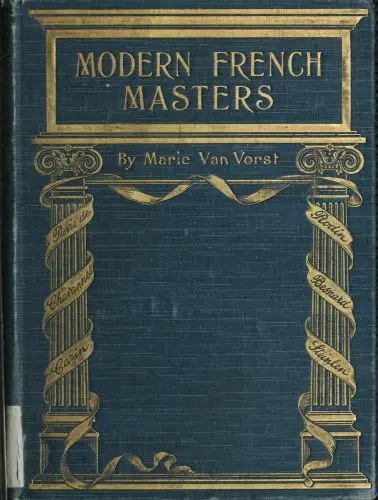
"Modern French Masters" by Marie Van Vorst is a collection of essays written in the early 20th century. The book provides an insightful exploration of influential French artists of the time, focusing on their artistic philosophies, techniques, and the impact they had on the art world. Notably, it showcases artists such as Puvis de Chavannes, Jean Charles Cazin, Rodin, and Paul Albert Besnard. The opening of this work presents a comprehensive preface by Alexander Harrison, which sets the tone for the following essays. It outlines the nature of art as deeply intertwined with love and passion, while introducing the themes of originality, genius, and individualism in artistic expression. Each discussed artist is portrayed in relation to their contributions to modern art, detailing their struggles for recognition and the evolution of their styles within the turbulent backdrop of their time. Thus, readers are engaged not only with the individual stories of these artists but with a broader reflection on the essence of artistic creation itself.
Introduction adapted from the source catalogue; source summaries may be automatically generated.
Free to read · English · 20,133 words · No account needed
MAKE TIME FOR A GOOD BOOK
On by default. Untick to stop anonymous reading totals. Each page counts after 10 seconds in view. How this works.
Anonymous counting is on unless you have switched it off.
tried to make the most of every expression, every turn, of my varying model,--for the human being changes constantly, and my time was infinitely precious and infinitely short. I was never able to bring to satisfactory termination very much during these séances. It was in the paid week, it was during the days of others, that I really produced. I permitted myself then a careful mental study of what Sunday had suggested and had failed to achieve. As I thus meditated, fleeting thoughts and inspirations came to me, and I would hold them, force them to remain, until at the following séance with my model I could mould their likeness in clay. I consider that this training of my memory was of inestimable advantage.”
In 1877 “L’Age d’Airain” was sent to the Salon, and accepted. The extraordinary criticism it evoked is sufficient praise. It was said to be “too perfect,” and the sculptor was accused of having “cast the statue from life”! When these insulting suspicions had been disproved to the eminent jury’s satisfaction, Rodin’s statue--a strong, beautiful male form of Greek purity and classical simplicity of outline--received, in 1880, a third-class medal. This was bought by the State, and can be seen in the Luxembourg Gardens.
Thus, successively accused first of too great originality, second of too faithful realism, Rodin was received by his censors; but ridicule reached its dizzy height when at the Salon of 1898 was exhibited the statue of Balzac, ordered by the Société des Gens de Lettres, and refused by them.
Above the éclat of that time, when Paris made rendezvous before the rejected monument to laugh and
immoderately jeer, it is hard even now to raise a reasonable voice.
The august Société, which claimed that it “failed to recognise Balzac in the statue,” should have been put to the blush by a commercial man, a Monsieur Pellerin, who pleaded to purchase the Balzac. The sculptor refused, and took the offending plaster back to his own workshop. “I was cruelly hurt and made ill,” Rodin said, “and it did me great harm.” A brilliant pamphlet was forthcoming, however, by Arsène Alexandre, which suggested to at least part of the intelligent spectators that “they may have laughed too soon.” The Balzac has held, during the Exposition, chief place in the Pavilion Rodin, where those who still seek it for its stimulus to laughter may find it, and where others may study it to calm advantage. France’s greatest novelist, the writer of the Comédie Humaine, as conceived and made to exist in sculptured form by a man like Rodin, is a combination in itself not without interest. There is in this work a tremendous, almost savage force, a virility and power, an abandonment to subject above form, characteristic of Rodin. Balzac is posed as a spectator, his arms folded across the chest under the flowing monk’s robe which the novelist assumed when at work. His body is rested on one backward-drawn foot, whilst the other, a little advanced, throws out the line of leg and knee. The head, superb and massive, is lifted and backward inclined; the lips are parted, the eyes, deep-set, caverns of thought under heavy brows, look out at the defile of humanity which the romancer so keenly studied to immortal results. This Balzac is moqueur, rêveur, student, analyst; and the genius which has--roughly if you will--mightily modelled the Titian of literature, has finely comprehended, with the kinship of greatness, the type of the immortal Parisian. The stupendous figure has nothing in common with the approved style of statues to great men that mark the public places and squares of our cities and towns, and there is everything in the outrance of presentation, the novel, daring, crude handling, to bewilder the crowd who distrust what they fail to understand. But it is sufficient for the serious, unprejudiced observer to come once and look, to return and gaze, in order to recognise that he is before a masterpiece--the effigy of a human being appearing as in life from a flowing garment, symbol of the art of the romancer, the robe of imagination with which he enveloped his analyses. It becomes thus impossible not to feel the power of Rodin’s Balzac as one studies the gigantic head emerging from the
Your reading position is saved on this browser. Take it to another device with a library code. Reading pages adapt to text, rather than matching a printed edition.
Marie Van Vorst
Marie Van Vorst
Marie Van Vorst
Marie Van Vorst
BEHIND THE BOOK
This eBook is for the use of anyone anywhere in the United States and most other parts of the world at no cost and with almost no restrictions whatsoever. You may copy it, give it away or re-use it under the terms of the Project Gutenberg License included with this eBook or online at www.gutenberg.org. If you are not located in the United States, you will have to check the laws of the country where you are located before using this eBook. Read the source licence.
The original source file, including credits and licence, is retained by this library. Request an original-format copy at no charge. Please include the book title and Project Gutenberg identifier #58279.
KEEP YOUR CURIOSITY GOING

David Patterson (Spirit) Hatch

David Patterson (Spirit) Hatch

David Patterson (Spirit) Hatch

Ralph Waldo Emerson

Maurice Baring

Oscar Wilde & James McNeill Whistler