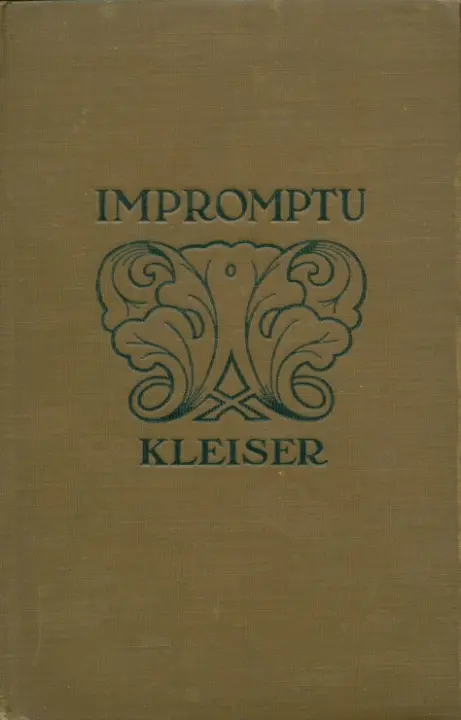
“Impromptu”; or, How to Think on Your Feet
Grenville Kleiser
THE CLASSIC COLLECTION · 1920
"Model Speeches for Practice" by Grenville Kleiser is a comprehensive collection of exemplary speeches written in the early 20th century. The purpose of this work is to serve as a practical guide for students and aspiring speakers, encompassing a variety of successful oratory examples from notable figures. Kleiser emphasizes the importance of studying and practicing these speeches for the development of effective public speaking skills. The opening of the book presents a preface where the author outlines the aims and purposes of public speaking. He discusses the significance of having clear objectives when addressing an audience and stresses that true oratory is not merely about instruction or entertainment but about influencing thought and action. Kleiser advises aspiring speakers to carefully analyze his selection of speeches, practice them aloud, and cultivate their speaking style through regular practice, which he suggests is crucial to mastering the art of public speaking.
Introduction adapted from the source catalogue; source summaries may be automatically generated.
Free to read · English · 29,101 words · No account needed
MAKE TIME FOR A GOOD BOOK
On by default. Untick to stop anonymous reading totals. Each page counts after 10 seconds in view. How this works.
Anonymous counting is on unless you have switched it off.
In the name of the Queen and the other members of my family, on behalf of the Princess and for myself, I thank you most sincerely for your enthusiastic reception of this toast, proposed by you, my Lord Mayor, in such kind and generous terms. Your feeling allusion to our recent long absence from our happy family circle gives expression to that sympathy which has been so universally extended to my dear parents, whether in times of joy or sorrow, by the people of this country, and upon which my dear mother felt she could ever reckon from the first days of her life here amongst them. As to ourselves, we are deeply sensible of the great honor done us on this occasion, and our hearts are moved by the splendid reception which to-day has been accorded us by the authorities and inhabitants of the City of London. And I desire to take this opportunity to express our deepest gratitude for the sympathetic interest with which our journey was followed by our fellow countrymen at home, and for the warm welcome with which we were greeted on our return. You were good enough, my Lord Mayor, to refer to his Majesty having marked our home-coming by creating me Prince of Wales. I only hope that I may be worthy to hold that ancient and historic title, which was borne by my dear father for upward of fifty-nine years.
My Lord Mayor, you have attributed to us more credit than I think we deserve. For I feel that the debt of gratitude is not the nation's to us, but ours to the King and Government for having made it possible for us to carry out, with every consideration for our comfort and convenience, a voyage unique in its character, rich in the experience gained and in memories of warm and affectionate greetings from the many races of his Majesty's subjects in his great dominions beyond the seas. And here in the capital of our great Empire I would repeat how profoundly touched and gratified we have been by the loyalty, affection and enthusiasm which invariably characterized the welcome extended to us throughout our long and memorable tour. It may interest you to know that we travelled over 45,000 miles, of which 33,000 were by sea, and I think it is a matter of which all may feel proud that, with the exception of Port Said, we never set foot on any land where the Union Jack did not fly. Leaving England in the middle of March, we first touched at Gibraltar and Malta, where, as a sailor, I was proud to meet the two great fleets of the Channel and Mediterranean. Passing through the Suez Canal--a monument of the genius and courage of a gifted son of the great friendly nation across the Channel--we entered at Aden the gateway of the East. We stayed for a short time to enjoy the unrivaled scenery of Ceylon and the Malay Peninsula, the gorgeous displays of their native races, and to see in what happy contentment these various peoples live and prosper under British rule. Perhaps there was something still more striking in the fact that the Government, the commerce, and every form of enterprise in these countries are under the leadership and direction of but a handful of our countrymen, and to realize the high qualities of the men who have won and kept for us that splendid condition. Australia saw the consummation of the great mission which was the more immediate object of our journey, and you can imagine the feelings of pride with which I presided over the inauguration of the first representative Assembly of the new-born Australian Commonwealth, in whose hands are placed the destinies of the great island continent. During a happy stay of many weeks in the different States, we were able to gain an insight into the working of the commercial, social and political institutions of which the country justly boasts, and to see something of the great progress which it has already made, and of its great capabilities, while making the acquaintance of the warm-hearted and large-minded men to whose personality and energy so much of that progress is due. New Zealand afforded us a striking example of a vigorous, independent and prosperous people, living in the full enjoyment of free and liberal institutions, and where many interesting social experiments are being put to the test of experience. Here we had the satisfaction of meeting large gatherings of the Maori people--once a brave and resolute foe, now peaceful and devoted subjects of the King. Tasmania, which in natural characteristics and climate reminded us of the old country, was visited when our faces were at length turned homeward. Mauritius, with its beautiful tropical scenery, its classical, literary and naval historical associations, and its population gifted with all the charming characteristics of old France, was our first halting-place, on our way to receive, in Natal and Cape Colony, a welcome remarkable in its warmth and enthusiasm, which appeared to be accentuated by the heavy trial of the long and grievous war under which they have suffered. To Canada was borne the message--already conveyed to Australia and New Zealand--of the Motherland's loving appreciation of the services rendered by her gallant sons. In a journey from ocean to ocean, marvelous in its comfort and organization, we were enabled to see something of its matchless scenery, the richness of its soil, the boundless possibilities of that vast and but partly explored territory. We saw, too, the success which has crowned the efforts to weld into one community the peoples of its two great races. Our final halting-place was, by the express desire of the King, Newfoundland, the oldest of our colonies and the first visited by his Majesty in 1860. The hearty seafaring population of this island gave us a reception the cordiality of which is still fresh in our memories.
Your reading position is saved on this browser. Take it to another device with a library code. Reading pages adapt to text, rather than matching a printed edition.
Grenville Kleiser
Grenville Kleiser
Grenville Kleiser
Grenville Kleiser
BEHIND THE BOOK
This eBook is for the use of anyone anywhere in the United States and most other parts of the world at no cost and with almost no restrictions whatsoever. You may copy it, give it away or re-use it under the terms of the Project Gutenberg License included with this eBook or online at www.gutenberg.org. If you are not located in the United States, you will have to check the laws of the country where you are located before using this eBook. Read the source licence.
The original source file, including credits and licence, is retained by this library. Request an original-format copy at no charge. Please include the book title and Project Gutenberg identifier #18323.
KEEP YOUR CURIOSITY GOING

David Patterson (Spirit) Hatch

David Patterson (Spirit) Hatch

David Patterson (Spirit) Hatch

Ralph Waldo Emerson

Maurice Baring

Oscar Wilde & James McNeill Whistler