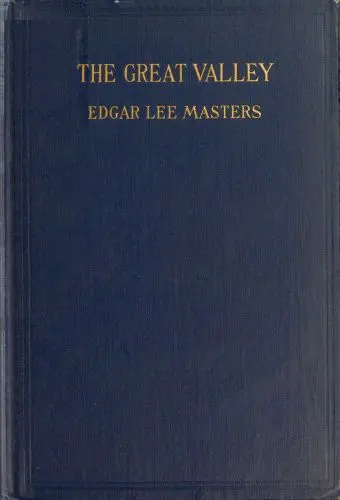
The Great Valley
Edgar Lee Masters
THE CLASSIC COLLECTION · 1920
"Mitch Miller" by Edgar Lee Masters is a fictional narrative written in the early 20th century. The story revolves around the childhood experiences of the main character, Skeeter, and his friendship with Mitch Miller, a boy described as exceptional and fun-loving. Through their adventures in the small town of Petersburg, the narrative explores themes of friendship, innocence, and the excitement of youth, filled with local color and community dynamics. The opening portion of the novel introduces readers to Skeeter's waking moments and gradual realization of his surroundings, leading to the discovery of Mitch Miller. Skeeter is portrayed in a semi-dreamlike state, absorbing the sights and sounds of his childhood home as he recalls moving to Petersburg. A significant event occurs when Skeeter encounters Mitch, who offers thrilling plans for adventures, including a fight between two local men and the pursuit of treasure reminiscent of literary tales such as "Tom Sawyer." As the boys' friendship develops, they navigate their town's vibrant life, embarking on escapades that promise both excitement and mischief. The tone combines nostalgia and the innocence of childhood, setting up a rich backdrop for their forthcoming adventures.
Introduction adapted from the source catalogue; source summaries may be automatically generated.
Free to read · English · 71,040 words · No account needed
MAKE TIME FOR A GOOD BOOK
On by default. Untick to stop anonymous reading totals. Each page counts after 10 seconds in view. How this works.
Anonymous counting is on unless you have switched it off.
"I can't believe anybody would sign his name to a letter. Besides I wrote him one and it reached him, because this letter was his answer."
"And are these your reasons for believing that Tom Sawyer lives and
wrote to you?"
"Yes, sir."
"Do you ever have dreams, Mitchie?"
"Lots."
"Didn't you dream about being up in this tree?"
"No, sir."
"Do you sometimes see dreams when you're not asleep--when it's day?"
"Sometimes."
"Didn't you pass the house of Joe Rainey the next morning after he was
killed?"
"I believe I did."
"And wasn't it then that you picked up this pistol?"
"No, sir."
"Did you know what it means, if it was true, to see a pistol put down by
a woman by this porch?"
"I think so."
"Tell me."
"Well, I thought it meant that somebody wanted to make it appear that
Joe Rainey had it."
"Well, then you knew it was your duty as a good boy to tell the authorities--to tell the State's Attorney?"
"Yes, sir, I know it now."
"Didn't you know it then?"
"In a kind of way, but I was so taken up with the treasure and going to see Tom Sawyer; and I had been subpoenaed in the Doc Lyon case and I was afraid I would be subpoenaed in this case and kept here so I couldn't go away."
"Your father is a preacher, isn't he?"
"Yes, sir."
"And you have been raised to tell the truth and do your duty?"
"Yes, sir--but the flesh is weak."
"And the flesh pots are tempting," said Major Abbott right quick, "and you love treasure and love to live over the life of Tom Sawyer, a boy who never lived?"
"I can't answer that."
"Why?"
"Well, I love treasure, that is I love to find it--but I'm not livin' over Tom Sawyer's life any more than is natural."
"But it is true that you deceived your father, it is true you ran away, it is true you meant to run away from the court--all this is true?"
"Yes, sir."
"And then all of a sudden you got this idea of duty?"
"Yes, sir--by reading 'Hamlet.'"
"'Hamlet'?"
"Yes, sir, he kept foolin' with his duty, and it taught me not to."
"Did your father tell you to say that?"
"No, sir."
"I thought the great example of Lincoln had influenced you?"
"It did."
"Have you read 'Hamlet'?"
"Yes, sir, I have."
"Did he live, too?"
"Yes, sir--everybody lives that was ever wrote about."
Your reading position is saved on this browser. Take it to another device with a library code. Reading pages adapt to text, rather than matching a printed edition.
Edgar Lee Masters
Edgar Lee Masters
Edgar Lee Masters
Edgar Lee Masters
BEHIND THE BOOK
This eBook is for the use of anyone anywhere in the United States and most other parts of the world at no cost and with almost no restrictions whatsoever. You may copy it, give it away or re-use it under the terms of the Project Gutenberg License included with this eBook or online at www.gutenberg.org. If you are not located in the United States, you will have to check the laws of the country where you are located before using this eBook. Read the source licence.
The original source file, including credits and licence, is retained by this library. Request an original-format copy at no charge. Please include the book title and Project Gutenberg identifier #21910.
KEEP YOUR CURIOSITY GOING
Coulson Kernahan

Maurice Baring
Frances Wright
Cécile Tormay

Frederic Jesup Stimson

W. H. P. (William Henry Pope) Jarvis