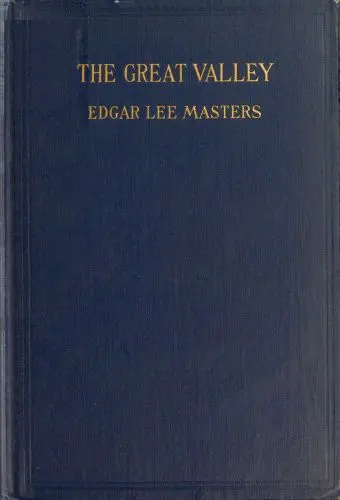
The Great Valley
Edgar Lee Masters
THE CLASSIC COLLECTION · 1920
"Mitch Miller" by Edgar Lee Masters is a fictional narrative written in the early 20th century. The story revolves around the childhood experiences of the main character, Skeeter, and his friendship with Mitch Miller, a boy described as exceptional and fun-loving. Through their adventures in the small town of Petersburg, the narrative explores themes of friendship, innocence, and the excitement of youth, filled with local color and community dynamics. The opening portion of the novel introduces readers to Skeeter's waking moments and gradual realization of his surroundings, leading to the discovery of Mitch Miller. Skeeter is portrayed in a semi-dreamlike state, absorbing the sights and sounds of his childhood home as he recalls moving to Petersburg. A significant event occurs when Skeeter encounters Mitch, who offers thrilling plans for adventures, including a fight between two local men and the pursuit of treasure reminiscent of literary tales such as "Tom Sawyer." As the boys' friendship develops, they navigate their town's vibrant life, embarking on escapades that promise both excitement and mischief. The tone combines nostalgia and the innocence of childhood, setting up a rich backdrop for their forthcoming adventures.
Introduction adapted from the source catalogue; source summaries may be automatically generated.
Free to read · English · 71,040 words · No account needed
MAKE TIME FOR A GOOD BOOK
On by default. Untick to stop anonymous reading totals. Each page counts after 10 seconds in view. How this works.
Anonymous counting is on unless you have switched it off.
"What else?"
"By God."
"You believe in God, do you, Mitchie?" asked my pa in a quieter voice.
"I do," said Mitch.
"And a hereafter."
"I do."
"And that you'll be punished in the hereafter if you don't tell the
truth?"
"That's leading, your honor," interrupted Major Abbott.
"Yes," said the judge.
"Very well," said my pa.
"What else will happen to you if you don't tell the truth, Mitchell?"
"I'll be punished in the hereafter."
"Cross-examine," said my pa.
Then Major Abbott began in kind of a sneerin' voice.
"So you think you'll be punished in the hereafter?"
"Yes, sir."
"Why?"
"Why wouldn't I be for swearin' a man's life away?"
"For swearin' a man's life away," repeated Major Abbott, kind of
stunned.
"That's what I'm obliged to do," said Mitch.
"Well, one thing at a time, my boy," said the Major, a little friendlier. "Tell me now who told you about the obligations of an oath."
"I've read about it," said Mitch.
"Where?"
"In Blackstone's Commentaries."
"Where did you ever hear of Blackstone's Commentaries?"
"First out at Old Salem, where Linkern lived."
The jury sat up straighter than ever.
"Who told you?"
"An old man."
"What's his name?"
"I don't know."
"When was that?"
"This summer, about a month ago."
"Well, did you ever read Blackstone's Commentaries?"
"Yes, sir, some."
"Where?"
"In Mr. Kirby's office."
"The States Attorney?"
"Yes, sir."
"When?"
"Since that old man told me."
"How did he happen to be talking about Blackstone's Commentaries?"
"He told me that Linkern found Blackstone's Commentaries in a barl."
There was a titter in the court room.
"Did you believe him?"
"Yes, sir."
"What were you doin' out there?"
"Diggin' for treasure."
"Oh, like Tom Sawyer?"
"Yes, sir."
"And so now you're testifyin' like Tom Sawyer?"
"Yes, sir."
"Don't you dream a good deal, my boy?"
"I don't know. I think a lot."
"You think, eh? What about, for instance?"
"Everything."
"Well, tell me a few things you think about."
"The world, life, books, Shakespeare."
"Shakespeare?"
"Yes, sir."
"I suppose you've heard your father talk Shakespeare?"
"Yes, sir."
"And so you think of that?"
"I've read lots of it, too."
"Shakespeare?"
"Yes, sir."
"Uh, huh! Can you tell me the name of the play where there is a fencer?"
"'Hamlet.'"
"'Hamlet'?"
"Yes, sir. I've committed to memory the speech of the ghost."
"Well, this isn't a theater, Mitchell, so you don't need to recite."
"No, sir."
"But now tell me, has your father talked to you?"
"Yes, sir."
"Did you get from him this idea that you would be punished in the hereafter if you didn't tell the truth?"
"Yes, and not exactly either. I believe that."
Your reading position is saved on this browser. Take it to another device with a library code. Reading pages adapt to text, rather than matching a printed edition.
Edgar Lee Masters

Edgar Lee Masters
Edgar Lee Masters
Edgar Lee Masters
BEHIND THE BOOK
This eBook is for the use of anyone anywhere in the United States and most other parts of the world at no cost and with almost no restrictions whatsoever. You may copy it, give it away or re-use it under the terms of the Project Gutenberg License included with this eBook or online at www.gutenberg.org. If you are not located in the United States, you will have to check the laws of the country where you are located before using this eBook. Read the source licence.
The original source file, including credits and licence, is retained by this library. Request an original-format copy at no charge. Please include the book title and Project Gutenberg identifier #21910.
KEEP YOUR CURIOSITY GOING
Coulson Kernahan

Maurice Baring
Frances Wright
Cécile Tormay

Frederic Jesup Stimson

W. H. P. (William Henry Pope) Jarvis