THE CLASSIC COLLECTION✦A dead man’s diaryCLASSIC FREE BOOKS
A dead man’s diary
Coulson Kernahan
THE CLASSIC COLLECTION · 1927
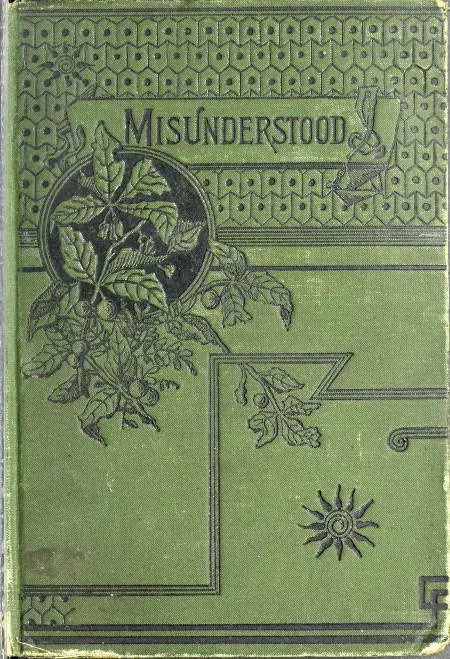
"Misunderstood" by Florence Montgomery is a novel written in the late 19th century. The story centers around two young brothers, Humphrey and Miles Duncombe, who navigate the complexities of childhood within the backdrop of their home at Wareham Abbey. Through their adventures, the book explores themes of childhood innocence, the misunderstandings that arise in familial relationships, and the longing for parental attention after the loss of their mother. At the start of the novel, the brothers are waiting eagerly for their father’s return, while reflecting on the rainy weather that has thwarted their plans to meet him. Each brother has a distinctive personality; Humphrey is adventurous and bold, often leading Miles into mischief, while Miles is more timid and sensitive. They interact with their caretakers and ponder their late mother, revealing glimpses of their affection and the void her absence has left in their lives. As they await their father’s arrival, their innocent conversations and imaginative play highlight the joys and trials of childhood, setting the tone for their adventures ahead.
Introduction adapted from the source catalogue; source summaries may be automatically generated.
Free to read · English · 45,809 words · No account needed
MAKE TIME FOR A GOOD BOOK
On by default. Untick to stop anonymous reading totals. Each page counts after 10 seconds in view. How this works.
Anonymous counting is on unless you have switched it off.
He was not a morbid man, and he did not reproach himself for what had been unavoidable; for a man belongs more to the world than to his home; and his home ought not to throw any hindrance in his path of usefulness. But he told himself plainly that he had failed; that, satisfied if his children were well and happy, he had been content to go no further, and to remain in ignorance of all that Humphrey's simple words had disclosed.
He was filled with admiration for the generous nature which had borne so patiently to see another preferred, and had charmed away the feeling which had arisen sometimes, by the reflection, "It is quite fair."
He thought how the same circumstances acting upon a different temperament might have produced jealousy, discontent, and bitter feeling; the little brothers might have grown up to hate each other, and he would never have perceived it. And with an uncontrollable feeling he knelt down by the bedside, and covered the child with kisses.
Humphrey opened his eyes and smiled. "I was dreaming of mother," he said; "she was asking me if you had sent her any message."
"Tell her, my darling, how much I love you, and how sorry I am to let
you go."
"So sorry to let me go," he repeated, with the old expression of triumph coming into his face; "and that you love me very much; as much as Miles, shall I say."
"As much as Miles," said Sir Everard.
"And that's quite true, father?"
"Quite true, my own precious child."
A smile flitted over his face, and he shut his eyes, saying, "I've often forgotten your messages before, father, but I shan't forget this one!"
Presently he roused up again, and said, "I should like to do that thing people do before they die."
"What thing?"
"I forget the name of it in English. In French it is the same as the
Gospels and Epistles."
"The same as the Gospels and Epistles? What can you mean?"
"Virginie calls them 'Le Noveau Testament.' What's the English for
that?"
"New Testament."
"But what's testament in English? I can't remember words now."
"Testament in English? Oh! will."
"Oh, yes!--will--that's it. Well, I want to make my will; will you write
it down as I say it?"
Sir Everard fetched some writing materials, and drew a little table to
the bedside.
Humphrey dictated. "In large letters first, father, write--
Your reading position is saved on this browser. Take it to another device with a library code. Reading pages adapt to text, rather than matching a printed edition.
BEHIND THE BOOK
This eBook is for the use of anyone anywhere in the United States and most other parts of the world at no cost and with almost no restrictions whatsoever. You may copy it, give it away or re-use it under the terms of the Project Gutenberg License included with this eBook or online at www.gutenberg.org. If you are not located in the United States, you will have to check the laws of the country where you are located before using this eBook. Read the source licence.
The original source file, including credits and licence, is retained by this library. Request an original-format copy at no charge. Please include the book title and Project Gutenberg identifier #55222.
KEEP YOUR CURIOSITY GOING
Coulson Kernahan

Maurice Baring
Frances Wright
Cécile Tormay

Frederic Jesup Stimson

W. H. P. (William Henry Pope) Jarvis