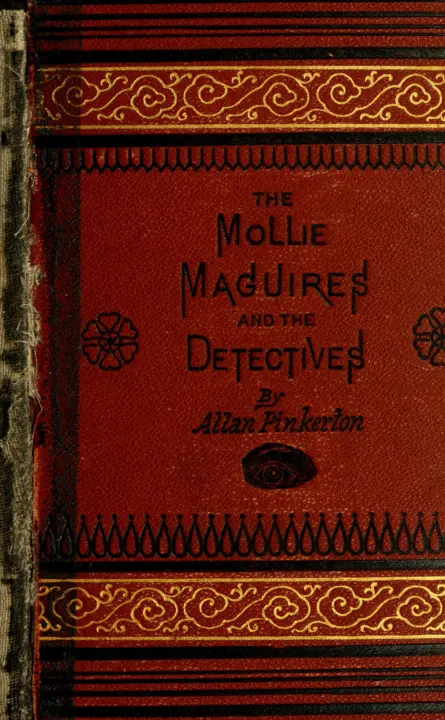
The Molly Maguires and the detectives
Allan Pinkerton
THE CLASSIC COLLECTION · 1879
"Mississippi Outlaws and the Detectives" by Allan Pinkerton is a historical detective narrative likely written in the late 19th century. This book focuses on the perilous world of post-Civil War outlawry along the Mississippi River, detailing the efforts of the Pinkerton National Detective Agency to track down a notorious gang of robbers. The narrative reveals both the crimes committed by these outlaws and the intricate methods employed by the detectives to bring them to justice. At the start of the narrative, we're introduced to a daring express robbery orchestrated by a gang of criminals who exploit the lawlessness of the era. The opening details the circumstances surrounding the crime, including the ineffective systems in place that allowed such thefts to occur with increasing frequency. Allan Pinkerton describes the setting—the swamps and cane-brakes of the Mississippi region—and introduces the obstacles faced by his son, William A. Pinkerton, who is tasked with investigating the robbery. As William navigates through false leads and the treacherous terrain, he recounts the eccentric and often dangerous lives of those living in the area, foreshadowing the challenges the detective agency will encounter as they unravel this web of crime.
Introduction adapted from the source catalogue; source summaries may be automatically generated.
Free to read · English · 94,502 words · No account needed
MAKE TIME FOR A GOOD BOOK
On by default. Untick to stop anonymous reading totals. Each page counts after 10 seconds in view. How this works.
Anonymous counting is on unless you have switched it off.
It will be observed how completely this confession corroborated our investigations, there being few new points learned. The information that Mrs. Farrington had possession of nearly all the stolen money was valuable, and I sent instructions to Cottrell, at once, to attach all of her property in the name of the Southern Express Company, if it could be done. But the most important feature brought out was the hiding-place of Levi Farrington, which was given as Farmington, Illinois. It will be remembered that William found, at the store at Lester's Landing, some pieces of paper, upon which was scribbled, "Kate Graham, Farmington, Illinois;" that I sent a detective to that place to see Mrs. Graham; that the latter answered, with every evidence of truthfulness, that she did not know Russell, Clark, or Barton; and that the clue was dropped immediately. From Barton, however, William learned that Mrs. Kate Graham was a cousin of the Farringtons, and that, being a highly respectable and conscientious woman, she knew nothing of their aliases, nor of their crimes. It was there that Levi Farrington had gone to hide. Barton's confession was made on the fourteenth, and William instantly sent me a cipher dispatch containing the important features of it. By the evening train of that day, my other son, Robert A. Pinkerton, took passage for Farmington, accompanied by Detective W. T. Brown, of my force. They arrived there about noon the next day, and soon learned that Levi Farrington was staying with his relatives. Having presented letters of introduction to one or two influential men, Robert obtained an introduction to the city marshal, who promised to give all the aid in his power to arrest Farrington.
About two o'clock they saw the latter coming down the street, and, by previous arrangement, Robert allowed Levi to pass him, both walking toward Brown and the marshal. Levi Farrington was a very powerful man, standing six feet in his stockings, with a frame and muscles in proportion to his size. Remembering the desperate character of the man, Robert did not deem it advisable to give him any chance to draw a weapon or show fight; he therefore followed Farrington closely until he was about ten feet from the marshal, and then, springing at him, he pinioned the desperado's arms by clasping him tightly around the body just at the elbows. Farrington did not stop to question the cause of this proceeding--he knew the reason of his seizure well enough--but, gathering his whole strength, he made one jump away from the two officers who were approaching in front, and landed nearly in the middle of the street, taking Robert along with him. Robert clung to him like a vise, however, and before he could make another such an effort, the other two were upon him. A terrible struggle now ensued in the street, during which both Robert and Brown were badly bruised by being rolled upon and kicked by their powerful prisoner. Robert knew that Farrington was desperate enough to fight to the bitter end, and that he would kill as many as he could before being killed himself; to release his arms, therefore, would enable him to draw a weapon, as he was undoubtedly well armed, hence Robert never relaxed his hold. Having a professional pride in securing his prisoner alive, moreover, he did not wish to resort to extreme measures except to save the lives of other persons, and, as a large crowd had gathered around the moment the struggle began, there would have been evident danger in allowing him an instant's freedom. Over and over they rolled together, therefore, Farrington striving with all his strength to break Robert's clasp upon his arms, while the other two officers were doing their best to pinion his legs. After a ten minutes' struggle, they succeeded at length in holding him down and sitting upon his legs until he could be tied with ropes. By this time, the whole party were pretty thoroughly exhausted, but, after resting a few minutes to recover their breath, the officers got handcuffs on their prisoner's wrists, and took him to the railroad station, where he was searched. Little money was found on his person, but he had a large revolver, two Derringer pistols, and a large dirk concealed about him. He was then placed in the freight office, while Brown and Mr. Graham, Mrs. Kate Graham's husband, went to the latter's house to get Levi's baggage. On their return, the whole party took passage for Chicago, where they did not arrive until next day, owing to the failure to make connections. In Levi's valise were found two revolvers, some jewelry, and a very large sum of money.
Your reading position is saved on this browser. Take it to another device with a library code. Reading pages adapt to text, rather than matching a printed edition.
Allan Pinkerton
Allan Pinkerton
Allan Pinkerton
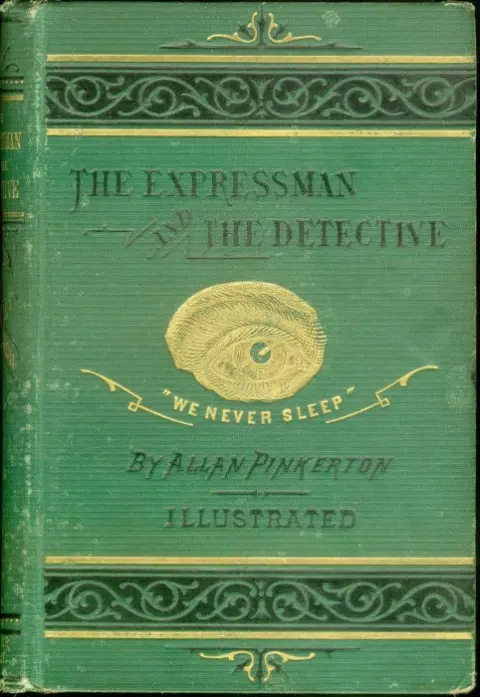
Allan Pinkerton
BEHIND THE BOOK
This eBook is for the use of anyone anywhere in the United States and most other parts of the world at no cost and with almost no restrictions whatsoever. You may copy it, give it away or re-use it under the terms of the Project Gutenberg License included with this eBook or online at www.gutenberg.org. If you are not located in the United States, you will have to check the laws of the country where you are located before using this eBook. Read the source licence.
The original source file, including credits and licence, is retained by this library. Request an original-format copy at no charge. Please include the book title and Project Gutenberg identifier #35686.
KEEP YOUR CURIOSITY GOING
Cécile Tormay

Moritz Busch
John L. Ransom
Frances Wright
Cécile Tormay

Mabel Potter Daggett