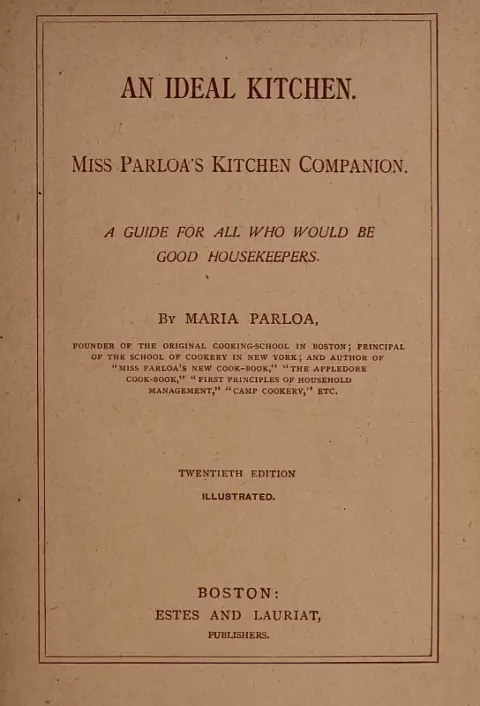
An Ideal Kitchen: Miss Parloa’s Kitchen Companion A Guide for All Who Would Be Good Housekeepers
Maria Parloa
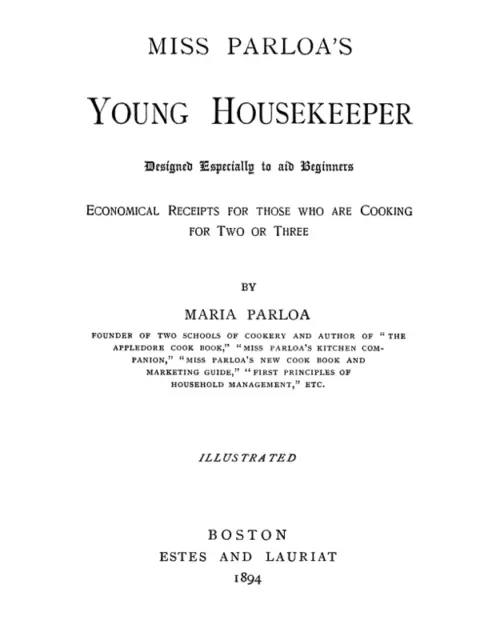
THE CLASSIC COLLECTION · 1893
"Miss Parloa's Young Housekeeper" by Maria Parloa is a practical guidebook written in the late 19th century. This work is designed to assist beginner cooks and young housekeepers in managing a household, particularly for those preparing meals for small families, emphasizing economical and effective cooking methods. The book is structured to provide readers with essential culinary techniques and advice on managing household tasks, aiming to foster a nurturing and organized home environment. The opening of "Miss Parloa's Young Housekeeper" introduces the author's philosophy of good housekeeping, emphasizing that successful home management goes beyond mere cleanliness and order. Parloa addresses the challenges faced by novice housekeepers, discussing the need for a balance between diligence and emotional well-being, while laying the foundation for an inviting and kind home atmosphere. She also highlights the importance of careful planning in meal preparation and household care, making it clear that even with modest means, one can maintain a joyful and hospitable home. Parloa's insights at the beginning serve as a heartening introduction to her subsequent practical advice on cooking and household management.
Introduction adapted from the source catalogue; source summaries may be automatically generated.
Free to read · English · 113,072 words · No account needed
MAKE TIME FOR A GOOD BOOK
On by default. Untick to stop anonymous reading totals. Each page counts after 10 seconds in view. How this works.
Anonymous counting is on unless you have switched it off.
Muffin pans, two,—each holding eight or twelve muffins.
Pitchers, four, for milk, etc.
Plates, one dozen.
Platters, two stone-china, for meat.
Pudding mould, melon, three-pint.
Quart measure.
Range.
Rolling-pin.
Roll-pans, French, holding six or eight rolls.
Scotch bowl, No. 4.
Skewers, set of steel.
Soap-shaker.
Spice boxes or jars.
Spoons,—six teaspoons, two table spoons, two wooden spoons,
two large iron spoons.
Steamer.
Stewpans,—two one-quart, two two-quart, two three-quart, one
six-quart.
Stone pots, several small ones, with covers, for various kinds
of meal.
Stove-brush.
Strainers, two, small,—one for general use, the other for
gravy; also one of fine wire.
Tables, two; if possible, have one covered with zinc or enamel
cloth.
Teakettle.
Teapot.
Tin boxes for bread and cake.
Tin plates, four, deep.
Tin sheet.
Towels,—three kinds for dishes, and others for the hands.
Vegetable masher.
In olden times the bride came to her new home with a generous supply of linen, the greater part of which was spun and woven by her own hands; in many cases, indeed, the flax was raised and prepared for the spinning-wheel by her. In some parts of Europe this custom still exists. The bride of to-day takes great pains and pride in providing her household linen, many months being given to dainty sewing and embroidery. Each article has stitched into it many bright hopes and day dreams. Nothing else in the furnishing of the home has blended with it so many tender, loving thoughts, and to the woman of sentiment it is more sacred than almost any other household possession. Once acquired, this love for fine household linen will cling to a woman all her life. Indeed, what material thing can she bring to her new home that will give more pleasure than a generous supply for her linen closet?
Imported Linens.
Irish, French, Scotch and English table linens cover many grades, from the coarsest to the finest weaving and the most elaborate patterns. All the new designs are large, but in some of the choicest damasks it is possible to get small patterns, if they be preferred. The damask sold by the yard rarely reaches a higher price than two dollars and a half. If one wish for especially pleasing designs and extremely fine quality, it will be necessary to buy the set,—table-cloth and one dozen napkins. The usual width of the best table damask is two yards and a half, but it may be three yards in width. The cloths come from two and a half to four yards in length. In these handsome cloths the border is deep, and the centre frequently perfectly plain.
Table-cloths and Napkins.
Your reading position is saved on this browser. Take it to another device with a library code. Reading pages adapt to text, rather than matching a printed edition.
Maria Parloa

Maria Parloa & Helen Campbell & Juliet Corson & Marion Harland & Mary J. (Mary Johnson) Lincoln & Catherine Owen & Hester M. (Hester Martha) Poole
Maria Parloa
Maria Parloa
BEHIND THE BOOK
This eBook is for the use of anyone anywhere in the United States and most other parts of the world at no cost and with almost no restrictions whatsoever. You may copy it, give it away or re-use it under the terms of the Project Gutenberg License included with this eBook or online at www.gutenberg.org. If you are not located in the United States, you will have to check the laws of the country where you are located before using this eBook. Read the source licence.
The original source file, including credits and licence, is retained by this library. Request an original-format copy at no charge. Please include the book title and Project Gutenberg identifier #56540.
KEEP YOUR CURIOSITY GOING

Charles G. (Charles Griffith) Ross
Hannah Webster Foster

Emily Lawless
Edwin Hamlin Carr

Charles De Lano Hine
Andrew Ure