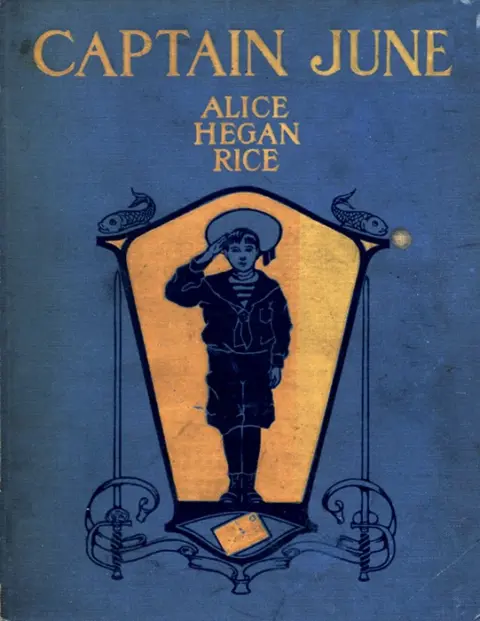
Captain June
Alice Caldwell Hegan Rice
THE CLASSIC COLLECTION · 1905
"Miss Mink's Soldier and Other Stories" by Alice Caldwell Hegan Rice is a collection of short stories written in the early 20th century. The stories delve into the lives of quirky characters, particularly focusing on Miss Mink, a small and stubborn woman who grapples with change and unexpected elements in her routines and beliefs, often with humor and pathos. The collection showcases themes of personal growth, societal norms, and the impact of war on everyday lives. At the start of "Miss Mink's Soldier," we meet Miss Libby Mink, a solitary churchgoer who struggles with the minister's request for parishioners to invite soldiers to dinner during wartime. Despite her patriotism, the idea of hosting a soldier fills her with apprehension. Just as she resolves to continue her routine without engaging, a soldier named Alexis Bowinski sits next to her, and through a moment of panic and desperation, she invites him to her home for dinner. What follows is a comedic and awkward exploration of their interactions, showcasing her fears, prejudices, and the unexpected warmth she discovers in the company of Bowinski, revealing much about her character’s growth and her understanding of connection in challenging times.
Introduction adapted from the source catalogue; source summaries may be automatically generated.
Free to read · English · 34,516 words · No account needed
MAKE TIME FOR A GOOD BOOK
On by default. Untick to stop anonymous reading totals. Each page counts after 10 seconds in view. How this works.
Anonymous counting is on unless you have switched it off.
As he did so the room darkened. He involuntarily looked up. Framed in the circle of the port-hole were the head and shoulders of Tsang Foo. Not a muscle of the yellow face moved, not a tremor of the slanting eyelids showed surprise. The right hand, holding a bit of tow, mechanically continued polishing the brass around the port-hole, but the left--long, thin, and with claw-like nails, shot stealthily forward and snatched the pistol.
For a full minute the polishing continued, then face and figure
vanished, and Reynolds was left staring in impotent rage at the empty
port-hole.
When the room steward appeared in answer to an imperative summons, he was directed to send Tsang Foo to room No. 7 at once.
Tsang came almost immediately, bearing tea and anchovy sandwiches, which he urbanely placed on a camp-stool.
"Where's my pistol?" demanded Reynolds hotly, holding to the door to
steady himself.
Tsang's eyes, earnest as a dog's, were lifted to his:
"He fall overboard," he explained suavely, "me velly solly."
Reynolds impulsively lifted his arm to strike, but a second impulse, engulfing the first, made him turn and fling himself upon his berth, struggling to master the heavy sobs that shook him from head to foot.
The Chinaman softly closed the door and slipped the bolt, then he dropped to a sitting posture on the floor and waited.
When the squall had passed, Reynolds addressed his companion from the depths of the pillows in language suited to his comprehension.
"Me belong large fool, Tsang!" he said savagely. "Have drink too much. No good. You go 'long, I'm all right now."
Tsang's eye swept the disordered room and returned to the figure on the bed. "Suppose me go," he said, "you makee one hole in head?"
"That's my business," said Reynolds, his wrath rekindling. "You go 'long, and get my pistol; there's a good chap."
Tsang did not stir; he sat with his hands clasped about his knees, and contemplated space with the abstract look of a Buddha gazing into Nirvana.
Reynolds passed from persuasion to profanity with no satisfactory result. His language, whether eloquent or fiery, beat upon an unresponsive ear. But being in that condition that demands sympathy, he found the mere talking a relief, and presently drifted into a recital of his woes.
"I'm up against it, in the hole, you know, much largee trouble," he amplified with many gestures, sitting on the side of his berth, and pounding out excited, incoherent phrases to the impassive figure opposite. "Company sent me out to collect money. My have spent all. No can go back home. Suppose my lose face, more better die!"
Your reading position is saved on this browser. Take it to another device with a library code. Reading pages adapt to text, rather than matching a printed edition.
Alice Caldwell Hegan Rice
Alice Caldwell Hegan Rice
Alice Caldwell Hegan Rice
Alice Caldwell Hegan Rice
BEHIND THE BOOK
This eBook is for the use of anyone anywhere in the United States and most other parts of the world at no cost and with almost no restrictions whatsoever. You may copy it, give it away or re-use it under the terms of the Project Gutenberg License included with this eBook or online at www.gutenberg.org. If you are not located in the United States, you will have to check the laws of the country where you are located before using this eBook. Read the source licence.
The original source file, including credits and licence, is retained by this library. Request an original-format copy at no charge. Please include the book title and Project Gutenberg identifier #15230.
KEEP YOUR CURIOSITY GOING
Coulson Kernahan

Maurice Baring
Frances Wright
Cécile Tormay

Frederic Jesup Stimson

W. H. P. (William Henry Pope) Jarvis