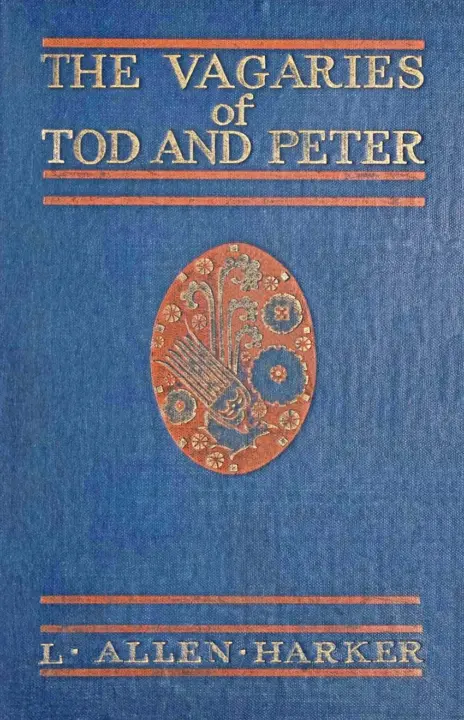
The Vagaries of Tod and Peter
L. Allen (Lizzie Allen) Harker
THE CLASSIC COLLECTION · 1908
"Miss Esperance and Mr. Wycherly" by L. Allen Harker is a novel written in the early 20th century. The story introduces readers to the titular characters, Miss Esperance, a kind-hearted old lady living in a modest home in the village of Burnhead, and Mr. Wycherly, her scholarly yet eccentric companion. The narrative likely revolves around their lives together, exploring themes of love, friendship, and the challenges they face, particularly with the arrival of two young boys who bring new dynamics into their quiet existence. The opening of the novel introduces Miss Esperance as a respected figure in the village, devoted to helping those less fortunate, and Mr. Wycherly, who is characterized by his love for literature and scholarly pursuits, though he struggles with an alcohol problem. Their lives change dramatically when they take in the boys—Montagu, a thoughtful child, and his mischievous brother Edmund—after the death of a young relative. This part of the narrative sets the stage for a blend of light-hearted and poignant events as the characters navigate their altered lives and the impact of these children on their previously simple routines. The stage is established for personal growth, unexpected adventures, and the intertwining of their fates.
Introduction adapted from the source catalogue; source summaries may be automatically generated.
Free to read · English · 57,553 words · No account needed
MAKE TIME FOR A GOOD BOOK
On by default. Untick to stop anonymous reading totals. Each page counts after 10 seconds in view. How this works.
Anonymous counting is on unless you have switched it off.
All the same she smiled, and she left her hand in Mr. Wycherly's. It was not unpleasant to her to be considered capable of romance; her life had been so safe and seemly always, a little monotonous and commonplace, perhaps, but she had once been young.
"I don't know much," Mr. Wycherly answered humbly; "but surely character is the same in man or woman, and given a certain character a certain line of conduct is inevitable."
"And you think it is inevitable that I should forgive Margaret?"
"Assuredly," said Mr. Wycherly.
"As I said before"--here Lady Alicia thought fit to withdraw her hand--"you are an ignorant man: but we won't quarrel. Time will show whether you or I know most about me."
She turned to walk to the gate where her carriage was waiting. He helped her in and shut the door upon her in absolute silence. Then, just as the man was driving off, he asked: "What do you think they would like for a wedding present?"
"Man, you are incorrigible," exclaimed Lady Alicia, but her brow was smooth and her eyes smiling.
Mr. Wycherly stood at the green gate for some time, lost hi thought. As he turned to walk up the path to the house he said aloud: "I should like to know what that young man has done that he should be singled out by the gods for such supreme good fortune."
When the days grew long once more Lady Alicia came back to the "big house," but no fair-haired Margaret came to play with the little boys.
"Where is she?" asked Montagu of his tutor. "Why doesn't she come?"
"She is married," said Mr. Wycherly; "she has to stay with her husband."
"When I marry," said Montagu, "I shall marry somebody like Margaret; then she'll stay with me and I shall never be lonely."
"When you marry," Mr. Wycherly said very seriously, "take care of just one thing. Take care that she is kind."
"I'd like her to be beautiful, too," Montagu said eagerly, "beautiful
and tall, like Margaret."
"I hope she will be beautiful, but kindness comes first," and Mr. Wycherly spoke with conviction, as one who knew.
"How can one tell if she is kind?" Montagu asked.
"Compare her with your aunt, Montagu: if she stands such comparison, she is all your best desires need seek."
"I will remember," Montagu said solemnly, "kind and beautiful--but the kindness must come first. I wish Margaret hadn't been in such a hurry, she would have done beautifully."
Your reading position is saved on this browser. Take it to another device with a library code. Reading pages adapt to text, rather than matching a printed edition.
L. Allen (Lizzie Allen) Harker
L. Allen (Lizzie Allen) Harker
L. Allen (Lizzie Allen) Harker
L. Allen (Lizzie Allen) Harker
BEHIND THE BOOK
This eBook is for the use of anyone anywhere in the United States and most other parts of the world at no cost and with almost no restrictions whatsoever. You may copy it, give it away or re-use it under the terms of the Project Gutenberg License included with this eBook or online at www.gutenberg.org. If you are not located in the United States, you will have to check the laws of the country where you are located before using this eBook. Read the source licence.
The original source file, including credits and licence, is retained by this library. Request an original-format copy at no charge. Please include the book title and Project Gutenberg identifier #54538.
KEEP YOUR CURIOSITY GOING
Coulson Kernahan

Maurice Baring
Frances Wright
Cécile Tormay

Frederic Jesup Stimson

W. H. P. (William Henry Pope) Jarvis