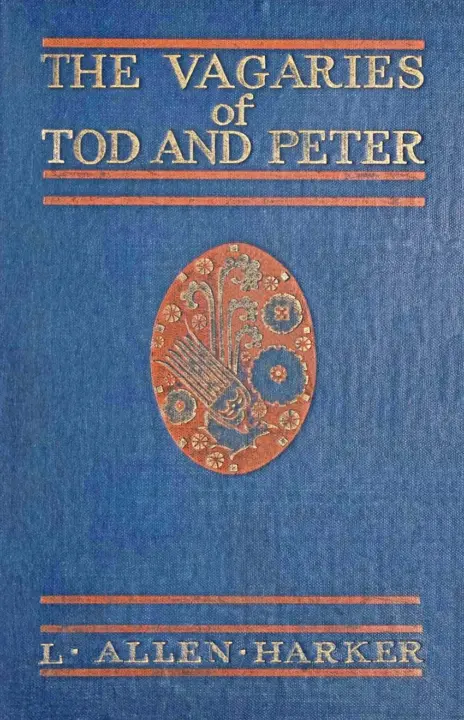
The Vagaries of Tod and Peter
L. Allen (Lizzie Allen) Harker
THE CLASSIC COLLECTION · 1908
"Miss Esperance and Mr. Wycherly" by L. Allen Harker is a novel written in the early 20th century. The story introduces readers to the titular characters, Miss Esperance, a kind-hearted old lady living in a modest home in the village of Burnhead, and Mr. Wycherly, her scholarly yet eccentric companion. The narrative likely revolves around their lives together, exploring themes of love, friendship, and the challenges they face, particularly with the arrival of two young boys who bring new dynamics into their quiet existence. The opening of the novel introduces Miss Esperance as a respected figure in the village, devoted to helping those less fortunate, and Mr. Wycherly, who is characterized by his love for literature and scholarly pursuits, though he struggles with an alcohol problem. Their lives change dramatically when they take in the boys—Montagu, a thoughtful child, and his mischievous brother Edmund—after the death of a young relative. This part of the narrative sets the stage for a blend of light-hearted and poignant events as the characters navigate their altered lives and the impact of these children on their previously simple routines. The stage is established for personal growth, unexpected adventures, and the intertwining of their fates.
Introduction adapted from the source catalogue; source summaries may be automatically generated.
Free to read · English · 57,553 words · No account needed
MAKE TIME FOR A GOOD BOOK
On by default. Untick to stop anonymous reading totals. Each page counts after 10 seconds in view. How this works.
Anonymous counting is on unless you have switched it off.
which he felt would meet with but scant approval from his present
audience.
"Say 'ime, say 'ime, man!" cried Edmund, with an ominous droop of the
corners of his mouth.
"Say 'Hickory, dickory, dock," Montagu suggested kindly, "he likes that--and you tickle him where it runs up, and where it runs down, and at the end, you know."
"But I don't know any poem called 'Hickory, dickory, dock," Mr. Wycherly
protested despairingly.
"Say 'ime, man! Say dock!" Edmund persisted, punching Mr. Wycherly in the chest to emphasise his wishes. "Say dock. Quit."
"I'll whisper it to you," murmured the helpful Montagu, "it goes like this--'Hickory, dickory, dock."
"Hickory, dickory, dock," Mr. Wycherly repeated dutifully and
distinctly.
"The mouse ran up the clock," Montagu continued.
"The mouse ran up the clock----"
"But you didn't tickle him," Montagu interrupted.
Mr. Wycherly looked at Edmund, and Edmund looked with eager expectation
at Mr. Wycherly.
Now to tickle any one appeared to Mr. Wycherly a most unwarrantable liberty. Such a mode of procedure had never entered into his scheme of life at all. He was not even sure how he ought to set about it. He decided that tickling was altogether out of his province, and he would not experiment, even upon Edmund.
He cleared his throat nervously. "Ahem," said Mr. Wycherly, "Hickory, dickory, dock, the mouse ran up the clock----"
"No! No!" shouted Edmund. "'E mouse 'an down."
"The mouse ran down the clock," echoed the obedient Mr. Wycherly.
"No, No," cried both the little boys. "The clock struck one." Here Edmund gave a most tremendous bounce that really hurt Mr. Wycherly.
"Ve mouse 'an down," he continued, scrabbling with his fingers all over Mr. Wycherly's face, and seizing him by the collar of his night shirt to burrow in his neck.
"Hickory, dickory, dock," Montagu concluded in a joyful chant. "Now you know it, only you must run up and down, you know."
"Oh, I really cannot do that," Mr. Wycherly expostulated, "not before I
am dressed."
Montagu looked puzzled. "You ought to tickle us, you know, like Edmund did, and with your fingers; it's quite easy, really."
"Adain!" Edmund commanded, squirming and jumping all over the very softest portions of Mr. Wycherly's person, and causing that patient gentleman acute agony. "Adain!"
"Let us all say it together," Mr. Wycherly gasped, painfully drawing himself a little higher up in the bed, "and do you think you could sit a little more to one side, or a little further forward, or a little lower down, or anywhere except just where you are at present?"
"Edmund heavy boy," that youth remarked proudly.
Your reading position is saved on this browser. Take it to another device with a library code. Reading pages adapt to text, rather than matching a printed edition.
L. Allen (Lizzie Allen) Harker
L. Allen (Lizzie Allen) Harker
L. Allen (Lizzie Allen) Harker
L. Allen (Lizzie Allen) Harker
BEHIND THE BOOK
This eBook is for the use of anyone anywhere in the United States and most other parts of the world at no cost and with almost no restrictions whatsoever. You may copy it, give it away or re-use it under the terms of the Project Gutenberg License included with this eBook or online at www.gutenberg.org. If you are not located in the United States, you will have to check the laws of the country where you are located before using this eBook. Read the source licence.
The original source file, including credits and licence, is retained by this library. Request an original-format copy at no charge. Please include the book title and Project Gutenberg identifier #54538.
KEEP YOUR CURIOSITY GOING
Coulson Kernahan

Maurice Baring
Frances Wright
Cécile Tormay

Frederic Jesup Stimson

W. H. P. (William Henry Pope) Jarvis