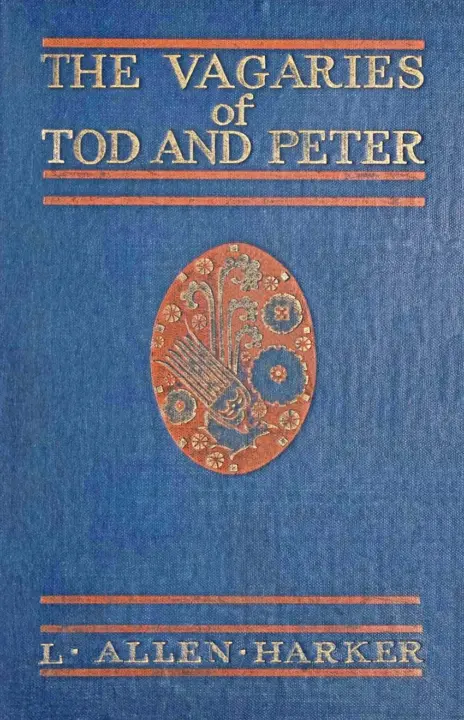
The Vagaries of Tod and Peter
L. Allen (Lizzie Allen) Harker
THE CLASSIC COLLECTION · 1908
"Miss Esperance and Mr. Wycherly" by L. Allen Harker is a novel written in the early 20th century. The story introduces readers to the titular characters, Miss Esperance, a kind-hearted old lady living in a modest home in the village of Burnhead, and Mr. Wycherly, her scholarly yet eccentric companion. The narrative likely revolves around their lives together, exploring themes of love, friendship, and the challenges they face, particularly with the arrival of two young boys who bring new dynamics into their quiet existence. The opening of the novel introduces Miss Esperance as a respected figure in the village, devoted to helping those less fortunate, and Mr. Wycherly, who is characterized by his love for literature and scholarly pursuits, though he struggles with an alcohol problem. Their lives change dramatically when they take in the boys—Montagu, a thoughtful child, and his mischievous brother Edmund—after the death of a young relative. This part of the narrative sets the stage for a blend of light-hearted and poignant events as the characters navigate their altered lives and the impact of these children on their previously simple routines. The stage is established for personal growth, unexpected adventures, and the intertwining of their fates.
Introduction adapted from the source catalogue; source summaries may be automatically generated.
Free to read · English · 57,553 words · No account needed
MAKE TIME FOR A GOOD BOOK
On by default. Untick to stop anonymous reading totals. Each page counts after 10 seconds in view. How this works.
Anonymous counting is on unless you have switched it off.
"That word, Edmund, is never applied to well-bred women at any time of life. It is not in itself a term of reproach, but it refers generally to--" Miss Esperance paused.
"What's it refer to?"
"Well--to women of the less refined classes. It is a South of England word--somewhat equivalent to our 'lassie."
"Which is the less refined classes, Aunt Esperance? Is they in a
school?"
"Oh, dear! Oh, dear! You do nothing but ask questions to-day," Miss Esperance sighed. "Still, it is right you should understand. The less refined classes, Edmund, are such as have not had many advantages in the way of education or upbringing. Excellent persons often----"
"Perhaps yon wench was an excellent person," Edmund suggested hopefully.
Miss Esperance showed no inclination to discuss the possible merits of this young woman, and Edmund continued, "Had you many advantages, Aunt Esperance?"
"Certainly I had."
"Then you was never a wench?"
"Never!"
"Why should he like a wench to sit on his knee, Aunt Esperance? She'd
be very hot and heavy."
"I really must refuse to discuss that song any more. Forget it as soon as you can, and never, never sing it again."
"He was such a nice man," Edmund persisted. "He had such a beautiful
helmet."
"Perhaps," said Miss Esperance, "if you are both good boys I'll take you over one day to Pier's Hill to see the soldiers being drilled." And in this entrancing prospect Edmund forgot all about the "unsuitable" song.
"Aunt Esperance would like you should come to tea with us this
afternoon, Guardie, dear."
It was Montagu who spoke. Lessons were over, but he had sought Mr. Wycherly again to deliver this message.
"It is most kind of Miss Esperance," said Mr. Wycherly. "I shall of course be delighted and highly honoured, but why am I to have this treat to-day, is it a birthday?--No--I know it isn't a birthday----"
"Colonel Dundas is coming. He knew my daddie, and he knew my
grandfather, and Aunt Esperance is very anxious he should see you. She
said so."
"Don't you think," Mr. Wycherly said nervously, "that I might be a little in the way? If Colonel Dundas is such an old friend, they will have many things to talk over. Wouldn't it be better for me to come some other time?"
"No, it wouldn't; I'm sure it wouldn't. Aunt Esperance said that she most pertikler wants Colonel Dundas to see you. Do you think he'll be able to sing, Guardie, dear?"
"To sing," Mr. Wycherly repeated. "Why should he sing at tea-time?"
Your reading position is saved on this browser. Take it to another device with a library code. Reading pages adapt to text, rather than matching a printed edition.
L. Allen (Lizzie Allen) Harker
L. Allen (Lizzie Allen) Harker
L. Allen (Lizzie Allen) Harker
L. Allen (Lizzie Allen) Harker
BEHIND THE BOOK
This eBook is for the use of anyone anywhere in the United States and most other parts of the world at no cost and with almost no restrictions whatsoever. You may copy it, give it away or re-use it under the terms of the Project Gutenberg License included with this eBook or online at www.gutenberg.org. If you are not located in the United States, you will have to check the laws of the country where you are located before using this eBook. Read the source licence.
The original source file, including credits and licence, is retained by this library. Request an original-format copy at no charge. Please include the book title and Project Gutenberg identifier #54538.
KEEP YOUR CURIOSITY GOING
Coulson Kernahan

Maurice Baring
Frances Wright
Cécile Tormay

Frederic Jesup Stimson

W. H. P. (William Henry Pope) Jarvis