
The type-writer girl
Grant Allen
THE CLASSIC COLLECTION · 1899
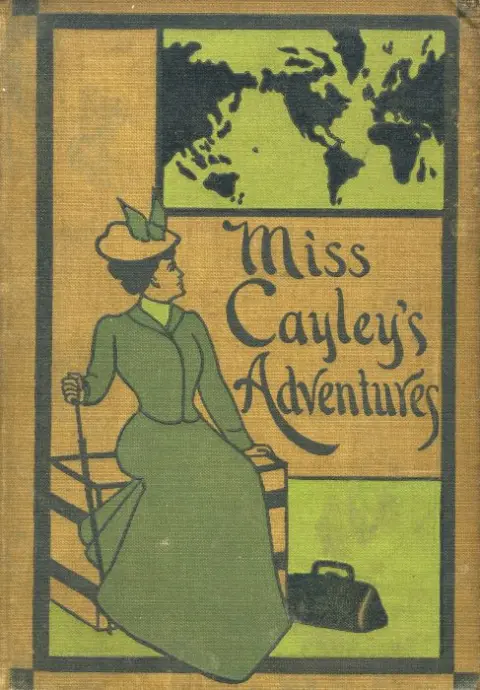
"Miss Cayley's Adventures" by Grant Allen is a novel written in the late 19th century. The story follows the spirited young woman Lois Cayley, who, after the death of her stepfather, embarks on a quest for adventure and self-discovery in London and beyond. With a paltry twopence in her pocket, she rejects conventional paths such as teaching and instead seeks thrilling experiences, which leads her to a series of humorous encounters and escapades. At the start of the narrative, Lois is introduced as a headstrong and independent character who is determined to embrace life on her own terms. After discussing her plans with her friend Elsie, she decides against a teaching career and expresses her desire to seek out adventure. This determination drives her to approach a haughty old lady, known as the "Cantankerous Old Lady," in a park, offering to accompany her on a journey to Schlangenbad. The interplay between their contrasting personalities sets the tone for Lois’ misadventures as she navigates social expectations, personal challenges, and, ultimately, her aspirations for a life filled with excitement and independence.
Introduction adapted from the source catalogue; source summaries may be automatically generated.
Free to read · English · 85,925 words · No account needed
MAKE TIME FOR A GOOD BOOK
On by default. Untick to stop anonymous reading totals. Each page counts after 10 seconds in view. How this works.
Anonymous counting is on unless you have switched it off.
'Southminster's the wiliest fool that ever lived,' Harold broke out bitterly. 'Under that mask of imbecility, he's a fox for trickiness.'
I bit my lip. 'Well, if you succeed in evading him,' I said, 'you will have cleared your character. And if you don't--then, Harold, our time will have come: you will have your longed-for chance of trying me.'
'That won't do me much good,' he answered, 'if I have to wait fourteen years for you--at Portland.'
Next morning, in court, I heard Harold's cross-examination. He described exactly where he had found the contested will in his uncle's escritoire. The cross-eyed Q.C., a heavy man with bloated features and a bulbous nose, begged him, with one fat uplifted forefinger, to be very careful. How did he know where to look for it?
'Because I knew the house well: I knew where my uncle was likely to keep
his valuables.'
'Oh, indeed; not because you had put it there?'
The court rang with laughter. My face grew crimson.
After an hour or two of fencing, Harold was dismissed. He stood down, baffled. Counsel recalled Lord Southminster.
The pea-green young man, stepping briskly up, gazed about him, open-mouthed, with a vacant stare. The look of cunning on his face was carefully suppressed. He wore, on the contrary, an air of injured innocence combined with an eye-glass.
'You did not put this will in the drawer where Mr. Tillington found it, did you?' counsel asked.
The pea-green young man laughed. 'No, I certainly didn't put it theah. My cousin Harold was man in possession. He took jolly good care I didn't come neah the premises.'
'Do you think you could forge a will if you tried?'
Lord Southminster laughed. 'No, I don't,' he answered, with a well-assumed naivete. 'That's just the difference between us, don't yah know. I'm what they call a fool, and my cousin Harold's a precious clevah fellah.'
There was another loud laugh.
'That's not evidence,' the judge observed, severely.
It was not. But it told far more than much that was. It told strongly
against Harold.
'Besides,' Lord Southminster continued, with engaging frankness, 'if I forged a will at all, I'd take jolly good care to forge it in my own favah.'
My turn came next. Our counsel handed me the incriminated will. 'Did you draw up this document?' he asked.
I looked at it closely. The paper bore our Florentine water-mark, and was written with a Spread-Eagle. 'I type-wrote it,' I answered, gazing at it with care to make sure I recognised it.
Your reading position is saved on this browser. Take it to another device with a library code. Reading pages adapt to text, rather than matching a printed edition.
Grant Allen
Grant Allen

Grant Allen

Grant Allen
BEHIND THE BOOK
This eBook is for the use of anyone anywhere in the United States and most other parts of the world at no cost and with almost no restrictions whatsoever. You may copy it, give it away or re-use it under the terms of the Project Gutenberg License included with this eBook or online at www.gutenberg.org. If you are not located in the United States, you will have to check the laws of the country where you are located before using this eBook. Read the source licence.
The original source file, including credits and licence, is retained by this library. Request an original-format copy at no charge. Please include the book title and Project Gutenberg identifier #30970.
KEEP YOUR CURIOSITY GOING
Wilfrid Scawen Blunt
Wilfrid Scawen Blunt

E. W. (Edgar Watson) Howe
Coulson Kernahan

Maurice Baring
Frances Wright