THE CLASSIC COLLECTION✦A dead man’s diaryCLASSIC FREE BOOKS
A dead man’s diary
Coulson Kernahan
THE CLASSIC COLLECTION · 1915
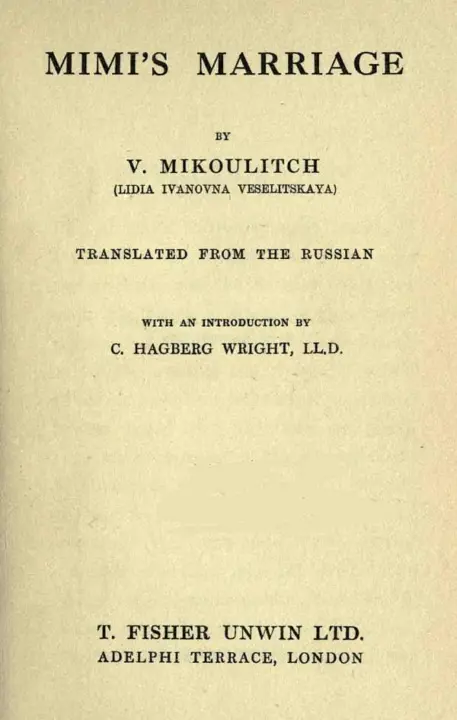
"Mimi's Marriage" by Lidiia Ivanovna Veselitskaia is a novel written in the early 20th century. The story revolves around the life of Mimi, a young woman navigating her engagement and the expectations placed upon her by society and her family. With a focus on the dynamics of relationships and the societal pressures of marriage, the narrative explores themes of love, social status, and personal happiness. The opening of "Mimi's Marriage" introduces us to the titular character, Mimotchka, who has just become engaged. The initial excitement surrounding her engagement is illustrated through the reactions of her family, particularly the delight of her aunts. Despite their enthusiasm, it is clear that Mimotchka is unsure of her own feelings towards her fiancé, Spiridon Ivanovitch. As she reflects on her past relationships, including a previous, more charming engagement that ended abruptly, the complexities of her emotions begin to emerge. This opening sets the stage for a deeper exploration of her character's internal conflicts and the societal expectations that she must navigate.
Introduction adapted from the source catalogue; source summaries may be automatically generated.
Free to read · English · 44,841 words · No account needed
MAKE TIME FOR A GOOD BOOK
On by default. Untick to stop anonymous reading totals. Each page counts after 10 seconds in view. How this works.
Anonymous counting is on unless you have switched it off.
No, Mimotchka had not the least shade of a flirtation, and, together with mamma, made fun of their neighbour on the adjoining balcony, a young widow from Smolensk, who, although she was still wearing mourning, said to her acquaintances, "Yes, I am not against a flirtation, only I don't want to take the initiative." And when, soon after, a young officer of the line[13] took to visiting her, mamma called him "the officer with the initiative." And what a nuisance he was to them! He spat and coughed and smoked cigarette after cigarette, and the worst possible cigarettes too, while the widow, in a languishing voice, sang about
"The night, and love, and the moon."
[13] Officers of the line rank lower in social position than officers
of the guards.
Mamma used to listen to their conversations; the balconies were only divided by a canvas partition.
"Haven't you anything to read to me?" asked the widow; "it's so dull. Lend me some book, only not a love story, please.... Are there any such books?"
"Of course there are. Have you read any of Gleb Ouspensky's[14] books?"
"Gleb? No. Are they good?"
"Well, you must read them. I'll bring them to you."
"Bring them; yes, do bring them."
And they read Gleb Ouspensky together, afterwards they read Schopenhauer. And mamma, sitting with her work on her own balcony, laughed to herself, thinking, "Read on, read on; evidently, tout chemin mène à Rome."
[14] A realistic author, who chiefly wrote sketches of peasant life.
When the officer was tired of reading he put the book down on the table
and lit a cigarette.
"How true, how true it all is!" said the widow, gazing pensively towards Beshtau. "I look on life just as Schopenhauer does. There is nothing that can bear being analysed without being dispersed like smoke. Truly, life is not worth living."
"Yes, certainly life is a pretty considerable muddle. But still, for all that, why not try and live without analysing and reflecting about everything?"
"No, once you know that life is worthless, it's not worth while living."
"No, it's worth trying just for the sake of being convinced."
"But if you know beforehand it's not worth while?"
"But why isn't it worth while? Why, Schopenhauer himself went through it all before writing about it."
"But then, what sort of a life did he live? Well, yes, he found out that everything is falsehood, fancy, and vanity, that we deceive ourselves. And we all come to the same conclusion. Is it worth while wasting strength to come to a result already known, even though it be only known from books?"
Your reading position is saved on this browser. Take it to another device with a library code. Reading pages adapt to text, rather than matching a printed edition.
BEHIND THE BOOK
This eBook is for the use of anyone anywhere in the United States and most other parts of the world at no cost and with almost no restrictions whatsoever. You may copy it, give it away or re-use it under the terms of the Project Gutenberg License included with this eBook or online at www.gutenberg.org. If you are not located in the United States, you will have to check the laws of the country where you are located before using this eBook. Read the source licence.
The original source file, including credits and licence, is retained by this library. Request an original-format copy at no charge. Please include the book title and Project Gutenberg identifier #56719.
KEEP YOUR CURIOSITY GOING
Coulson Kernahan

Maurice Baring
Frances Wright
Cécile Tormay

Frederic Jesup Stimson

W. H. P. (William Henry Pope) Jarvis